Ponte Vedra Beach in St. Johns County, Florida — The American South (South Atlantic)
Fort San Diego
(Diego Plains)
Photographed by Cosmos Mariner, December 22, 2016
1. Fort San Diego Marker
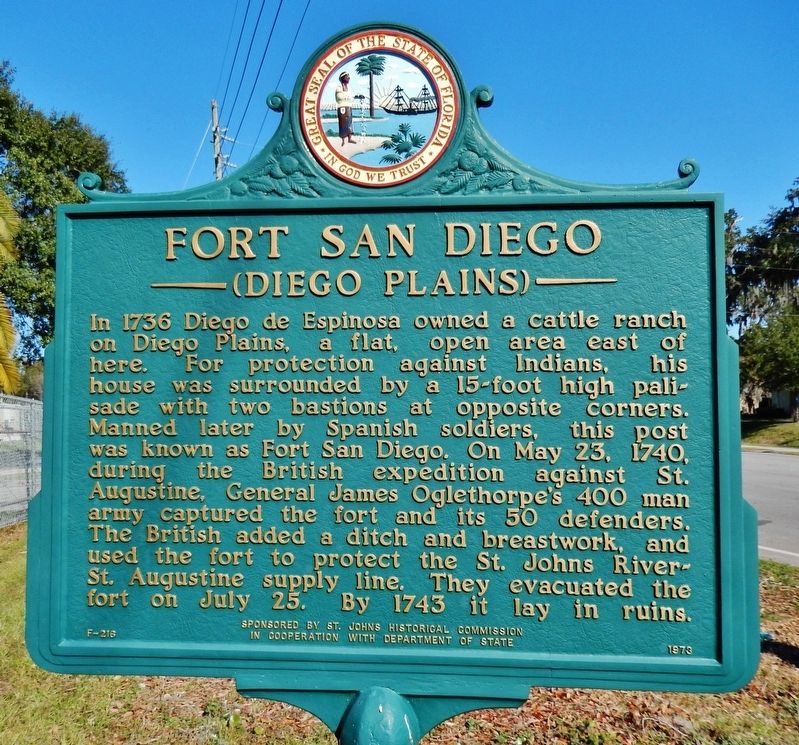
In 1736 Diego de Espinosa owned a cattle ranch on Diego Plains, a flat, open area east of here. For protection against Indians, his house was surrounded by a 15-foot high palisade with two bastions at opposite corners. Manned later by Spanish soldiers, this post was known as Fort San Diego. On May 23, 1740, during the British expedition against St. Augustine, General James Oglethorpe’s 400 man army captured the fort and its 50 defenders. The British added a ditch and breastwork, and used the fort to protect the St. Johns River-St. Augustine supply line. They evacuated the fort on July 25. By 1743 it lay in ruins.
Erected 1973 by St. Johns Historical Commission in Cooperation with Department of State. (Marker Number F-216.)
Topics. This historical marker is listed in these topic lists: Colonial Era • Forts and Castles • Hispanic Americans • Settlements & Settlers. A significant historical year for this entry is 1736.
Location. 30° 9.791′ N, 81° 23.395′ W. Marker is in Ponte Vedra Beach, Florida, in St. Johns County. It is on Landrum Lane 0.3 miles west of Palm Valley Road, on the right when traveling
this page online

Regionally, this marker is in First Coast and in Greater Jacksonville. It is also in the American South and on the Eastern Seaboard. Globally, it is in the North Atlantic Region, North America, a Gulf of Mexico state, the Western Hemisphere, the Western World, and the Anglosphere. Historically, it finds itself in what was once New Spain, the territory of the Mississippian Culture, one of the Confederate States of America, and the Antebellum South.
Other nearby markers. At least 8 other markers are within 4 miles of this marker, measured as the crow flies: Palm Valley (approx. 1.1 miles away); Mickler's Landing Park (approx. 1.9 miles away); Mickler's Landing (approx. 2 miles away); Mineral City (approx. 2 miles away); History of Palm Valley (approx. 2.1 miles away); a different marker also named History of Palm Valley (approx. 2.1 miles away); Jonathan Dickinson Shipwreck (approx. 3.7 miles away); Cattle Ranching
Photographed by Cosmos Mariner, December 22, 2016
2. Fort San Diego Marker
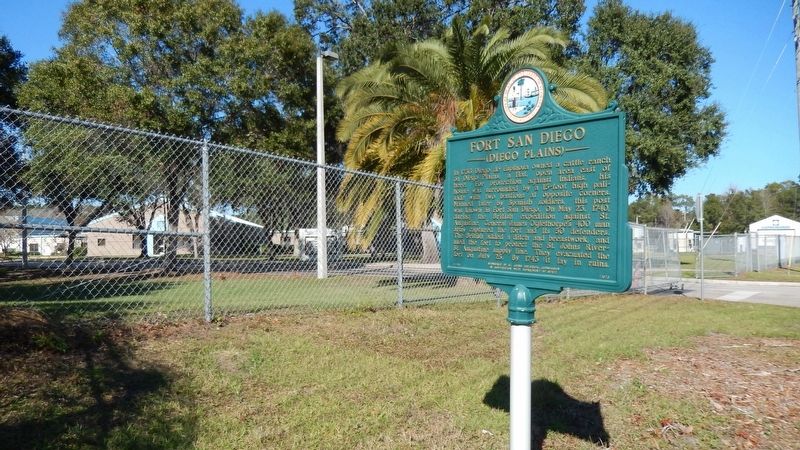
Wide view of marker showing Alice B. Landrum Middle School in the background.
More about this marker. Marker is in excellent condition. Both sides of the marker are identical.
Regarding Fort San Diego. There are no visible remains of the fort at this site.
Also see . . .
1. Siege of St. Augustine (1740). Wikipedia entry
In May 1740, Oglethorpe undertook an expedition to capture St. Augustine itself. In support of that objective, Oglethorpe first captured Fort San Diego, Fort Picolotta and Fort Mose, the first free black settlement in America. (Submitted on December 24, 2016, by Cosmos Mariner of Cape Canaveral, Florida.)
2. 1740 - Oglethorpe's Siege. National Park Service Fort Matanzas National Monument website entry (Submitted on November 20, 2023, by Larry Gertner of New York, New York.)
Credits. This page was last revised on November 20, 2023. It was originally submitted on December 24, 2016, by Cosmos Mariner of Cape Canaveral, Florida. This page has been viewed 2,324 times since then and 225 times this year. Photos: 1, 2. submitted on December 24, 2016, by Cosmos Mariner of Cape Canaveral, Florida. • Bill Pfingsten was the editor who published this page.
