Historic District in St. Augustine in St. Johns County, Florida — The American South (South Atlantic)
Remnant of Rodriguez Arsian House
Photographed by James R. Murray, January 5, 2017
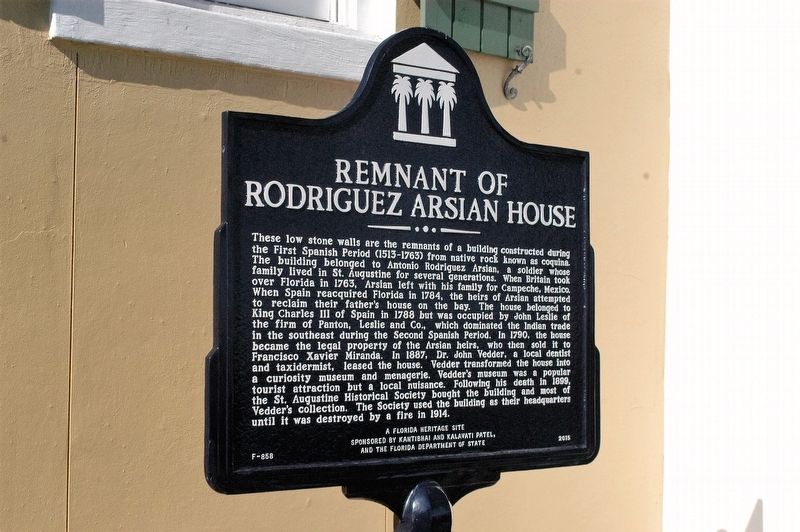
1. Remnants of Rodriguez Arsian House Marker
Inscription.
Remnant of Rodriguez Arsian House. . These low stone walls are the remnants of a building constructed during the First Spanish Period (1513-1763) from native rock known as coquina. The building belonged to Antonio Rodriquez Arsian, a soldier whose family lived in St. Augustine for several generations. When Britain took over Florida in 1763, Arsian left with his family for Campeche, Mexico. When Spain reacquired Florida in 1784, the heirs of Arsian attempted to reclaim their father’s house on the bay. The house belonged to King Charles III of Spain in 1788, but was occupied by John Leslie of the firm of Panton, Leslie and Co., which dominated the Indian trade in the southeast during the Second Spanish Period. In 1790, the house became the property of the Arsian heirs, who then sold it to Francisco Xavier Miranda. In 1887, Dr. John Vedder, a local dentist and taxidermist, leased the house. Vedder transformed the house into a curiosity museum and a menagerie. Vedder’s Museum was a popular tourist attraction but a local nuisance. Following his death in 1899, the St. Augustine Historical Society bought the building and most of Vedder’s collection. The Society used the building as their headquarters until it was destroyed by a fire in 1914.
A Florida Heritage Site.
These low stone walls are the remnants of a building constructed during the First Spanish Period (1513-1763) from native rock known as coquina. The building belonged to Antonio Rodriquez Arsian, a soldier whose family lived in St. Augustine for several generations. When Britain took over Florida in 1763, Arsian left with his family for Campeche, Mexico. When Spain reacquired Florida in 1784, the heirs of Arsian attempted to reclaim their father’s house on the bay. The house belonged to King Charles III of Spain in 1788, but was occupied by John Leslie of the firm of Panton, Leslie and Co., which dominated the Indian trade in the southeast during the Second Spanish Period. In 1790, the house became the property of the Arsian heirs, who then sold it to Francisco Xavier Miranda. In 1887, Dr. John Vedder, a local dentist and taxidermist, leased the house. Vedder transformed the house into a curiosity museum and a menagerie. Vedder’s Museum was a popular tourist attraction but a local nuisance. Following his death in 1899, the St. Augustine Historical Society bought the building and most of Vedder’s collection. The Society used
Click or scan to see this page online
the building as their headquarters until it was destroyed by a fire in 1914.
A Florida Heritage Site
Erected 2015 by Kantisnai and Lalavati Patel, and the Florida Department of State. (Marker Number F-858.)
Location. 29° 53.638′ N, 81° 18.671′ W. Marker is in St. Augustine, Florida, in St. Johns County. It is in the Historic District. It is at the intersection of Avenida Menendez (Business U.S. 1) and Treasury Street, on the right when traveling south on Avenida Menendez. Touch for map. Marker is at or near this postal address: 44 Avenida Menendez, Saint Augustine FL 32084, United States of America. Touch for directions.
Regionally, this marker is in First Coast and in Greater Jacksonville. It is also in the American South and on the Eastern Seaboard. Globally, it is in the North Atlantic Region, North America, a Gulf of Mexico state, the Western Hemisphere, the Western World, and the Anglosphere. Historically, it
Photographed by James R. Murray, January 5, 2017
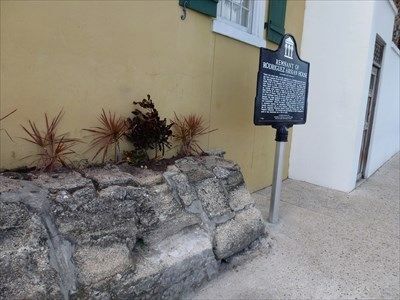
2. Remnants of Rodriguez Arsian House and Marker
finds itself in what was once New Spain, the territory of the Mississippian Culture, one of the Confederate States of America, and the Antebellum South.
Credits. This page was last revised on August 20, 2020. It was originally submitted on January 5, 2017, by James R. Murray of Elkton, Florida. This page has been viewed 1,953 times since then and 106 times this year. Photos:1, 2, 3. submitted on January 5, 2017, by James R. Murray of Elkton, Florida. • Bernard Fisher was the editor who published this page.