Near Manassas in Prince William County, Virginia — The American South (Mid-Atlantic)
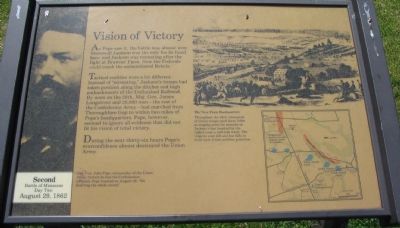
Vision of Victory
| — | Second Battle of Manassas - Day Two - August 29, 1862 | — |
Photographed by Craig Swain, May 4, 2008
1. Vision of Victory Marker
Tactical realities were a bit different. Instead of "retreating," Jackson's troops had taken position along the ditches and high embankments of the Unfinished Railroad. By noon on the 29th, Maj. Gen. James Longstreet and 28,000 men - the rest of the Confederate Army - had marched from Thoroughfare Gap to within two miles of Pope's headquarters. Pope, however, seemed to ignore all evidence that did not fit his vision of total victory.
During the next thirty-six hours Pope's overconfidence almost destroyed the Union Army.
Topics. This historical marker is listed in this topic list: War, US Civil.
Location. Marker has been reported missing. It was located near 38° 49.476′ N, 77° 31.936′ W. Marker was near Manassas, Virginia, in Prince William County. It could be reached from Sudley Road (U.S. 234) half a mile north of Lee Highway (Route 29), on the right when traveling north.
this page online

Regionally, this marker was in the Washington Metropolitan Area, in Northern Virginia, and in the Piedmont. It was also in the American South, specifically in the Upper South, in the Mid-Atlantic, and on the Eastern Seaboard. Globally, it was in the North Atlantic Region, North America, the Western Hemisphere, the Western World, and the Anglosphere. Historically, it found itself in what was once the territory of the Mississippian Culture, one of the original Thirteen Colonies, one of the Confederate States of America, and the Antebellum South.
Other nearby markers. At least 8 other markers are within walking distance of this location: The Fight for Matthews Hill (within shouting distance of this marker); Rhode Island Battery (within shouting distance of this marker); Dahlgren Boat Howitzers (about 400 feet away, measured in a direct line); Blocking the Union Advance (about 600 feet away); 2nd Rhode Island Infantry (about
Photographed by Craig Swain
2. Matthews Hill Markers
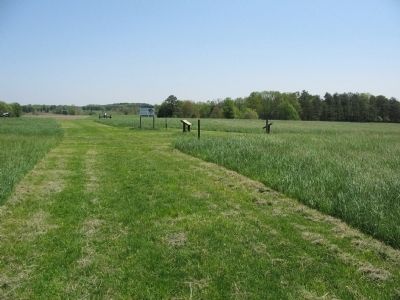
On the left is the Matthews Hill marker. On the right is the Vision of Victory marker. The white panel beyond the markers is a temporary informational sign detailing a project to restore historic woodlines.
Other markers no longer nearby. Matthews Hill (was here, next to this marker but has been confirmed missing); The Seventy-First Regiment (was approx. 0.2 miles away but has been replaced with another marker now near it).
More about this marker. On the far left is a portrait of Maj. Gen. John Pope, commander of the Union Army. Certain he had the Confederate cornered, Pope boasted on August 28, "We shall bag the whole crowd."
On the upper right is a drawing of The View from Headquarters
Throughout the 29th, thousands of Union troops used these fields as staging areas for assaults on Jackson's line (marked by the tallest trees a half-mile west). The ridge to your left and low hills in front were Union artillery positions.
The caption references a battle map on the lower right.
Also see . . . Second Manassas. General Pope's account of the battle. (Submitted on June 21, 2008, by Craig Swain of Leesburg, Virginia.)
Photographed by Craig Swain, May 4, 2008
3. View from Pope's Headquarters
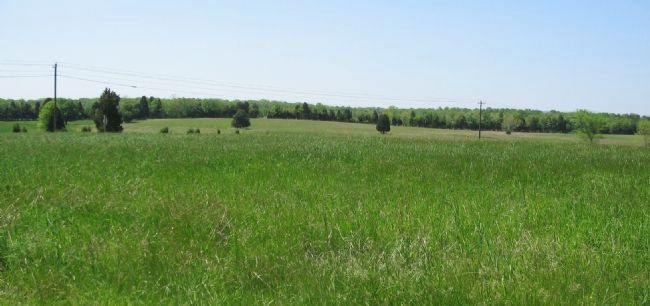
Looking northwest across Sudley Road. The Confederate line was anchored on an unfinished railroad bed running in the far distance. As mentioned on the marker, the line is among the larger trees about a half mile distant. Landscape restoration projects at the battlefield should restore the ground to 1862 tree lines. Thus offering a more "historic" view.
Credits. This page was last revised on November 16, 2022. It was originally submitted on June 21, 2008, by Craig Swain of Leesburg, Virginia. This page has been viewed 1,284 times since then and 13 times this year. Last updated on February 19, 2017, by Shane Oliver of Richmond, Virginia. Photos: 1. submitted on June 21, 2008, by Craig Swain of Leesburg, Virginia. 2. submitted on June 16, 2008, by Craig Swain of Leesburg, Virginia. 3. submitted on June 21, 2008, by Craig Swain of Leesburg, Virginia. • Bill Pfingsten was the editor who published this page.
