William Penn Annex East in Philadelphia in Philadelphia County, Pennsylvania — The American Northeast (Mid-Atlantic)
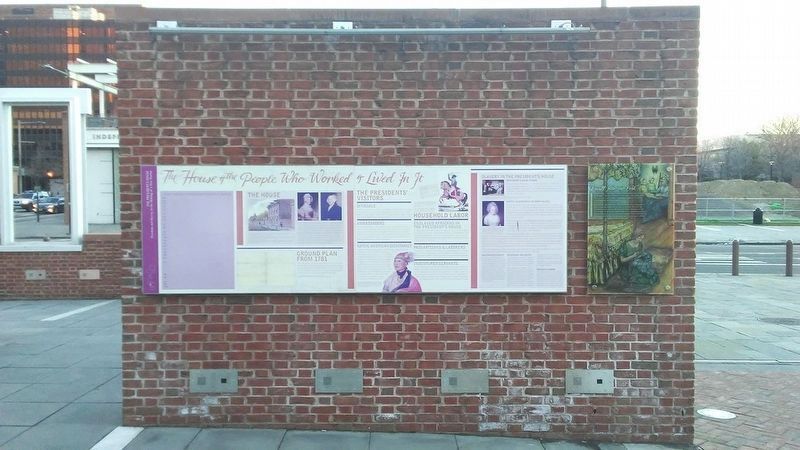
The House & the People Who Worked & Lived In It
Photographed by William Fischer, Jr., March 22, 2017
1. The House & the People Who Worked & Lived In It Marker
Before • For hundreds of years, Algonquian-speaking peoples lived here.
1682 • The city of Philadelphia was founded.
1767 • The house was built by Mary Lawrence Masters, a slaveholder and wealthy widow of the former mayor.
1772 • Mary Masters presented the house to her daughter, Polly, upon her wedding to Lieutenant Governor Richard Penn.
1778 • The house was headquarters of Major General Benedict Arnold whose betrayal of the Revolution began here.
1782 • Financier Robert Morris, a slaveholder, rebuilt and expanded the house after a major fire.
1790 • Philadelphia became the nation's temporary capital for the decade. George Washington made additions to the house to make room for his official duties, his extended family, his secretaries, as well as for enslaved, indentured, and free household servants.
1797 • Newly elected President John Adams and his wife Abigail moved into the house.
1800 • The house was converted into Francis's Union Hotel after government departed for Washington, D.C. Later it was remodeled for shops and a boarding house.
1832 • The house
this page online
1935 • Stores were demolished.
1945-67 • Creation of Independence Mall State Park.
1948 • Congress established Independence National Historical Park (INHP).
1951 • Last remaining walls of the former President's House were demolished to create Independence Mall.
1954 • Public restroom for Independence Mall was built on the house site.
1973 • Independence National Historical Park assumed management of the site.
1998 • Independence National Historical Park announced redesign for the three blocks of Independence Mall.
2000 • INHP unveiled the design for the Liberty Bell Center.
2001 • Independence Hall Association, a citizens' group, asked INHP to mark the outline of the President's House at the site.
2002 • The publication of an article in the Pennsylvania Magazine of History and Biography sparked public interest in the site and the presence of slavery in President Washington's household.
Construction of the Liberty Bell Center began. A public outcry about the project arose from both African-American and white advocates
Photographed by William Fischer, Jr., March 22, 2017
2. The House & the People Who Worked & Lived In It Marker Detail
2003 • Liberty Bell Center opened.
2005 • Funding for the design and construction of a commemorative exhibit at the President's House site was provided by the City of Philadelphia and federal government.
2007 • Archeology revealed partial foundations of the house and back buildings.
2010 • President's House exhibit and memorial to the enslaved opened.
Today • You have the opportunity to explore this site and discover its important place in American history.
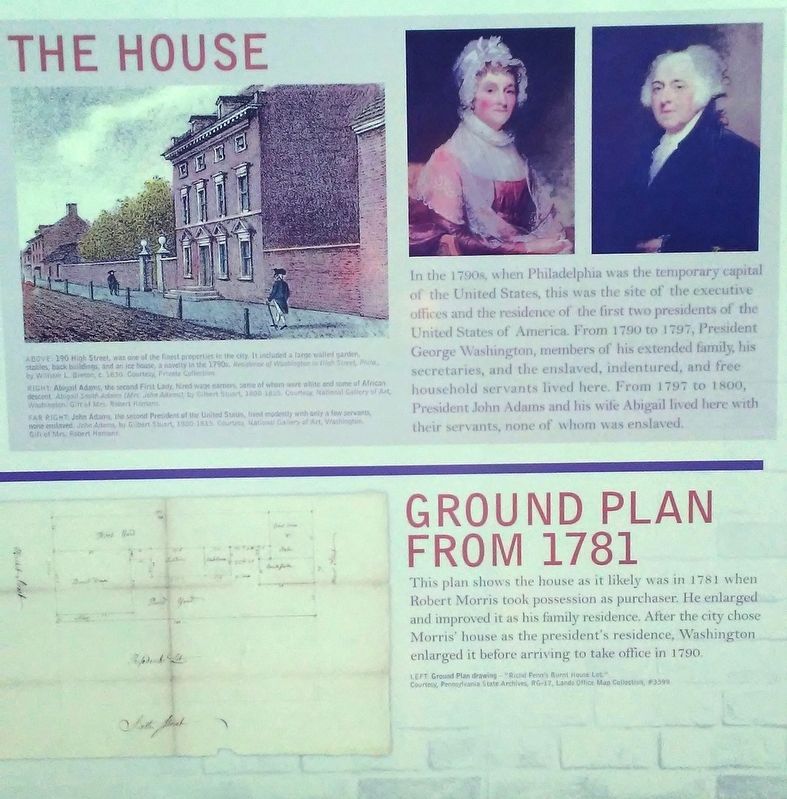
The House
[Illustration captions read]
Above: 190 High Street was one of the finest properties in the city. It included a large walled garden, stables, back buildings, and an ice house, a novelty in the 1790s. Residence of Washington in High Street, Phila., by William L. Breton, c. 1830. Courtesy, Private Collection.
Right: Abigail Adams, the second First Lady,

Photographed by William Fischer, Jr., March 22, 2017
3. The House & the People Who Worked & Lived In It Marker Detail
Far Right: John Adams, the second President of the United States, lived modestly with only a few servants, none enslaved. John Adams, by Gilbert Stuart, 1800-1815. Courtesy, National Gallery of Art, Washington. Gift of Mrs. Robert Homans.
In the 1790s, when Philadelphia was the temporary capital of the United States, this was the site of the executive offices and the residence of the first two presidents of the United States of America. From 1790 to 1797, President George Washington, members of his extended family, his secretaries, and the enslaved, indentured, and free household servants lived here. From 1797 to 1800, President John Adams and his wife Abigail lived here with their servants, none of whom was enslaved.
Ground Plan From 1781
This plan shows the house as it likely was in 1781 when Robert Morris took possession as purchaser. He enlarged and improved it as his family residence. After the city chose Morris'
Photographed by William Fischer, Jr., March 22, 2017
4. The House & the People Who Worked & Lived In It Marker Detail
[Illustration caption reads]
Left: Ground Plan drawing - "Richd Penn's Burnt House Lot." Courtesy, Pennsylvania State Archives, RG-17, Lands Office Map Collection, #3399.
The Presidents' Visitors
Officials
Many dignitaries met or dined with Presidents Washington and Adams, including men who would become presidents themselves—Thomas Jefferson, James Madison, James Monroe, and John Quincy Adams. Visitors also included Supreme Court justices, cabinet secretaries, and congressmen.
Ambassadors
Foreign ambassadors and emissaries were welcomed. Secretary of State Timothy Pickering met with Joseph Bunel who was sent by Toussaint L'Ouverture to strengthen economic ties with Haiti. L'Ouverture led the revolution that liberated the enslaved Africans in St. Domingue (Haiti) and was the first government leader in the Western Hemisphere of African descent.
Native American Dignitaries
Presidents Washington and Adams met with many delegations from indigenous nations. President Washington invited Thayendanegea, also known as Joseph Brant, a famous Mohawk leader of the Iroquois Nations. Washington also invited a Chickasaw delegation, including Chiefs Piomingo, George Colbert, and William Glover, to the house to discuss future relations with the United States. Other Native American chiefs, including Seneca Chief Red Jacket, met with Washington in the state dining room. Efforts to befriend the native tribes and secure treaties of peace during this period failed over time.
[Illustration captions reads] Right: Thayendanegea, a Mohawk leader also known as Joseph Brant, was invited here by President Washington to ask his help with efforts to secure peace with warring tribes on the western frontier. Joseph Brant/Thayendanegea, by Charles Willson Peale, 1797. Courtesy, Independence National Historical Park.
Above: Invitation image – President Washington invited guests by sending this card with the name and date entered in the blanks. Blank dinner invitation from President and Mrs. Washington, c. 1790-1797. Courtesy, The Mount Vernon Ladies Association.
Right: Toussaint L'Ouverture rose from enslavement to lead a violent and successful overthrow of slavery in Haiti. Toussaint L'Ouverture, artist unknown, n.d. Courtesy, The John Carter Brown Library at Brown University.
Household Labor
Enslaved Africans in the President's House
George and Martha Washington transported nine enslaved African descendants from their Mount Vernon estate to Philadelphia. The enslaved included their cook Hercules, Hercules's son Richmond, Martha's personal maid Oney Judge, Oney's brother Austin, Christopher, Giles, Joe, Paris, and Moll.
Paid Artisans & Laborers
Thousands of craftsmen and laborers, including free people of African descent, lived in Philadelphia in the 1790s and were essential to the city's prosperity. Some worked and lived in the presidential households.
Indentured Servants
George Washington also had indentured servants at the President's House and in nearby Germantown, where he lived for several weeks with his family and servants in the summer of 1794. Most indentures required at least three years of work without wages in exchange for ship's passage, housing, food, clothing, and training. At the end of the indenture, the servant was free to negotiate wages for labor.
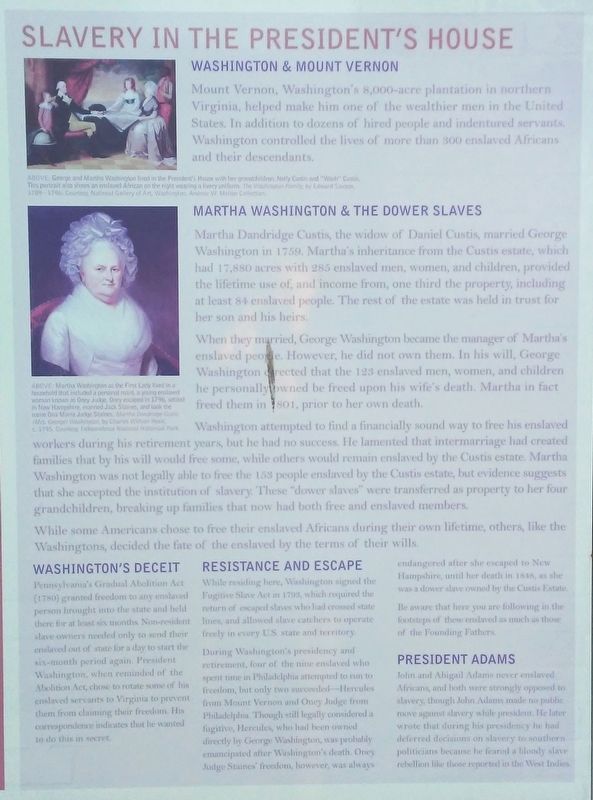
Slavery in the President's House
Washington & Mount Vernon
Mount Vernon, Washington's 8,000-acre plantation in northern Virginia, helped make him one of the wealthier men in the United States. In addition to dozens of hired people and indentured servants, Washington controlled the lives of more than 300 enslaved Africans and their descendants.
[Illustration caption reads]
Above: George and Martha Washington lived in the President's House with her grandchildren; Nelly Custis and "Wash" Custis. This portrait also shows an enslaved African on the right wearing a livery uniform. The Washington Family, by Edward Savage, 1789-1796. Courtesy, National Gallery of Art, Washington. Andrew W. Mellon Collection.
Martha Washington & The Dower Slaves
Martha Dandridge Custis, the widow of Daniel Custis, married George Washington in 1759. Martha's inheritance from the Custis estate, which had 17,880 acres with 285 enslaved men, women, and children, provided the lifetime use of, and income from, one third the property, including at least 84 enslaved people. The rest of the estate was held in trust for her son and his heirs.
When they married, George Washington became the manager of Martha's enslaved people. However, he did not own them. In his will, George Washington directed that the 123 enslaved men, women, and children he personally owned be freed upon his wife's death. Martha in fact freed them in 1801, prior to her own death.
Washington attempted to find a financially sound way to free his enslaved workers during his retirement years, but he had no success. He lamented that intermarriage had created families that by his will would free some, while others would remain enslaved by the Custis estate. Martha Washington was not legally able to free the 153 people enslaved by the Custis estate, but evidence suggests that she accepted the institution of slavery. These "dower slaves" were transferred as property to her four grandchildren, breaking up families that now had both free and enslaved members.
While some Americans chose to free their enslaved Africans during their own lifetime, others, like the Washingtons, decided the fate of the enslaved by the terms of their wills.
Washington's Deceit
Pennsylvania's Gradual Abolition Act (1780) granted freedom to any enslaved person brought into the state and held there for at least six months. Non-resident slave owners needed only to send their enslaved out of state for a day to start the six-month period again. President Washington, when reminded of the Abolition Act, chose to rotate some of his enslaved servants to Virginia to prevent them from claiming their freedom. His correspondence indicates that he wanted to do this in secret.
Resistance And Escape
While residing here, Washington signed the Fugitive Slave Act in 1793, which required the return of escaped slaves who had crossed state lines, and allowed slave catchers to operate freely in every U.S. state and territory.
During Washington's presidency and retirement, four of the nine enslaved who spent time in Philadelphia attempted to run to freedom, but only two succeeded—Hercules from Mount Vernon and Oney Judge from Philadelphia. Though still legally considered a fugitive, Hercules, who had been owned directly by George Washington, was probably emancipated after Washington's death. Oney Judge Staines' freedom, however, was always endangered after she escaped to New Hampshire, until her death in 1848, as she was a dower slave owned by the Custis Estate.
Be aware that here you are following in the footsteps of these enslaved as much as those of the Founding Fathers.
President Adams
John and Abigail Adams never enslaved Africans, and both were strongly opposed to slavery, though John Adams made no public move against slavery while president. He later wrote that during his presidency he had deferred decisions on slavery to southern politicians because he feared a bloody slave rebellion like those reported in the West Indies.
Erected by National Park Service.
Topics and series. This historical marker is listed in these topic lists: Abolition & Underground RR • African Americans • Civil Rights. In addition, it is included in the Former U.S. Presidents: #01 George Washington, the Former U.S. Presidents: #02 John Adams, the Former U.S. Presidents: #04 James Madison, the Former U.S. Presidents: #05 James Monroe, and the Former U.S. Presidents: #06 John Quincy Adams series lists. A significant historical year for this entry is 1682.
Location. Marker has been permanently removed. It was located near 39° 57.029′ N, 75° 9.002′ W. Marker was in Philadelphia, Pennsylvania, in Philadelphia County. It was in William Penn Annex East. It was at the intersection of Market Street and South Independence Mall West (6th Street), on the right when traveling east on Market Street. Touch for map. Marker was at or near this postal address: 101 Market St, Philadelphia PA 19106, United States of America.
We have been informed that this marker is no longer there and will not be replaced. This page is an archival view of what was.
Regionally, this marker was in Southeast Pennsylvania. It was also in the American Northeast and in the Mid-Atlantic. Globally, it was in North America, the Western Hemisphere, the Western World, and the Anglosphere. Historically, it found itself in what was once the Haudenosaunee (Iroquois) Confederacy, New Netherland, and one of the original Thirteen Colonies.

Other nearby markers. At least 8 other markers are within walking distance of this location: William Howe (here, next to this marker); The Executive Mansion (here, next to this marker); Commander in Chief (here, next to this marker); Treaties and Appointments (here, next to this marker); Selecting a President (here, next to this marker); The President's House (here, next to this marker); State of the Union (here, next to this marker); What is Executive Power? (here, next to this marker). Touch for a list and map of all markers in Philadelphia.
Other markers no longer nearby. "I will fear no Evil" (was here, next to this marker but has been replaced with another marker now near it); The Keeper of the House (was here, next to this marker but has been replaced with another marker now near it); Suppressing the Opposition (was here, next to this marker but has been replaced with another marker now near it); "An Act respecting fugitives from Justice" (was here, next to this marker but has been replaced with another marker now near it); The Dirty Business of Slavery (was here, next to this marker but has been permanently removed); "We shall come to a civil war" (was here, next to this marker but has been permanently removed); "Burn this treaty to Hell!" (was here, next to this marker but has been replaced with another marker now near it); "I am free now" (was here, next to this marker but has been permanently removed).
Also see . . .
1. History of the President's House Site. (Submitted on April 3, 2017, by William Fischer, Jr. of Reynoldsburg, Ohio.)
2. President's House Site: Uncovering the Past through Archeology. (Submitted on April 3, 2017, by William Fischer, Jr. of Reynoldsburg, Ohio.)
3. George Washington’s Philadelphia Household, 1793-1794. (Submitted on April 3, 2017, by William Fischer, Jr. of Reynoldsburg, Ohio.)
4. Hercules. (Submitted on April 3, 2017, by William Fischer, Jr. of Reynoldsburg, Ohio.)
5. The Story of Oney Judge and The Real George Washington. (Submitted on April 3, 2017, by William Fischer, Jr. of Reynoldsburg, Ohio.)
6. Washington’s Will: A Decision to Free His Slaves. (Submitted on April 3, 2017, by William Fischer, Jr. of Reynoldsburg, Ohio.)
7. Trump admin removes memorial honoring people enslaved by George Washington in Philadelphia. The Department of the Interior is implementing Secretary’s Order 3431, which carries out President Donald J Trump’s Executive Order on 'Restoring Truth and Sanity to American History,' the statement said. "The President has directed federal agencies to review interpretive materials to ensure accuracy, honesty, and alignment with shared national values. Following completion of the required review, the National Park Service is now taking action to remove or revise interpretive materials in accordance with the Order." (Submitted on January 23, 2026, by Mark Hilton of Montgomery, Alabama.)
Additional commentary.
1. Removal of signs, exhibits, and educational materials.
The March 2025 executive order EO 14253 "Restoring Truth and Sanity to American History" initiated the removal of signs, exhibits, and educational materials at Washington D.C. monuments and national park sites. This order targeted content deemed to "inappropriately disparage" American history, leading to the removal of information on slavery, Native American history, and climate change.
— Submitted March 22, 2026.
Credits. This page was last revised on March 22, 2026. It was originally submitted on April 3, 2017, by William Fischer, Jr. of Reynoldsburg, Ohio. This page has been viewed 1,333 times since then and 719 times this year. Photos: 1, 2, 3, 4. submitted on April 3, 2017, by William Fischer, Jr. of Reynoldsburg, Ohio.
