Franklin in Williamson County, Tennessee — The American South (East South Central)
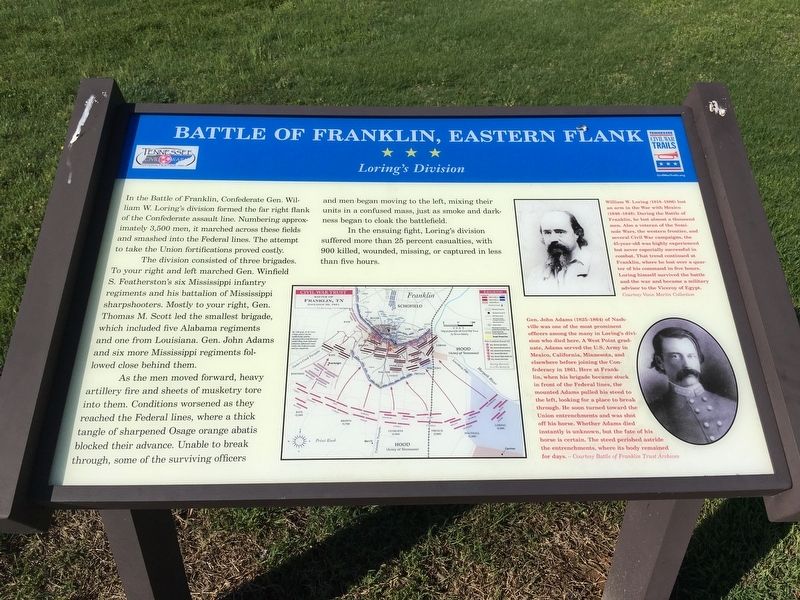
Battle of Franklin, Eastern Flank
Loring's Division
Photographed by Brandon Stahl, April 26, 2017
1. Eastern Flank Battlefield Park Marker
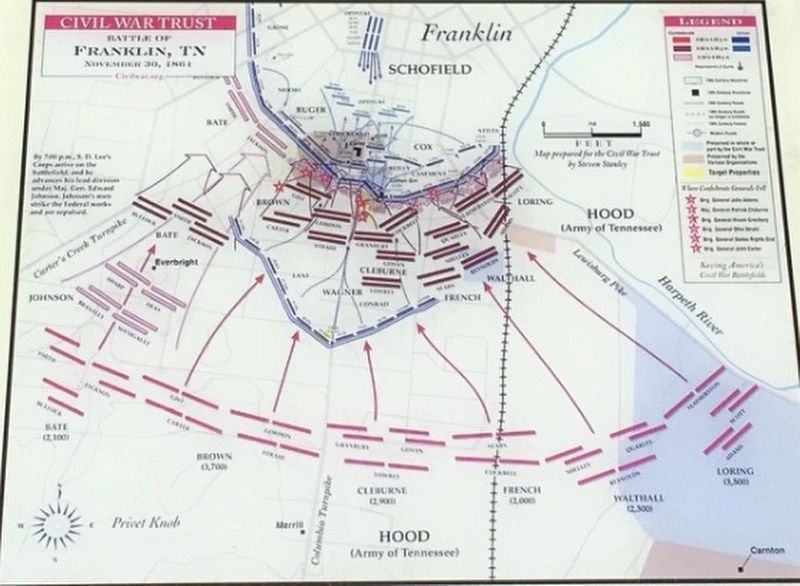
In the Battle of Franklin, Confederate Gen. William W. Loring’s division formed the far right flank of the Confederate assault line. Numbering approximately 3,500 men, it marched across these fields and smashed into the Federal lines. The attempt to take the Union fortifications proved costly.
The division consisted of three brigades. To your right and left marched Gen. Winfield S. Featherston’s six Mississippi infantry regiments and his battalion of Mississippi sharpshooters. Mostly to your right, Gen. Thomas M. Scott led the smallest brigade, which included five Alabama regiments and one from Louisiana. Gen. John Adams and six more Mississippi regiments followed close behind them.
As the men moved forward, heavy artillery fire and sheets of musketry tore into them. Conditions worsened as they reached the Federal lines, where a thick tangle of sharpened Osage orange abates blocked their advance. Unable to break through, some of the surviving officers and men began moving to the left, mixing their units in a confused mass, just as smoke and darkness began to cloak the battlefield.
In the ensuing fight, Loring’s
this page online
Erected by Tennessee Civil War Trails.
Topics and series. This historical marker is listed in this topic list: War, US Civil. In addition, it is included in the Tennessee Civil War Trails series list. A significant historical date for this entry is November 30, 1864.
Location. 35° 54.329′ N, 86° 51.583′ W. Marker is in Franklin, Tennessee, in Williamson County. It can be reached from Eastern Flank Circle 0.4 miles south of Lewsiburg Pike (Business U.S. 431), on the right when traveling west. Marker is located in Eastern Flank Battlefield Park. Touch for map. Marker is at or near this postal address: 1345 Eastern Flank Cir, Franklin TN 37064, United States of America. Touch for directions.

Regionally, this marker is in Middle Tennessee and in Greater Nashville. It is also in the American South and specifically in the Upper South. Globally, it is in North America, the Western Hemisphere, the Western World, and the Anglosphere. Historically, it finds itself in what was once the territory of the Mississippian Culture,
Photographed by Brandon Stahl, April 26, 2017
2. Eastern Flank Battlefield Park Marker
Other nearby markers. At least 8 other markers are within walking distance of this marker: A different marker also named Battle of Franklin, Eastern Flank (within shouting distance of this marker); a different marker also named Battle of Franklin, Eastern Flank (within shouting distance of this marker); The Long Road to Recovery (within shouting distance of this marker); Confederate Reunions at McGavock's Grove (within shouting distance of this marker); A Dream Postponed (within shouting distance of this marker); a different marker also named Battle of Franklin, Eastern Flank (within shouting distance of this marker); a different marker also named Battle of Franklin (about 300 feet away, measured in a direct line); a different marker also named Battle of Franklin, Eastern Flank (about 300 feet away). Touch for a list and map of all markers in Franklin.
Also see . . . Eastern Flank Battlefield Park. City of Franklin website entry (Submitted on May 17, 2017, by Brandon Stahl of Fairfax, Virginia.)
Photographed by Civil War Trust
3. Battle of Franklin Map
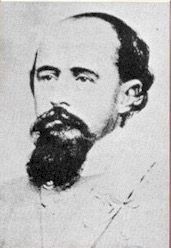
4. William W. Loring
William W. loring (1818-1886) lost an arm in the War with Mexico (1846-1848). During the Battle of Franklin, he lost almost a thousand men. Also a veteran of the Seminole Wars, the western frontier, and several Civil War campaigns, the 45- year old was highly experienced but never especially successful in combat. That trend continued at Franklin, where he lost over a quarter of his command in five hours. Loring himself survived the battle and the war and became a military adviser to the Viceroy of Egypt.
Battle of Franklin Trust Archives
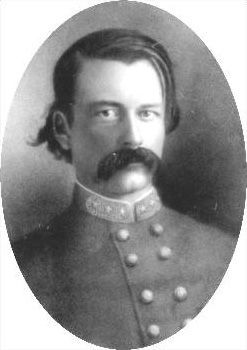
5. Gen. John Adams
Gen. John Adams (1825-1864) of Nashville was one of the most prominent officers among the many in Loring’s division who died here. A West Point graduate, Adams served the U.S. Army in Mexico, California, Minnesota, and elsewhere before joining the Confederacy in 1861. Here at Franklin, when his brigade became stuck in front of the Federal lines, the mounted Adams pulled his steed to the left, looking for a place to break though. He soon turned toward the Union entrenchments and was shot off his horse. Whether Adams died instantly is unknown, but the fate of his horse is certain. The steed perished astride the entrenchments, where its body remained for days.
Credits. This page was last revised on April 15, 2021. It was originally submitted on May 17, 2017, by Brandon Stahl of Fairfax, Virginia. This page has been viewed 1,622 times since then and 107 times this year. Photos: 1, 2, 3, 4, 5. submitted on May 17, 2017, by Brandon Stahl of Fairfax, Virginia. • Bernard Fisher was the editor who published this page.
