Leesburg in Loudoun County, Virginia — The American South (Mid-Atlantic)
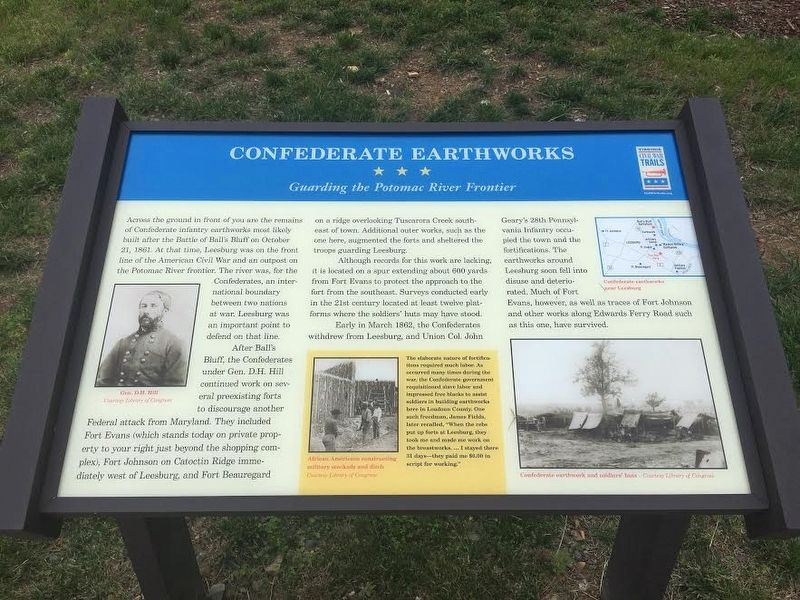
Confederate Earthworks
Guarding the Potomac River Frontier
Photographed by Brandon Stahl
1. Confederate Earthworks Marker
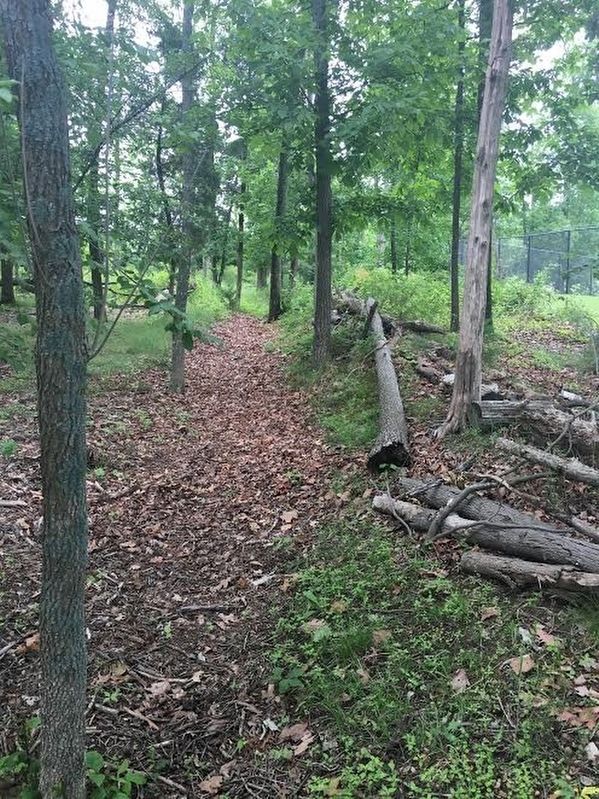
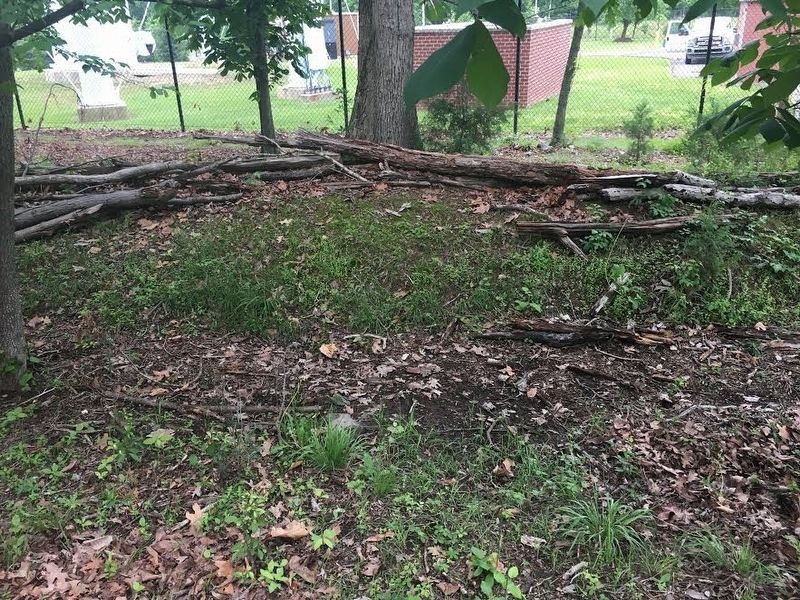
After Ball’s Bluff, the Confederates under Gen. D.H. Hill continued work on several preexisting forts to discourage another Federal attack from Maryland. They included Fort Evans (which stands today on private property to your right just beyond the shopping complex), Fort Johnson on Catoctin Ridge immediately west of Leesburg, and Fort Beauregard on a ridge overlooking Tuscarora southeast of town. Additional outer works, such as the one here, augmented the forts and sheltered the troops guarding Leesburg.
Although records for this work are lacking, it is located on a spur extending 600 yards from Fort Evans to protect the approach to the fort from the southeast. Surveys conducted early in the 21st century
this page online
Early in March 1862, the Confederates withdrew from Leesburg, and Union Col. John Geary’s 28th Pennsylvania Infantry occupied the town and the fortifications. The earthworks around Leesburg soon fell into disuse and deterioration. Much of Fort Evans, however, as well as traces of Fort Johnson and other works along Edwards Ferry Road such as this one, have survived.
Erected by Virginia Civil War Trails.
Topics and series. This historical marker is listed in these topic lists: African Americans • Forts and Castles • War, US Civil. In addition, it is included in the Virginia Civil War Trails series list. A significant historical month for this entry is March 1862.
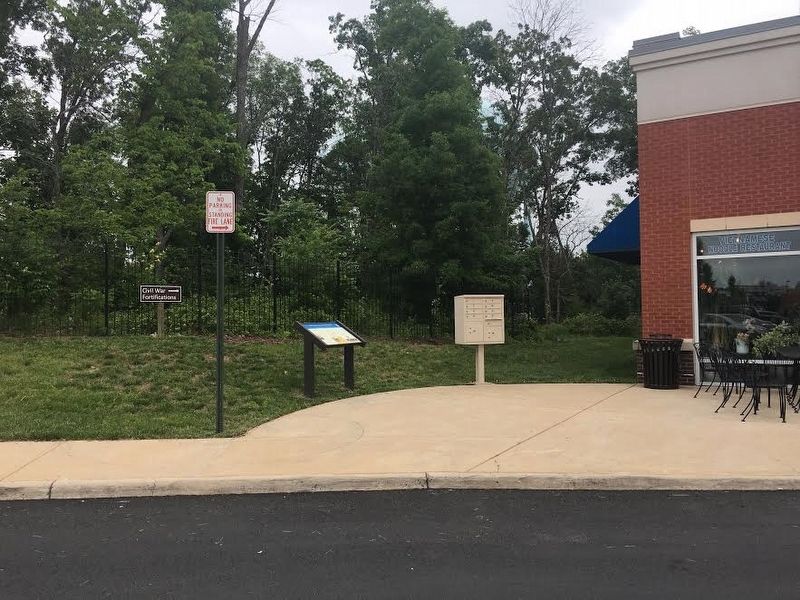
Location. 39° 6.365′ N, 77° 31.625′ W. Marker is in Leesburg, Virginia, in Loudoun County. It can be reached from Fort Evans Road NE (Virginia Route 773) 0.1 miles west of Battlefield Parkway, on the right when traveling west. The marker is outside Pho Royal in the in the Fort Evans II shopping center. Touch for map. Marker is at or near this postal address: 542 Fort Evans Rd NE, Leesburg VA 20176,
Photographed by Brandon Stahl
2. Confederate Earthworks Marker

Regionally, this marker is in the Washington Metropolitan Area and in Northern Virginia. It is also in the American South, specifically in the Upper South, and in the Mid-Atlantic. Globally, it is in North America, the Western Hemisphere, the Western World, and the Anglosphere. Historically, it finds itself in what was once the territory of the Mississippian Culture, one of the original Thirteen Colonies, one of the Confederate States of America, and the Antebellum South.
Other nearby markers. At least 8 other markers are within 2 miles of this marker, measured as the crow flies: Ball’s Bluff Masked Battery (approx. half a mile away); a different marker also named Ball’s Bluff Masked Battery (approx. 0.6 miles away); Two-Chambered Granary (approx. one mile away); Carriage House (approx. one mile away); Well House (approx. one mile away); Red Rock Wilderness Overlook Regional Park (approx. one mile away); Ice House (approx. 1.1 miles away); Douglass Community School (approx. 1½ miles away). Touch for a list and map of all markers in Leesburg.
Also see . . . Defenses of Leesburg.
Photographed by Brandon Stahl
3. Confederate Earthworks
Photographed by Brandon Stahl
4. Confederate Earthworks
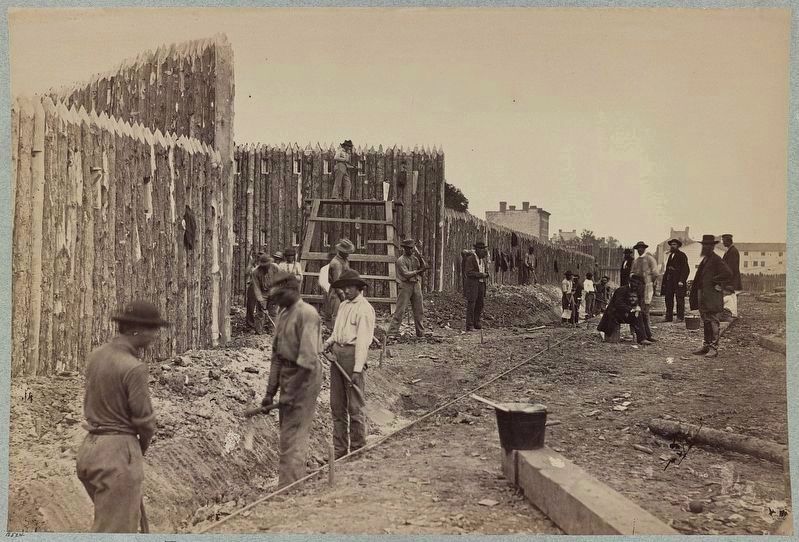
Photographed by Andrew Joseph Russell
5. Building stockade, Alexandria, Va.
Library of Congress (LC-DIG-ppmsca-34822)
Library of Congress
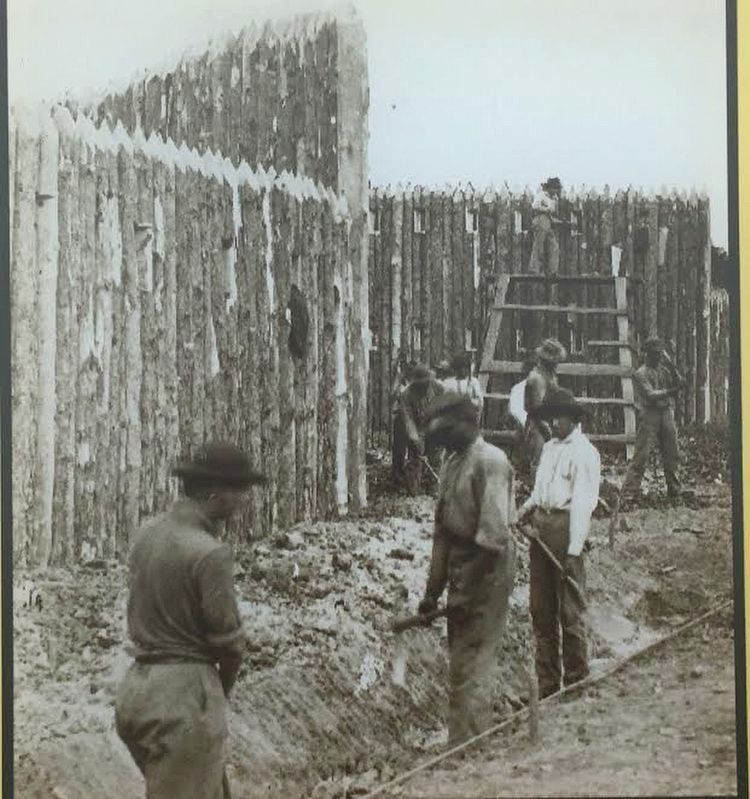
6. African Americans constructing military stockade and ditch
The elaborate nature of fortifications required much labor. As occurred many times during the war, the Confederate government requisitioned slave labor and impressed free blacks to assist soldiers in building earthworks here in Loudoun County. One such freedman, James Fields, later recalled, “When the rebs put up forts at Leesburg, they took me and made me work on the breastworks. … I stayed there 31 days – they paid me $6.00 in script for working.
Credits. This page was last revised on January 8, 2026. It was originally submitted on May 25, 2017, by Brandon Stahl of Fairfax, Virginia. This page has been viewed 1,749 times since then and 117 times this year. Photos: 1, 2, 3, 4. submitted on May 25, 2017, by Brandon Stahl of Fairfax, Virginia. 5. submitted on November 10, 2021. 6. submitted on May 25, 2017, by Brandon Stahl of Fairfax, Virginia. • Bernard Fisher was the editor who published this page.
