Veracruz, Mexico — The Gulf Coast (North America)
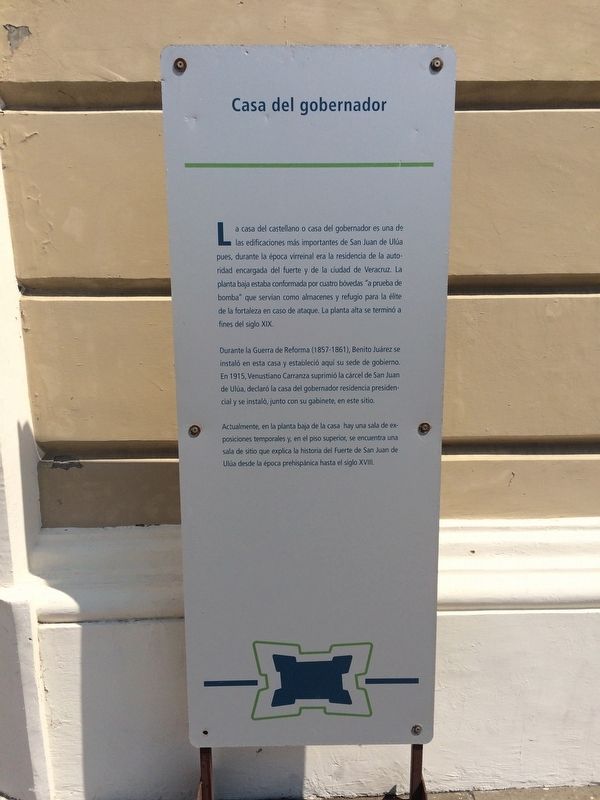
The Governor's House
Photographed by J. Makali Bruton, March 23, 2017
1. The Governor's House Marker
Durante la Guerra de Reforma (1857-1861), Benito Juárez se instaló en esta casa y estableció aquí su sede de gobierno. En 1915, Venustiano Carranza suprimió la cárcel de San Juan de Ulúa, declaró la casa del gobernador residencia presidencial y se instaló, junto con su gabinete, en este sitio.
Actualmente, en la planta baja de la casa hay una sala de exposiciones temporales y, en el piso superior, se encuentra una sala de sitio que explica la historia del Fuerte de San Juan de Ulúa desde la época prehispánica hasta el siglo XVIII.
English translation:
this page online
During the Reform War (1857-1861), Benito Juárez settled in this house and established his seat of government here. In 1915, Venustiano Carranza closed the prison of San Juan de Ulúa, declared the Governor´s House as the presidential residence and settled, together with his cabinet, in this place. Currently, on the ground floor of the house there is a temporary exhibition hall and, on the upper floor, there is a room that explains the history of the Fort of San Juan de Ulúa from pre-hispanic times to the eighteenth century.
Topics. This historical marker is listed in these topic lists: Colonial Era • Forts and Castles • Government & Politics • Wars, Non-US. A significant historical year for this entry is 1915.
Location. 19° 12.567′ N, 96° 7.863′ W. Marker is in Veracruz. It can be reached from Camino Escénico
Photographed by J. Makali Bruton, March 23, 2017
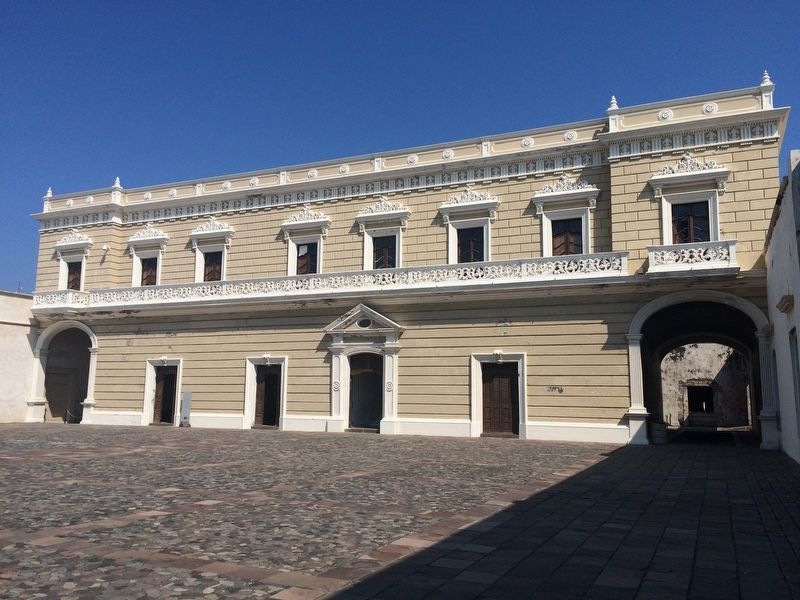
2. The Governor's House Marker
The marker is towards the left of the Governor's House.

Regionally, this marker is in the Gulf Coast and in the Sierra Madre. Globally, it is in North America, specifically in Mesoamerica, in a Gulf of Mexico state, on the Ring of Fire, and in the Western Hemisphere. Historically, it finds itself in what was once New Spain, a Spanish colony, and the Aztec Empire.
Other nearby markers. At least 8 other markers are within walking distance of this marker: General Miguel Barragán (within shouting distance of this marker); Benito Juárez in Prison in San Juan de Ulúa (within shouting distance of this marker); The Last Stronghold of the Spanish in Mexico (within shouting distance of this marker); The “Curtain” of San Fernando (within shouting distance of this marker); The Prison of San Juan de Ulúa (within shouting distance of this marker); The Bastion of San Crispin (within shouting distance of this marker); Patio of the Curtain or Dry Moat (about 90 meters away, measured
Photographed by J. Makali Bruton, March 23, 2017
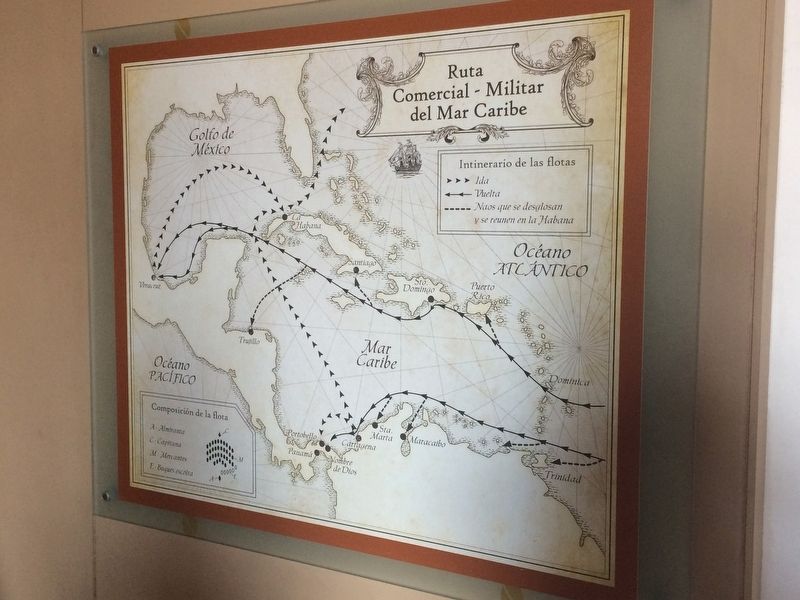
3. An exhibit at the Governor's House Museum
As the marker mentions, the second floor of the Governor's House serves as a museum. This is part of one of the exhibits, illustrating the sea routes that the Spanish used in the Caribbean and New Spain.
Photographed by J. Makali Bruton, March 23, 2017
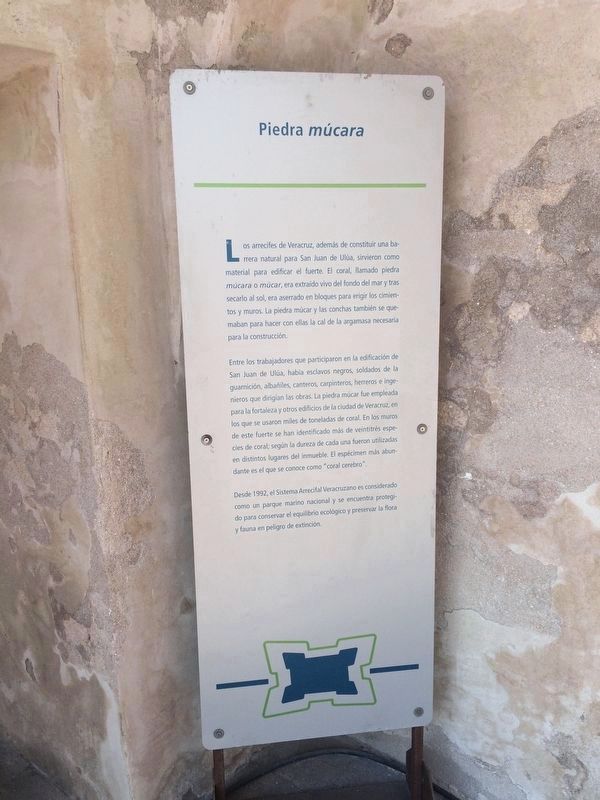
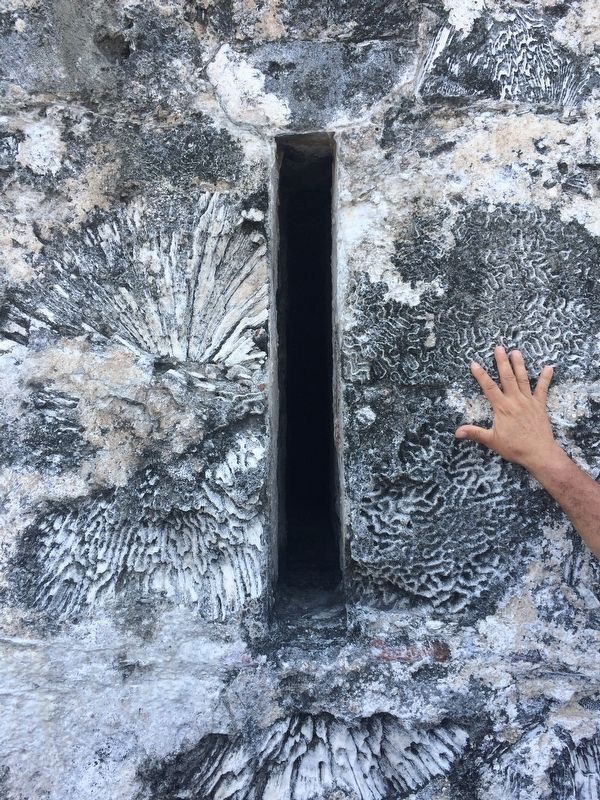
4. An additional marker on the coral stone used in the fort's construction
This marker is on the northern side of the large plaza in front of the Governor's House. It reads:
Piedra múcara Los arrecifes de Veracruz, además de constituir una barrera natural para San Juan de Ulúa, sirvieron como material para edificar el fuerte. El coral, llamado piedra múcara o múcar, era extraído vivo del fondo del mar y tras
secarlo al sol, era aserrado en bloques para erigir los cimientos y muros. La piedra múcar y las conchas también se quemaban para hacer con ellas la cal de la argamasa necesaria para la construcción.
Entre los trabajadores que participaron en la edificación de San Juan de Ulúa, había esclavos negros, soldados de la guarnición, albañiles, canteros, carpinteros, herreros e ingenieros que dirigían las obras. La piedra múcar fue empleada para la fortaleza y otros edificios de la ciudad de Veracruz, en los que se usaron miles de toneladas de coral. En los muros de este fuerte se han identificado más de veintitrés especies de coral; según la dureza de cada una fueron utilizadas en distintos lugares del inmueble. El espécimen más abundante es el que se conoce como "coral cerebro".
Desde 1992, el Sistema Arrecifal Veracruzano es considerado como un parque marino nacional y se encuentra protegido para conservar el equilibrio ecológico y preservar la flora y fauna en peligro de extinción.
English translation:
Múcara or Coral Stone The reefs of Veracruz, besides constituting a natural barrier for San Juan de Ulúa, served as material to build the fort. The coral, known in Spanish as múcara or mucar, was extracted alive from the bottom of the sea and after drying in the sun, was sawn into blocks to use in the foundations and walls.
Among the workers who took part in the construction of San Juan de Ulúa, there were slaves, soldiers of the garrison, masons, carpenters, blacksmiths and also engineers who directed the works. The stone was used for the fort and other buildings in the city of Veracruz, where thousands of tons of coral were used. In the walls of this fort more than twenty three species of coral have been identified. According to the hardness of each type of coral they were used in different places in the construction. The most abundant species used is what is known as "brain coral".
Since 1992, the Veracruz Reef System is considered a national marine park and is protected to preserve the local ecology and to preserve the flora and fauna in danger of extinction here.
Entre los trabajadores que participaron en la edificación de San Juan de Ulúa, había esclavos negros, soldados de la guarnición, albañiles, canteros, carpinteros, herreros e ingenieros que dirigían las obras. La piedra múcar fue empleada para la fortaleza y otros edificios de la ciudad de Veracruz, en los que se usaron miles de toneladas de coral. En los muros de este fuerte se han identificado más de veintitrés especies de coral; según la dureza de cada una fueron utilizadas en distintos lugares del inmueble. El espécimen más abundante es el que se conoce como "coral cerebro".
Desde 1992, el Sistema Arrecifal Veracruzano es considerado como un parque marino nacional y se encuentra protegido para conservar el equilibrio ecológico y preservar la flora y fauna en peligro de extinción.
English translation:
Among the workers who took part in the construction of San Juan de Ulúa, there were slaves, soldiers of the garrison, masons, carpenters, blacksmiths and also engineers who directed the works. The stone was used for the fort and other buildings in the city of Veracruz, where thousands of tons of coral were used. In the walls of this fort more than twenty three species of coral have been identified. According to the hardness of each type of coral they were used in different places in the construction. The most abundant species used is what is known as "brain coral".
Since 1992, the Veracruz Reef System is considered a national marine park and is protected to preserve the local ecology and to preserve the flora and fauna in danger of extinction here.
Photographed by J. Makali Bruton, March 23, 2017
5. An example of the coral stone used to construct the fort.
Credits. This page was last revised on June 12, 2017. It was originally submitted on June 9, 2017, by J. Makali Bruton of Washington, District of Columbia. This page has been viewed 288 times since then and 21 times this year. Photos: 1, 2, 3. submitted on June 9, 2017, by J. Makali Bruton of Washington, District of Columbia. 4, 5. submitted on June 12, 2017, by J. Makali Bruton of Washington, District of Columbia.
