Near Kerrs Creek in Rockbridge County, Virginia — The American South (Mid-Atlantic)
Kerr’s Creek
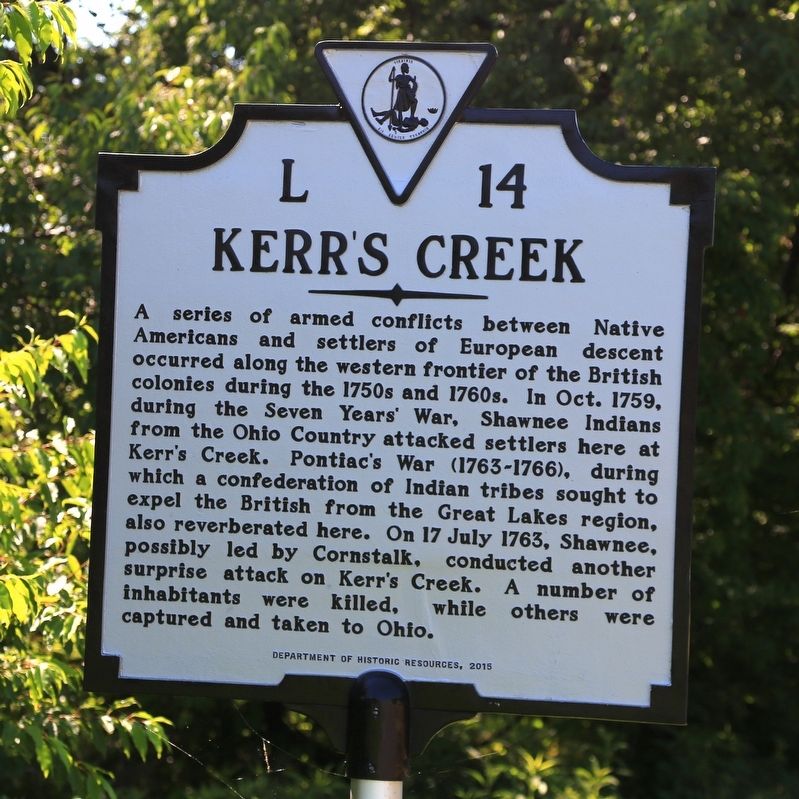
Photographed by J. J. Prats, June 11, 2017
1. Kerr’s Creek Marker
Erected 2015 by Department of Historic Resources. (Marker Number L-14.)
Topics and series. This historical marker is listed in these topic lists: Indigenous Peoples and Communities • Settlements & Settlers • Wars, US Indian. In addition, it is included in the Virginia Department of Historic Resources (DHR) series list. A significant historical year for this entry is 1750.
Location. 37° 50.933′ N, 79° 29.092′ W. Marker is near Kerrs Creek, Virginia, in Rockbridge County.
this page online

Regionally, this marker is in the Mountain Region. It is also in the American South, specifically in the Upper South, in Appalachia, and specifically in Southern Appalachia. Globally, it is in North America, the Western Hemisphere, the Western World, and the Anglosphere. Historically, it finds itself in what was once the territory of the Mississippian Culture, one of the original Thirteen Colonies, one of the Confederate States of America, and the Antebellum South.
Other nearby markers. At least 8 other markers are within 5 miles of this marker, measured as the crow flies: The Massacre of Kerr's Creek (about 300 feet away, measured in a direct line); Jane Todd Crawford (approx. 2.9 miles away); New Monmouth Church (approx. 2.9 miles away); New Monmouth Church and Morrison’s Birthplace (approx. 2.9 miles away); Liberty Hall Academy (approx. 4.3 miles away); Liberty Hall Academy Ruins
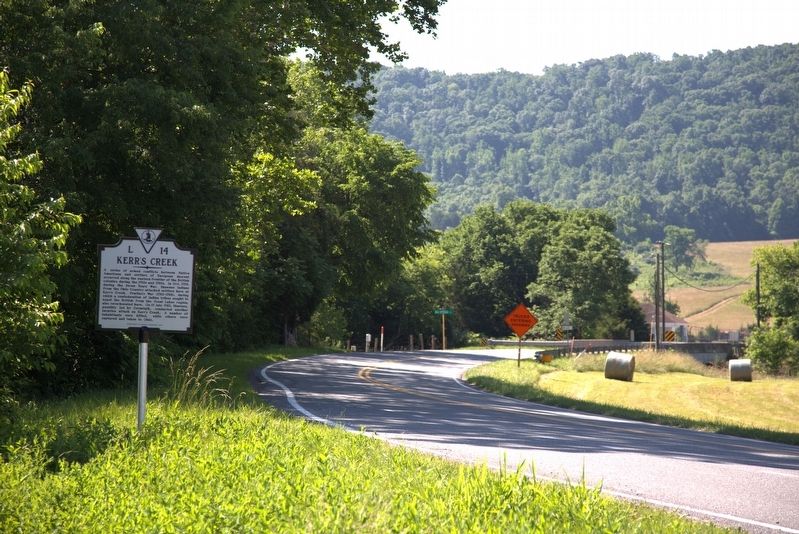
Photographed by J. J. Prats, June 11, 2017
2. Kerr’s Creek Marker
Also see . . . The Kerr's Creek Massacres (1759-1763). “Scarcely had the treaty (Treaty of Paris) ink dried before a powerful Ottawa chief named Pontiac began uniting the tribes throughout the Ohio. Said to have been instrumental in Braddock’s defeat near the opening of the French and Indian War, Pontiac had become a brilliant strategist who realized that without a united front the Native Americans were doomed. In a short time, he’d recruited from all the tribes from Lake Superior to Mexico. Each tribe in the confederation was to choose its best warriors. In May, 1763, the warriors were to attack 14 British garrisons along the frontier. Of those 14, all but four were captured. One of the four was Detroit, Pontiac’s personal goal. That summer, war raged up and down the frontier. Once again, the Shawnee Chief Cornstalk was assigned the area he knew well, the eastern Alleghanies, the Cowpasture and Jackson rivers, Botetourt, Kerrs Creek, Augusta. Small forts dotted the frontier from the French and Indian War. A confident Cornstalk knew he could take them all.” (Submitted on July 5, 2017.)
Credits. This page was last revised on July 5, 2017. It was originally submitted on July 5, 2017, by J. J. Prats of Powell, Ohio. This page has been viewed 5,062 times since then and 248 times this year. Photos: 1, 2. submitted on July 5, 2017, by J. J. Prats of Powell, Ohio.
