Plantage in Amsterdam, North Holland, Netherlands — Northwestern Europe
De Hortus
Plantage aan het Water
Photographed by Andrew Ruppenstein, June 18, 2017
1. Hortus Marker
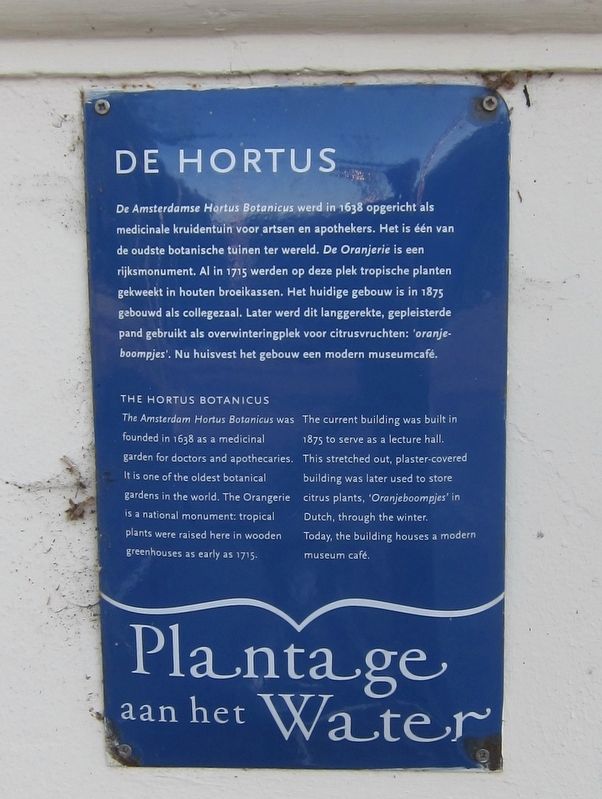
The Hortus Botanicus
The Amsterdam Hortus Botanicus was founded in 1638 as a medicinal garden for doctors and apothecaries. It is one of the oldest botanical gardens in the world. The Orangerie is a national monument: tropical plants were raised here in wooden greenhouses as early as 1715. The current building was built as a lecture hall. This stretched-out plaster-covered building was later used to store citrus plants, 'Oranjeboompjes' in Dutch, through the winter. Today, the building houses a modern museum café.
Topics. This historical marker is listed in these topic lists: Agriculture • Horticulture & Forestry
this page online
Location. 52° 22.028′ N, 4° 54.431′ E. Marker is in Amsterdam, Noord-Holland (North Holland). It is in Plantage. It is at the intersection of Plantage Middenlaan and Doctor D.M. Sluyspad on Plantage Middenlaan. Touch for map. Marker is in this post office area: Amsterdam, Noord-Holland 1011 RR, Netherlands. Touch for directions.

Regionally, it is in Europe, the European Union, Atlantic Europe, the Benelux Low Countries, the Schengen Area, Western Europe, and the Western World. Historically, it finds itself in what was once the Holy Roman Empire.
Other nearby markers. At least 8 other markers are within walking distance of this marker: Hortusbrug (a few steps from this marker); Toegangspoort / Entrance Gate (within shouting distance of this marker); David Henriques de Castro Mz. (1826-1898) (within shouting distance of this marker); Hugo de Vries Laboratorium (within shouting distance of this marker); Sara Bleekrode-Vita Israel (about 90 meters away, measured in a direct line); Andre Monnickendam (about 90 meters away); Gustaaf Karel Monnickendam
Photographed by Andrew Ruppenstein, June 18, 2017
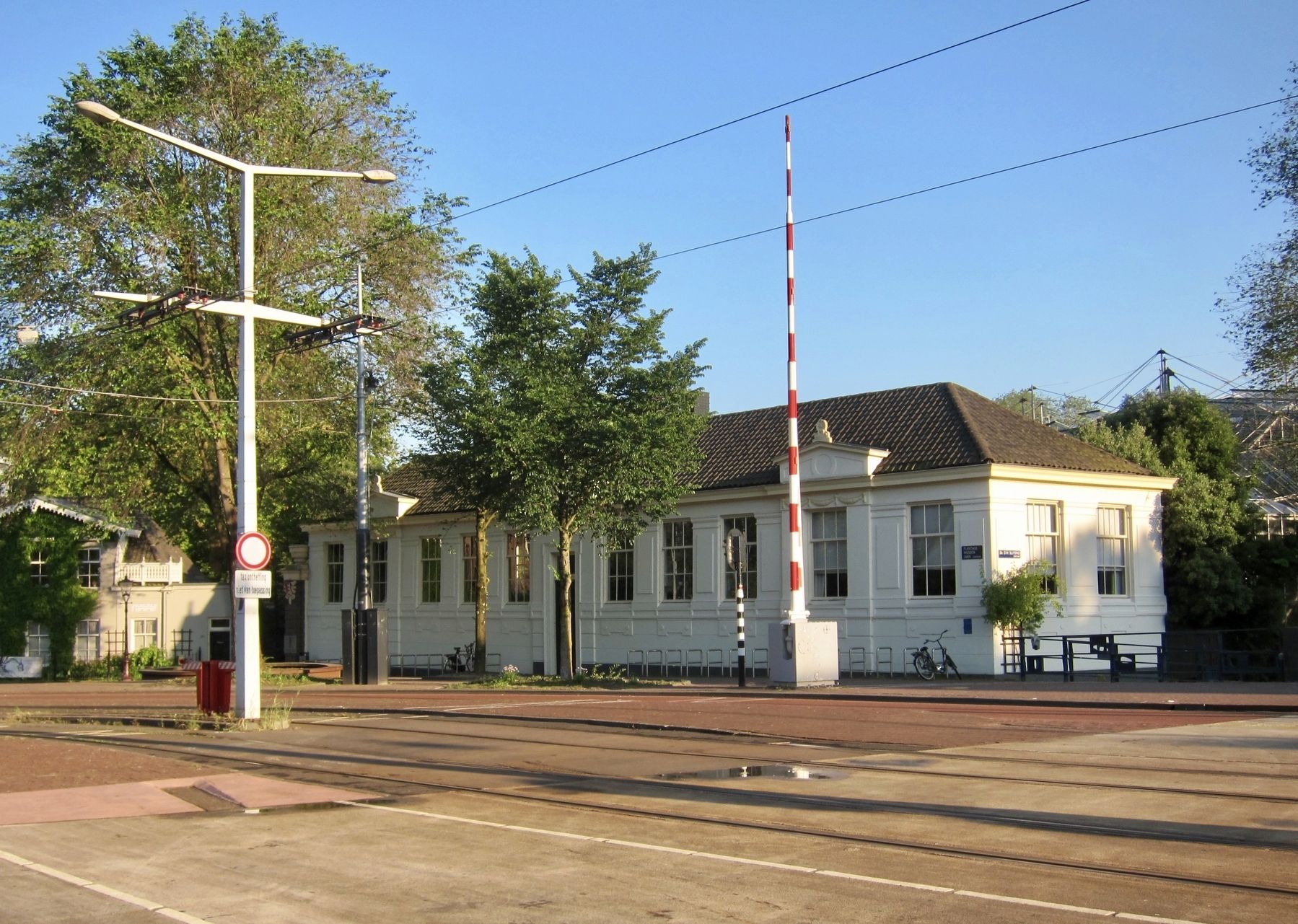
2. De Hortus Marker - Wide View, Looking South from Plantage Middenlaan
The marker is visible on the right corner of the building.
"Hortus Botanicus's initial collection was amassed during the 17th century through plants and seeds brought back by traders of the East India Company (VOC) for use as medicines and for their possibilities for commerce. A single coffee plant, Coffea arabica, in Hortus's collection served as the parent for the entire coffee culture in Central and South America....Likewise, two small potted oil palms brought back by the VOC from Mauritius, an island in the Indian Ocean, produced seeds after six years, and these were propagated throughout all of Southeast Asia, becoming a major source of revenue in the Dutch East Indies and now in Indonesia." - Wikipedia
"Hortus Botanicus's initial collection was amassed during the 17th century through plants and seeds brought back by traders of the East India Company (VOC) for use as medicines and for their possibilities for commerce. A single coffee plant, Coffea arabica, in Hortus's collection served as the parent for the entire coffee culture in Central and South America....Likewise, two small potted oil palms brought back by the VOC from Mauritius, an island in the Indian Ocean, produced seeds after six years, and these were propagated throughout all of Southeast Asia, becoming a major source of revenue in the Dutch East Indies and now in Indonesia." - Wikipedia
Also see . . .
1. Hortus Botanicus (Amsterdam). "Hortus Botanicus is a botanical garden in the Plantage district of Amsterdam, the Netherlands. One of the oldest in the world, it is one of Amsterdam's major tourist attractions." (Submitted on July 10, 2017.)
2. Heritage (de Hortus). "For the last 375 years, the Hortus has been a place for education and research. This means that we dealt – and still deal - with questions concerning the world of plants. Not as an isolated field, but within its own era and scientific, social, and spatial context....Through the ages, the science of botany has studied the immense variety in the realm of plants, from a worldwide scale down to the level of cells and genes. The history of the Hortus is therefore, first and foremost, a history of science...." (Submitted on July 10, 2017.)
Credits. This page was last revised on February 3, 2023. It was originally submitted on July 10, 2017, by Andrew Ruppenstein of Lamorinda, California. This page has been viewed 377 times since then and 23 times this year. Photos: 1, 2. submitted on July 10, 2017, by Andrew Ruppenstein of Lamorinda, California.
