
Central Harlem in Manhattan in New York County, New York — The American Northeast (Mid-Atlantic)
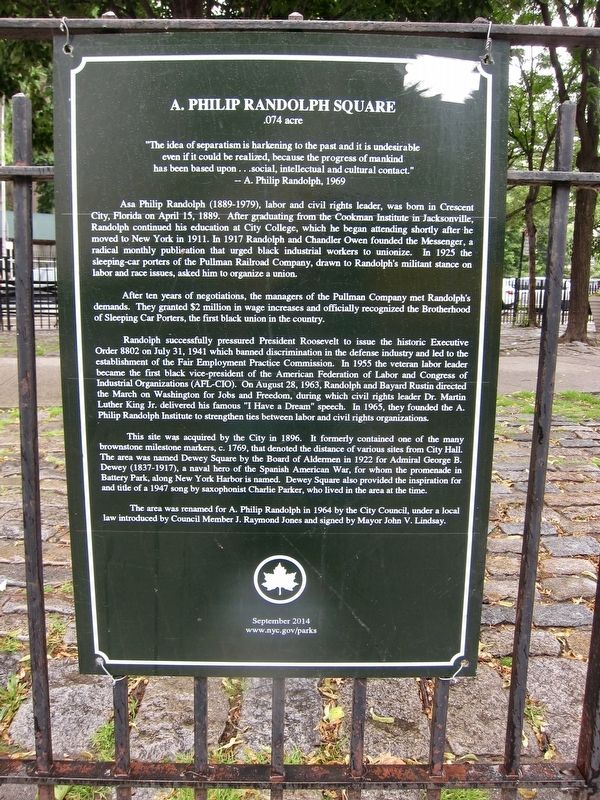
A. Philip Randolph Square
.074 Acre
Photographed by Andrew Ruppenstein, May 30, 2017
1. A. Philip Randolph Square Marker
"The idea of separatism is harkening to the past and it is undesirable even if it could be realized, because the progress of mankind has been based upon … social, intellectual and cultural contact." —A. Philip Randolph, 1969
Asa Philip Randolph (1889-1979), labor and civil rights leader, was born in Crescent City, Florida on April 15,1889. After graduating from the Cookman Institute in Jacksonville, Randolph continued his education at City College, which he began attending shortly after he moved to New York in 1911. In 1917 Randolph and Chandler Owen founded the Messenger, a radical monthly publication that urged black industrial workers to unionize. In 1925 the sleeping-car porters of the Pullman Railroad Company, drawn to Randolph's militant stance on labor and race issues, asked him to organize a union.
After ten years of negotiations, the managers of the Pullman Company met Randolph's demands. They granted $2 million in wage increases and officially recognized the Brotherhood of Sleeping Car Porters, the first black union in the country.
Randolph successfully pressured President Roosevelt to issue the historic
this page online
This site was acquired by the City in 1896. It formerly contained one of the many brownstone milestone markers, c. 1769, that denoted the distance of various sites from City Hall. The area was named Dewey Square by the Board of Aldermen in 1922 for Admiral George B. Dewey (1837-1917), a naval hero of the Spanish American War, for whom the promenade in Battery Park along New York Harbor is named. Dewey Square also provided the inspiration for and title of a 1947 song by saxophonist Charlie Parker,

Photographed by Ernest Hamlin Baker, circa 1945
2. A. Philip Randolph
This c. 1945 portrait of A. Philip Randolph by Ernest Hamlin Baker hangs in the National Portrait Gallery in Washington, DC.
“Civil rights activist A. Philip Randolph waged a lifelong battle for the economic empowerment of African Americans. In 1925, he accepted the challenge of organizing the Brotherhood of Sleeping Car Porters -- the first black labor union chartered by the American Federation of Labor. Continuing his advocacy for African American workers, Randolph called for a march on Washington in 1941 to protest the exclusion of blacks from defense industry jobs. He canceled that march only after President Franklin D. Roosevelt (1882-1945) signed an order mandating an end to discriminatory practices by government contractors.
Following World War II, Randolph led the effort to desegregate the nation’s armed forces and waged a civil disobedience campaign against the draft until President Harry Truman (1884-1972) ordered an end to segregation in the military in 1948. Randolph crowned his career in 1963 by helping to organize the celebrated March on Washington for Jobs and Freedom.” – National Portrait Gallery
“Civil rights activist A. Philip Randolph waged a lifelong battle for the economic empowerment of African Americans. In 1925, he accepted the challenge of organizing the Brotherhood of Sleeping Car Porters -- the first black labor union chartered by the American Federation of Labor. Continuing his advocacy for African American workers, Randolph called for a march on Washington in 1941 to protest the exclusion of blacks from defense industry jobs. He canceled that march only after President Franklin D. Roosevelt (1882-1945) signed an order mandating an end to discriminatory practices by government contractors.
Following World War II, Randolph led the effort to desegregate the nation’s armed forces and waged a civil disobedience campaign against the draft until President Harry Truman (1884-1972) ordered an end to segregation in the military in 1948. Randolph crowned his career in 1963 by helping to organize the celebrated March on Washington for Jobs and Freedom.” – National Portrait Gallery
The area was renamed for A. Philip Randolph in 1964 by the City Council, under a local law introduced by Council Member J. Raymond Jones and signed by Mayor John V. Lindsay.
Erected by New York City Parks & Recreation.
Topics and series. This historical marker is listed in these topic lists: African Americans • Civil Rights • Labor Unions. In addition, it is included in the NYC Parks series list. A significant historical year for this entry is 1969.
Location. Marker has been permanently removed. It was located near 40° 48.224′ N, 73° 57.144′ W. Marker was in Manhattan, New York, in New York County. It was in Central Harlem. It was at the intersection of Adam Clayton Powell Jr. Boulevard and West 116th Street, on the right when traveling south on Adam Clayton Powell Jr. Boulevard. Touch for map. Marker was in this post office area: New York NY 10026, United States of America.
We have been informed that this marker is no longer there and will not be replaced. This page is an archival view of what was.
Regionally, this marker was in New York City. It was also in the American Northeast,

Photographed by Andrew Ruppenstein, May 30, 2017
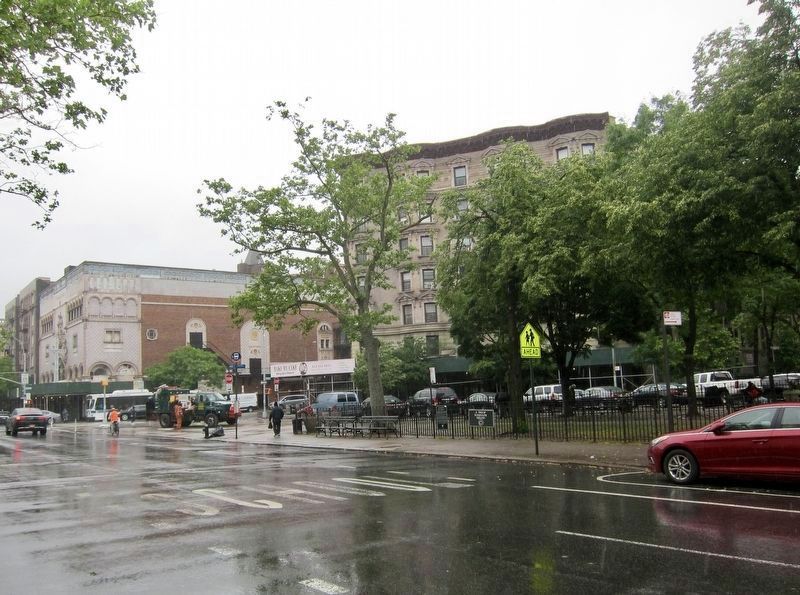
3. A. Philip Randolph Square Marker
The marker is visible here, mounted to the fence, with part of the square visible in the background.
Other nearby markers. At least 8 other markers are within walking distance of this location: Graham Court Apartments (within shouting distance of this marker); Harlem Landmark Trail (within shouting distance of this marker); GreenThumb (about 300 feet away, measured in a direct line); Minton's Playhouse (about 400 feet away); Houdini (approx. ¼ mile away); Lenox Lounge (approx. ¼ mile away); Martin Luther King Jr. Playground (approx. ¼ mile away); Joseph Daniel Wilson Memorial Garden (approx. ¼ mile away). Touch for a list and map of all markers in Manhattan.
Also see . . .
1. A. Philip Randolph Square (Biography.com). A. Philip Randolph was a trailblazing leader, organizer and social activist who championed equitable labor rights for African-American communities during the 20th century. (Submitted on July 10, 2017.)
2. A. Philip Randolph Square. Official NYC Parks description (Submitted on January 15, 2021, by Larry Gertner of New York, New York.)
Credits. This page was last revised on September 5, 2025. It was originally submitted on July 10, 2017, by Andrew Ruppenstein of Lamorinda, California. This page has been viewed 764 times since then and 30 times this year. Photos: 1. submitted on July 10, 2017, by Andrew Ruppenstein of Lamorinda, California. 2. submitted on March 3, 2019, by Allen C. Browne of Silver Spring, Maryland. 3. submitted on July 10, 2017, by Andrew Ruppenstein of Lamorinda, California.
