Colonia Tlatelolco in Ciudad de México, Mexico — The Valley of Mexico (The Central Highlands)
Friar Bernardino Sahagún
Photographed by J. Makali Bruton, August 7, 2017
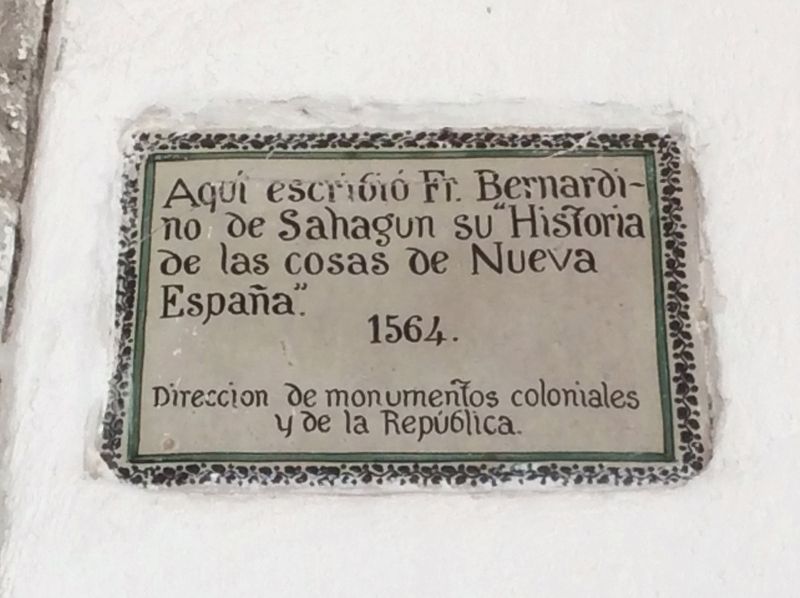
1. Friar Bernardino Sahagún Marker

de Sahagun su “Historia
de las cosas de Nueva
España.”
1564.
Direccion de monumentos coloniales y de la República.
wrote his “General History of the Things of New Spain.”
1564.
Office of Monuments of the Colony and the Republic.
Erected by Dirección de Monumentos Coloniales y de la República.
Topics. This historical marker is listed in these topic lists: Charity & Public Work • Colonial Era • Indigenous Peoples and Communities • Religion & Religious Structures. A significant historical year for this entry is 1564.
Location. 19° 27.036′ N, 99° 8.2′ W. Marker is in Ciudad de México. It is in Colonia Tlatelolco. It can be reached from Eje Central Lázaro Cárdenas just north of Avenida Ricardo Flores Magón. The marker is to the left of the southern archway that leads to the second level of the Old Convent of Santiago of Tlatelolco, just south of the Church of Santiago. Touch for map. Marker is in this post office area: Ciudad de México 06900, Mexico. Touch for directions.

Regionally, this marker is in Central
this page online
Other nearby markers. At least 8 other markers are within walking distance of this marker: Architectonic puzzle: The façade of Tecpan (within shouting distance of this marker); From peaceful convent to bellicose military barracks (within shouting distance of this marker); Santiago Church (within shouting distance of this marker); Church of Santiago (within shouting distance of this marker); Full color Tlatelolco: The temple of the paintings (within shouting distance of this marker); The Small Area of Tlatelolco (about 90 meters away, measured in a direct line); Coyolxauhqui: The dismembered goddess (about 90 meters away); The Palace (about 90 meters away). Touch for a list and map of all markers in Ciudad de México.
Also see . . . General History of the Things of New Spain by Fray Bernardino de Sahagún: The Florentine Codex. "Historia general de las cosas de nueva España (General history of the things of New Spain) is an encyclopedic work about the people and culture of central Mexico compiled by Fray Bernardino de Sahagún (1499–1590), a Franciscan missionary who arrived in Mexico in 1529, eight years after completion of the Spanish conquest by Hernan Cortés. Commonly called the Florentine Codex, the manuscript came into the possession of the Medici no later than 1588 and is now in the Medicea Laurenziana Library in Florence. Sahagún began conducting research into indigenous cultures in the 1540s, using a methodology that scholars consider to be a precursor to modern anthropological field technique. His motives were primarily religious: he believed that to convert the natives to Christianity and eradicate their devotion to false gods, it was necessary to understand those gods and the hold they had on the Aztec people. Sahagún was repelled by much of native culture, but he also came to admire many qualities of the Aztecs. As he wrote in the prologue to Book I of his work, the Mexicans “are held to be barbarians and of very little worth; in truth, however, in matters of culture and refinement, they are a step ahead of other nations that presume to be quite politic.” Sahagún gained the assistance of two important indigenous groups: the elders of a number of towns in central Mexico (principales) and Nahua students and former students at the College of Santa Cruz in Tlatelolco, where Sahagún worked for much of his time in Mexico. The principales answered questionnaires prepared by Sahagún about their culture and religion, and their responses were recorded in their own pictorial form of writing. The Nahua students interpreted the images and expanded the answers, phonetically transcribing Nahuatl using Latin letters. Sahagún then reviewed the Nahuatl text and added his own Spanish translation. The whole process took almost 30 years and finally was completed in 1575–77, when Sahagún had a new and complete copy of the manuscript prepared. It then was taken to Spain by Fray Rodrigo de Sequera, commissary general of the Franciscans and a supporter of Sahagún’s work. The 12 books of the codex originally were bound in four volumes but later rebound into three. The work is arranged in two columns: on the right is the original Nahuatl text, on the left is Sahagún’s Spanish translation. The 2,468 magnificent illustrations, made by the students, are mostly in the left-hand column, where the text is shorter. The illustrations combine the syntactic and symbolic traits of the ancient Nahua tradition of painting-writing with the formal qualities of European Renaissance painting."
Photographed by J. Makali Bruton, August 7, 2017
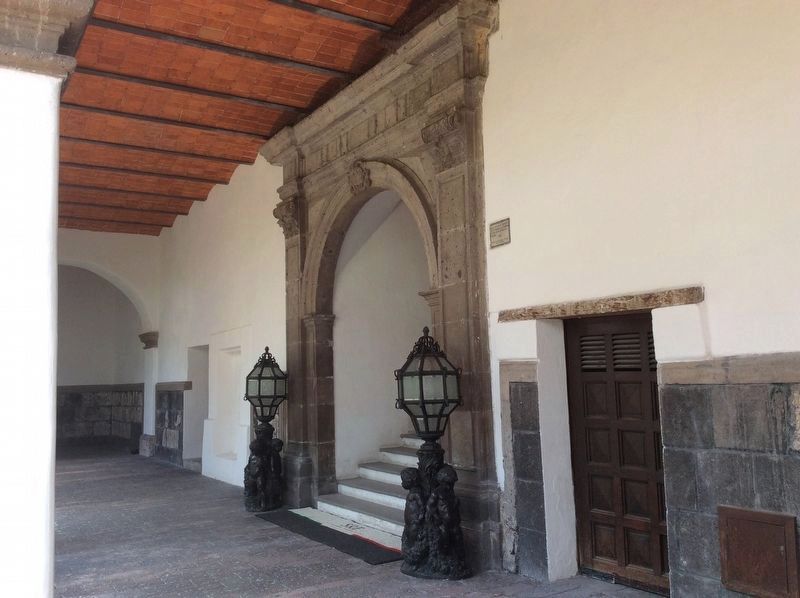
2. Friar Bernardino Sahagún Marker
The marker can be seen in this view to the right of the southern archway leading to the second floor of the Old Convent of Santiago at Tlatelolco.
Photographed by J. Makali Bruton, August 7, 2017
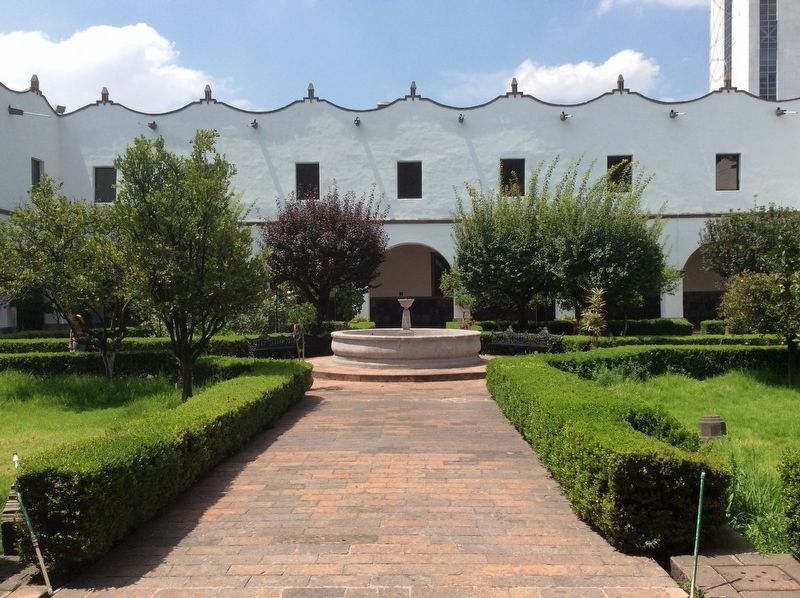
3. A view of the courtyard of the Old Convent of Santiago at Tlatelolco
The marker is towards the left in this view, under the arches in the background.
Photographed by J. Makali Bruton, August 7, 2017
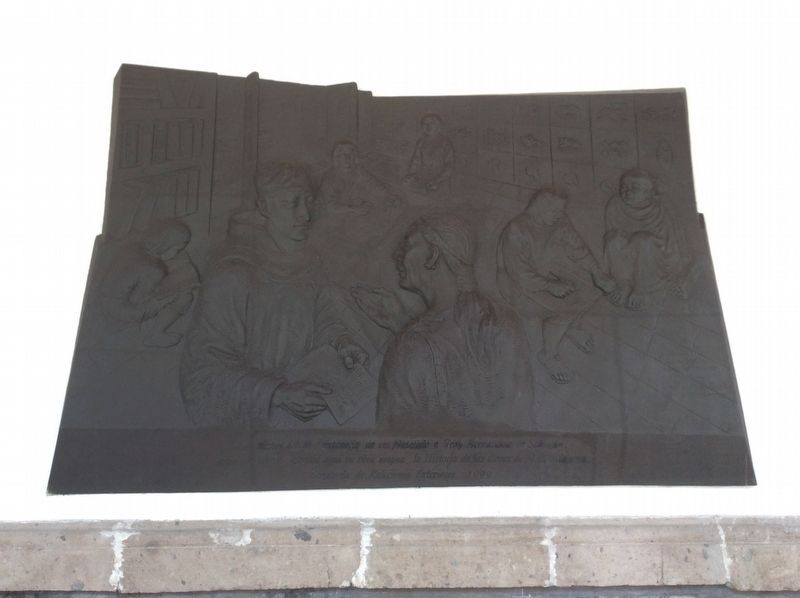
4. A nearby bronze dedicated to Friar Bernardino Sahagún
The artwork from 1999 was dedicated to the 500th anniversary of the birth of Sahagún in 1499. The bronze was a gift from the Ministry of Foreign Relations of Mexico (la Secretaría de Relaciones Exteriores). The artwork is interesting as it includes both European books (top left) and Aztec glyphs (top right) together with the image of Sahagún delivering a page of writing to an Aztec.
Credits. This page was last revised on April 17, 2020. It was originally submitted on August 9, 2017, by J. Makali Bruton of Washington, District of Columbia. This page has been viewed 536 times since then and 62 times this year. Photos: 1, 2, 3, 4. submitted on August 9, 2017, by J. Makali Bruton of Washington, District of Columbia.
