Fort Pierce in St. Lucie County, Florida — The American South (South Atlantic)
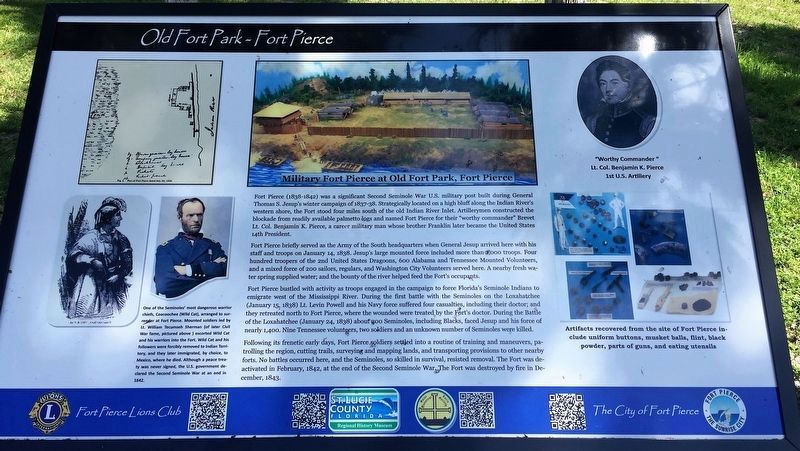
Military Fort Pierce at Old Fort Park, Fort Pierce
Old Fort Park - Fort Pierce
Photographed by Jay Kravetz, August 17, 2017
1. Military Fort Pierce at Old Fort Park, Fort Pierce Marker
Fort Pierce (1838-1842) was a significant Second Seminole War U.S. military post built during General Thomas S. Jesup’s winter campaign of 1837-38. Strategically located on a high bluff along the Indian River’s western shore, the Fort stood four miles south of the old Indian River Inlet. Artillerymen constructed the blockade from readily available palmetto logs and named Fort Pierce for their "worthy commander" Brevet Lt. Col. Benjamin K. Pierce, a career military man whose brother Franklin later became the United States 14th President.
Fort Pierce briefly served as the Army of the South headquarters when General Jesup arrived here with his staff and troops on January 14, 1838. Jesup's large mounted force included more than 1,000 troops. Four hundred troopers of the 2nd United States Dragoons, 600 Alabama and Tennessee Mounted Volunteers, and a mixed force of 200 sailors, regulars, and Washington City Volunteers served here. A nearby fresh water spring supplied water; and the bounty of the river helped feed the Fort's occupants.
Fort Pierce bustled with activity as troops engaged in the campaign to force Florida's
this page online
Following its frenetic early days, Fort Pierce soldiers settled into a routine of training and maneuvers, patrolling the region, cutting trails, surveying and mapping lands, and transporting provisions to other nearby forts. No battles occurred here, and the Seminoles, so skilled in survival, resisted removal. The Fort was deactivated in February, 1842, at the end of the Second Seminole War. The Fort was destroyed by fire in December, 1843.
Captions:
Military Fort Pierce at Old Fort Park, Fort Pierce
One of the Seminoles' most dangerous warrior chiefs, Coacoochee (Wild Cat), arranged to
Photographed by Jay Kravetz, August 17, 2017
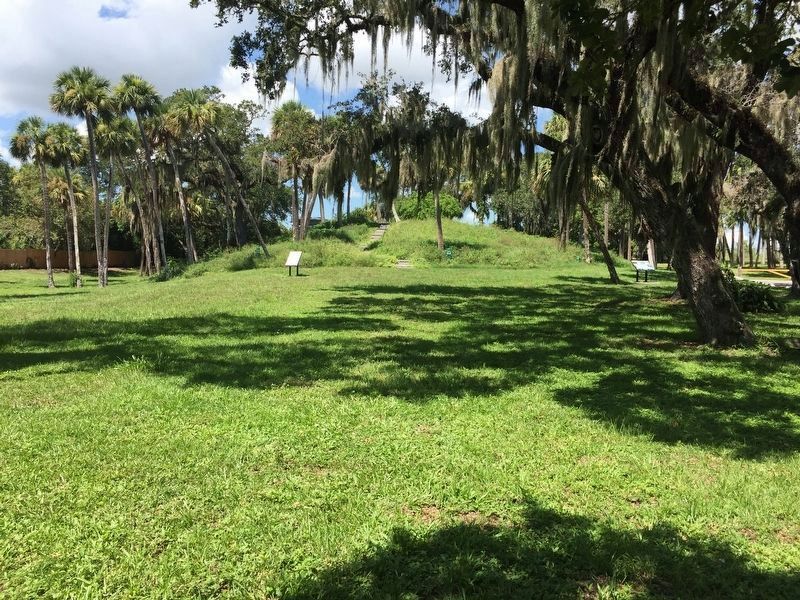
2. Military Fort Pierce at Old Fort Park, Fort Pierce Marker, towards the right
"Worthy Commander" Lt. Col. Benjamin K. Pierce 1st U.S. Artillery
Artifacts recovered from the site of Fort Pierce include uniform buttons, musket balls, flint, black powder, parts of guns, and eating utensils.
Erected 2016 by Fort Pierce Lions Club, Saint Lucie Regional History Museum, Saint Lucie Historical Society, City of Fort Pierce.
Topics. This historical marker is listed in these topic lists: Forts and Castles • Indigenous Peoples and Communities • Wars, US Indian. A significant historical year for this entry is 1838.
Location. 27° 26.236′ N, 80° 19.221′ W. Marker is in Fort Pierce, Florida, in St. Lucie County. It can be reached from South Indian River Drive (County Road 707) 0.3 miles south of Florida Avenue, on the right when traveling south. Marker is in Old Fort Park. Touch for map. Marker is at or near this postal address: 901 South Indian River Drive, Fort Pierce FL 34950, United States of America. Touch for directions.

Regionally, this marker is on Florida’s Treasure Coast. It is also in the American South and on the Eastern Seaboard. Globally, it is in the North Atlantic Region, North America, a Gulf of Mexico state, the Western Hemisphere, the Western World, and the Anglosphere. Historically, it finds itself in what was once New Spain, the territory of the Mississippian Culture, one of the Confederate States of America, and the Antebellum South.
Other nearby markers. At least 8 other markers are within 2 miles of this marker, measured as the crow flies: Traces of an Early Indian Village (within shouting distance of this marker); Old Fort Park (within shouting distance of this marker); Fort Pierce (within shouting distance of this marker); A.E. “Beanie” Backus Studio (approx. one mile away); A.E. “Bean” Backus (approx. one mile away); St. Lucie County Veterans Memorial (approx. 1.2 miles away); The United States Submarine Service Memorial (approx. 1.2 miles away); a different marker also named St. Lucie County Veterans Memorial (approx. 1.2 miles away). Touch for a list and map of all markers in Fort Pierce.
Another marker is no longer nearby. St. Lucie County (was approx. 0.6 miles away but has been confirmed missing).
Credits. This page was last revised on August 3, 2019. It was originally submitted on August 17, 2017, by Jay Kravetz of West Palm Beach, Florida. This page has been viewed 1,913 times since then and 177 times this year. Photos: 1, 2. submitted on August 17, 2017, by Jay Kravetz of West Palm Beach, Florida. • Bernard Fisher was the editor who published this page.
