
Chattahoochee in Gadsden County, Florida — The American South (South Atlantic)
Chattahoochee Landing Mound Group
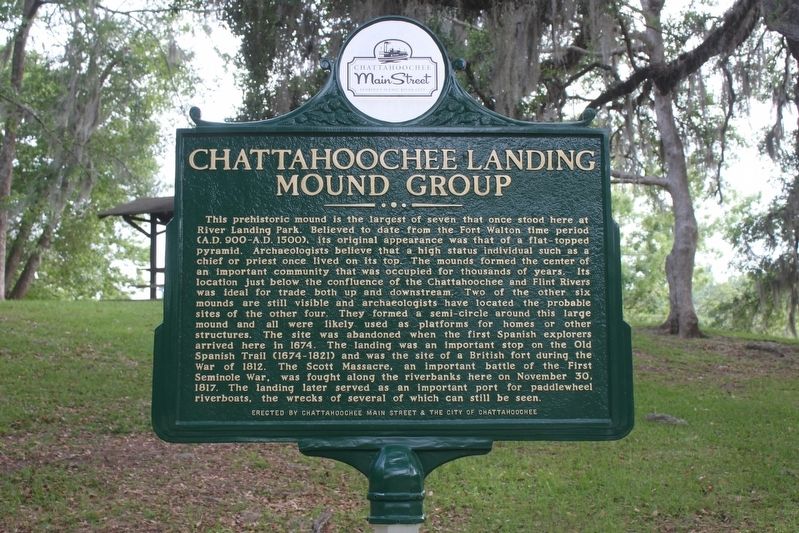
Photographed by Tim Fillmon, May 11, 2017
1. Chattahoochee Landing Mound Group Marker
this page online
Erected by Chattahoochee Main Street & The City of Chattahoochee.
Topics and series. This historical marker is listed in these topic lists: Anthropology & Archaeology • Indigenous Peoples and Communities • War of 1812 • Wars, US Indian. In addition, it is included in the Old Spanish National Trail series list.
Location. 30° 42.043′ N, 84° 51.404′ W. Marker is in Chattahoochee, Florida, in Gadsden County. It is on South River Landing Road half a mile south of West Washington Street (U.S. 90), on the right when traveling south. Touch for map. Marker is at or near this postal address: 400 South River Landing Road, Chattahoochee FL 32324, United States of America. Touch for directions.

Regionally, this marker is in Greater Tallahassee and on the Florida Panhandle. It is also in the American South and specifically in the Deep South. Globally, it is in the North Atlantic Region, North America, a Gulf of Mexico state, the Western Hemisphere, the Western World, and
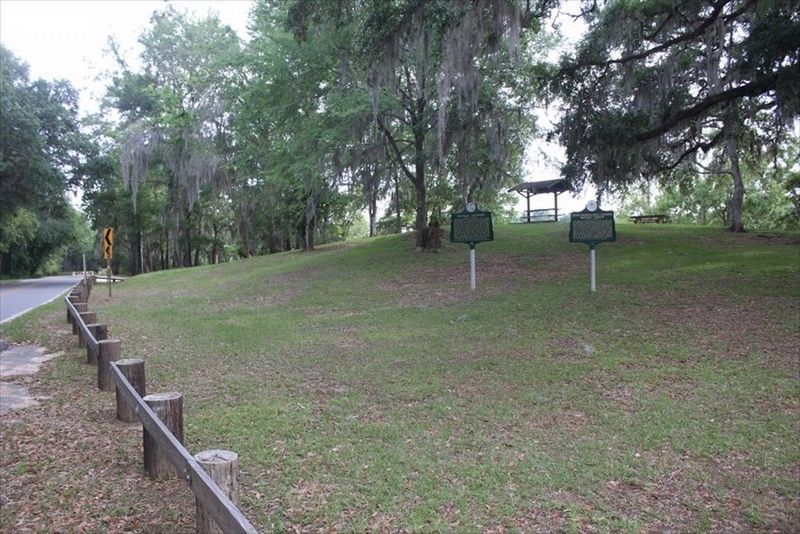
Photographed by Tim Fillmon, May 11, 2017
2. Chattahoochee Landing Mound Group Marker with Nicolls' Outpost marker and mound
Other nearby markers. At least 8 other markers are within walking distance of this marker: Nicolls' Outpost (here, next to this marker); The Scott Battle of 1817 (a few steps from this marker); a different marker also named Nicoll's Outpost (a few steps from this marker); The Scott Massacre (a few steps from this marker); a different marker also named The Chattahoochee Landing Mound Group (a few steps from this marker); The Apalachicola River - A Florida Blueway (within shouting distance of this marker); The First Seminole War (within shouting distance of this marker); Victory Bridge (within shouting distance of this marker). Touch for a list and map of all markers in Chattahoochee.
Another marker is no longer nearby. Florida's Inland Graveyard of Ships (was within shouting distance of this marker but has been confirmed missing).
Credits. This page was last revised on March 28, 2021. It was originally submitted on December 1, 2017, by Tim Fillmon of Webster, Florida. This page has been viewed 1,326 times since then and 106 times this year. Photos: 1, 2. submitted on December 1, 2017, by Tim Fillmon of Webster, Florida. • Bernard Fisher was the editor who published this page.
