
Centro Histórico in Ciudad de México, Mexico — The Valley of Mexico (The Central Highlands)
Pedestrian Bridge over the Templo Mayor
Photographed by J. Makali Bruton, December 4, 2017
1. Pedestrian Bridge over the Templo Mayor Marker

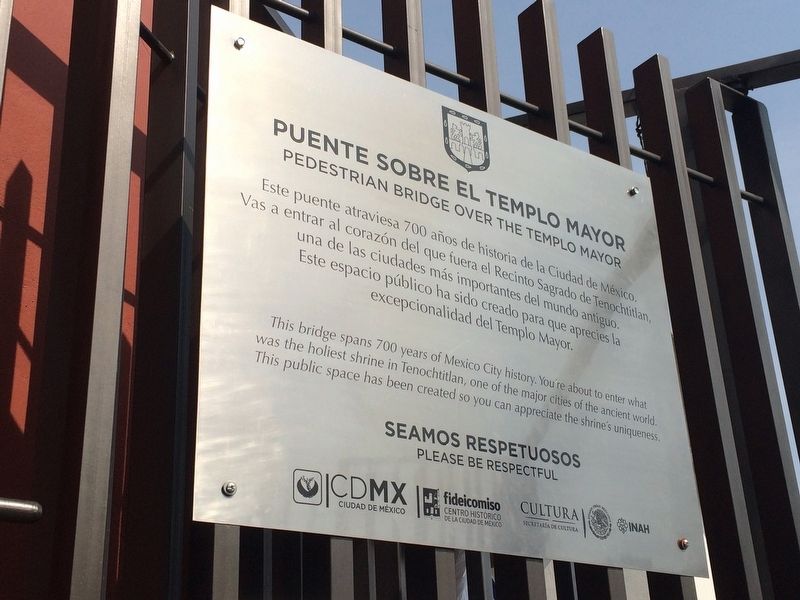
Puente Sobre el Templo Mayor
Este puente atraviesa 700 años de historia de la Ciudad de México. Vas a entrar al corazón del que fuera el Recinto Sagrado de Tenochtitlán, una de las ciudades más importantes del mundo antiguo. Este espacio público ha sido creado para que aprecies la excepcionalidad del Templo Mayor.
Pedestrian Bridge over the Templo Mayor
This bridge spans 700 years of Mexico City history. You're about to enter what was the holiest shrine in Tenochtitlan, one of the major cities of the ancient world. This public space has been created so you can appreciate the shrine's uniqueness.
Seamos respetuosos
Please be respectful
Erected by Instituto Nacional de Arqueología e Historia (INAH).
Topics and series. This historical marker is listed in these topic lists: Anthropology & Archaeology • Architecture • Indigenous Peoples and Communities • Religion & Religious Structures. In addition, it is included in the UNESCO World Heritage Sites series list.
Location. 19° 26.096′ N, 99° 7.925′ W. Marker is in Ciudad de México. It is
this page online

Regionally, this marker is in Central Mexico and specifically in Mexico City Metropolitan Area. Globally, it is in North America, specifically in Mesoamerica, on the Ring of Fire, and in the Western Hemisphere. Historically, it finds itself in what was once New Spain, a Spanish colony, and the Aztec Empire.
Other nearby markers. At least 8 other markers are within walking distance of this marker: The Sacred Tree (a few steps from this marker); The Sacred Precinct of Mexico-Tenochtitlan (a few steps from this marker); The Cuauhxicalco, Place of the Eagle Vessel (a few steps from this marker); What is the Templo Mayor made of? (within shouting distance of this marker); The Templo Mayor and its Seven Construction Stages (within shouting distance of this marker); The City of Tenochtitlan (within shouting distance of this marker); Execution of Alonso de Ávila Alvarado (within shouting distance
Photographed by J. Makali Bruton, December 4, 2017
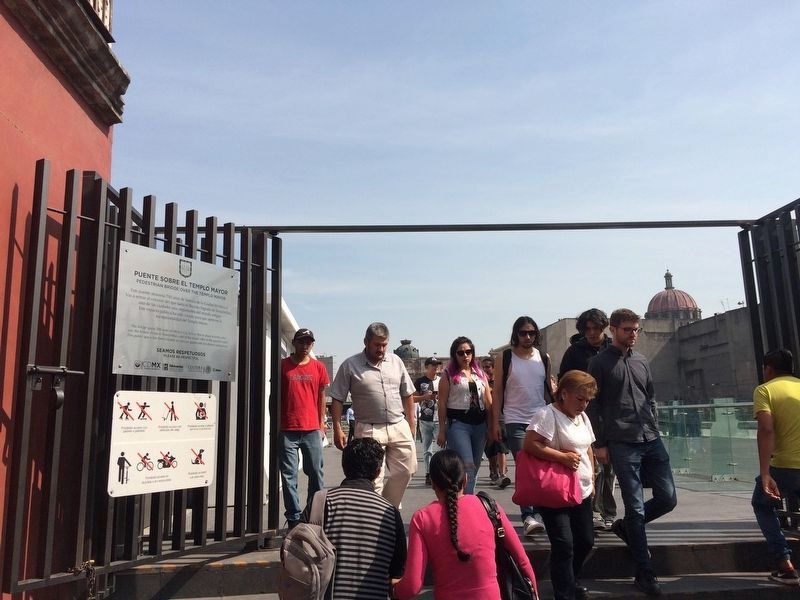
2. Pedestrian Bridge over the Templo Mayor Marker
The pedestrian bridge connects market areas a few blocks to the north to the historic city center.
Also see . . . The Templo Mayor (at Wikipedia). The Templo Mayor (Spanish for "Main Temple") was one of the main temples of the Aztecs in their capital city of Tenochtitlan, which is now Mexico City. Its architectural style belongs to the late Postclassic period of Mesoamerica. The temple was dedicated simultaneously to two gods, Huitzilopochtli, god of war, and Tlaloc, god of rain and agriculture, each of which had a shrine at the top of the pyramid with separate staircases. The spire in the center of the adjacent image was devoted to Quetzalcoatl in his form as the wind god, Ehecatl. The Great Temple devoted to Huitzilopochtli and Tlaloc, measuring approximately 100 by 80 m (328 by 262 ft) at its base, dominated the Sacred Precinct. Construction of the first temple began sometime after 1325, and it was rebuilt six times. The temple was destroyed by the Spanish in 1521 to make way for the new cathedral. Today, the archaeological site lies just to the northeast of the Zócalo,
Photographed by J. Makali Bruton, December 4, 2017
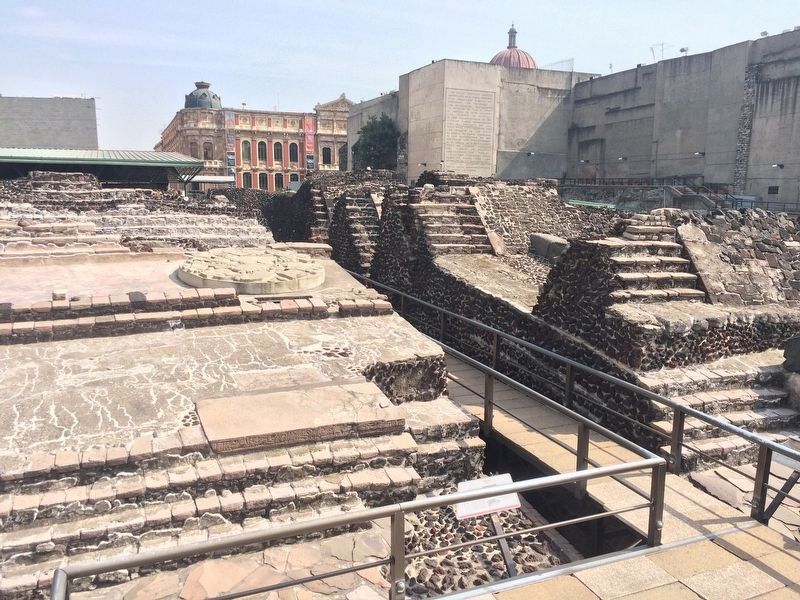
3. A view of the Templo Mayor ruins from the pedestrian bridge
The bridge looks out onto the ruins of the Templo Mayor complex. The temple was destroyed by the Spanish and its stones used to construct other buildings in the historic city center.
Photographed by J. Makali Bruton, December 4, 2017
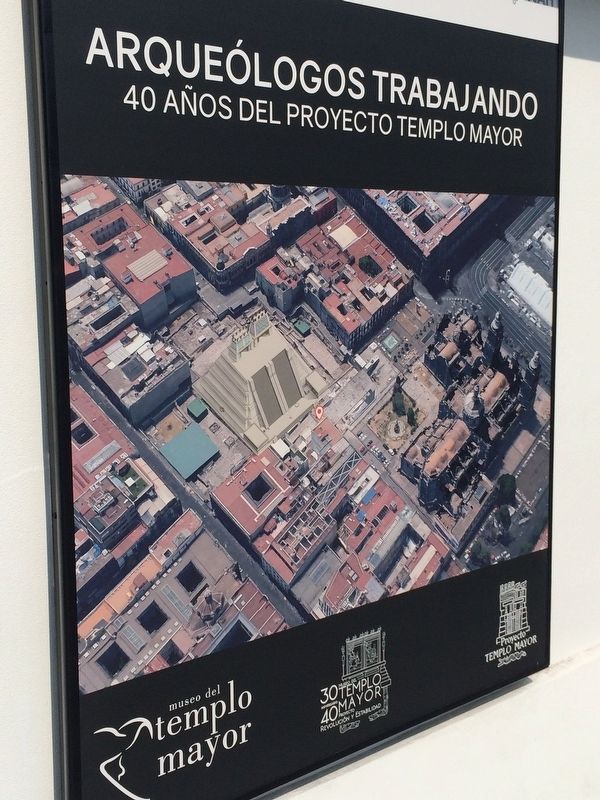
4. Imagining the Templo Mayor in its historical location in Mexico City
A series of posters line the pedestrian bridge, including this image of what the Templo Mayor would look like if it still stood in downtown Mexico City.
Photographed by J. Makali Bruton, December 4, 2017
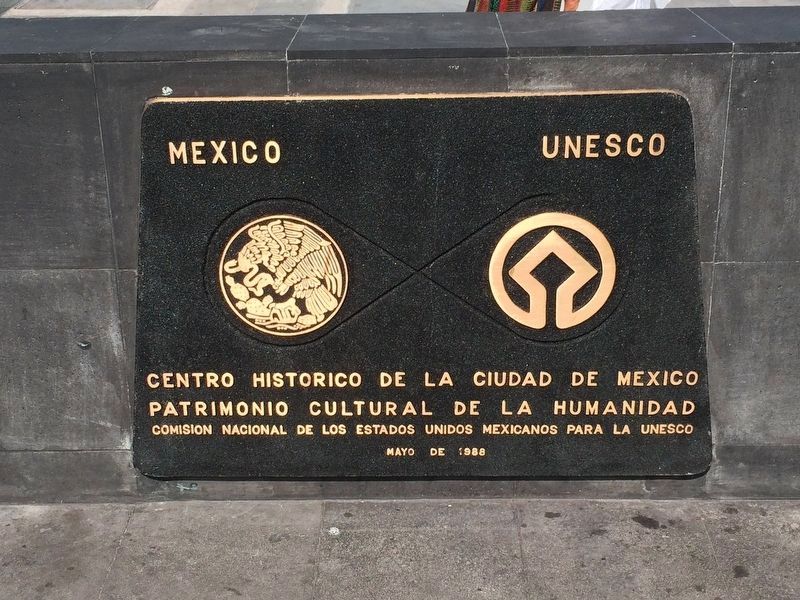
5. A nearby UNESCO World Heritage marker from 1988
This marker near the entrance to the nearby Templo Mayor Museum notes that the Historic Center of Mexico City was named a World Heritage Site by UNESCO in 1988.
Credits. This page was last revised on March 4, 2025. It was originally submitted on December 11, 2017, by J. Makali Bruton of Washington, District of Columbia. This page has been viewed 495 times since then and 36 times this year. Photos: 1, 2, 3, 4, 5. submitted on December 11, 2017, by J. Makali Bruton of Washington, District of Columbia.
