Anderson in Grimes County, Texas — The American South (West South Central)
Rocky Creek Bridge
Photographed by Cosmos Mariner, June 4, 2013
1. Rocky Creek Bridge Marker
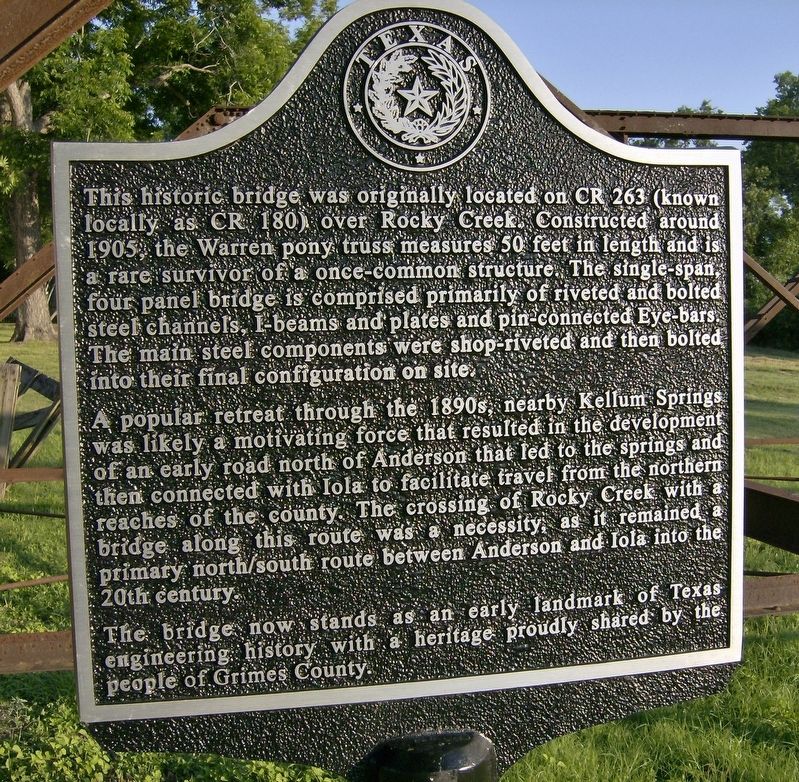
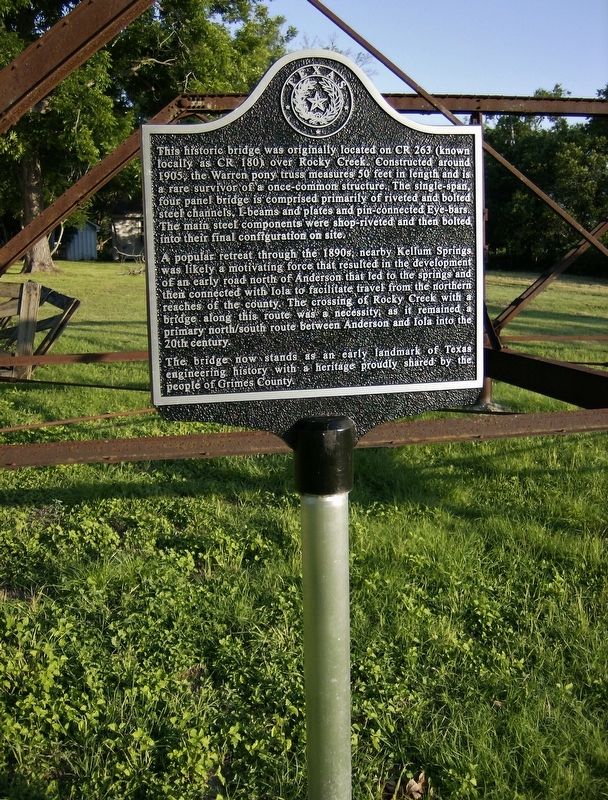
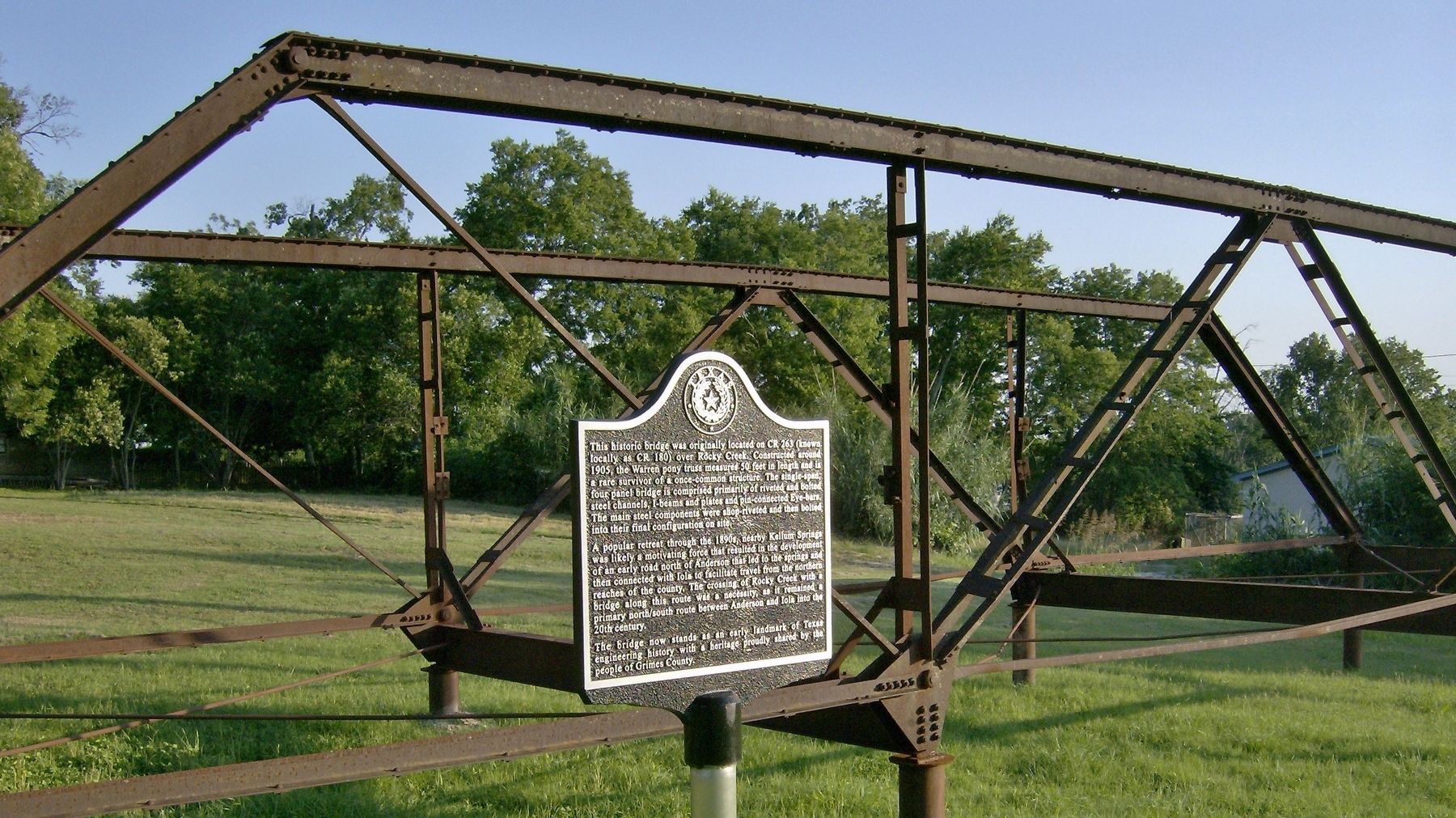
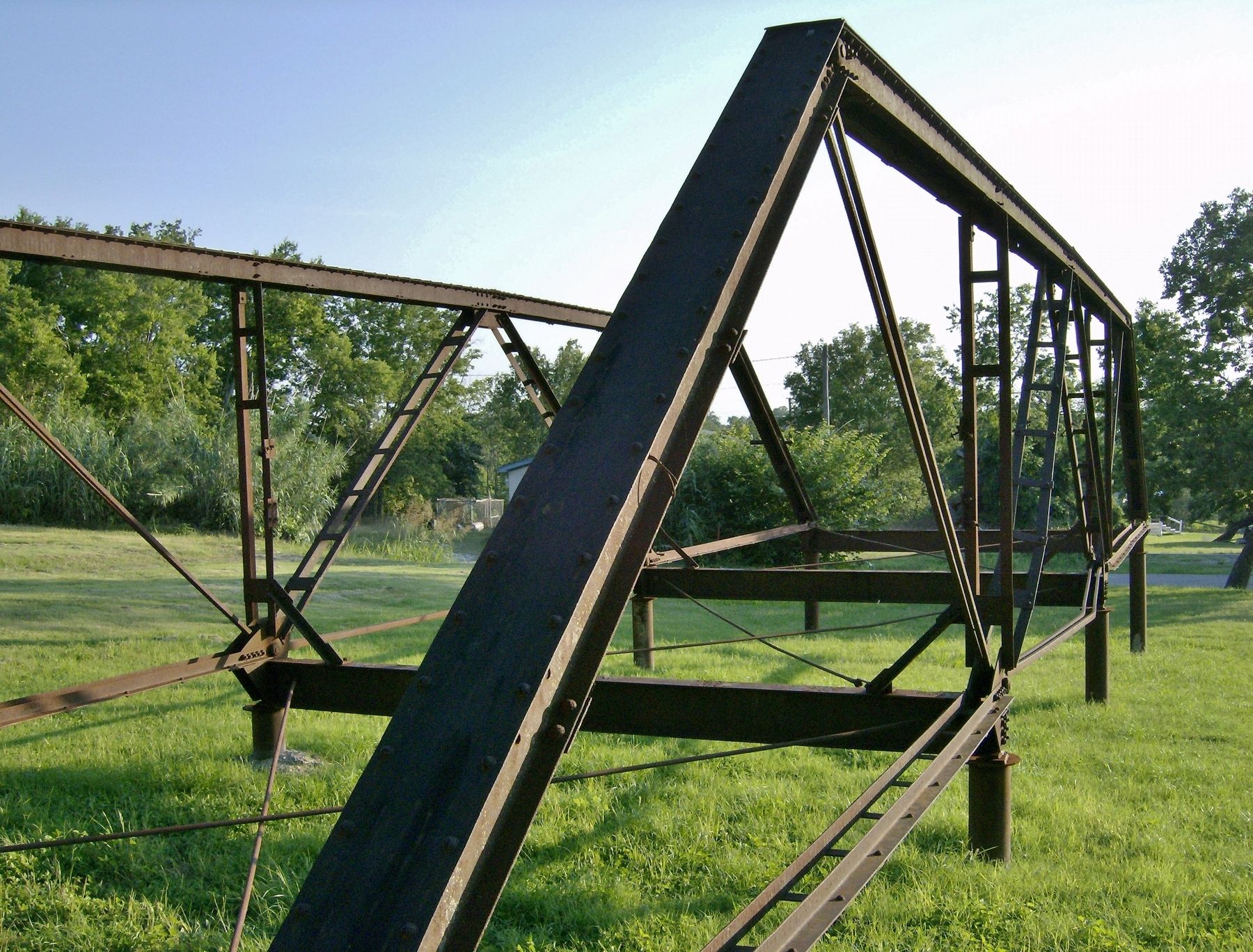
A popular retreat through the 1890s, nearby Kellum Springs was likely a motivating force that resulted in the development of an early road north of Anderson that led to the springs and then connected with Iola to facilitate travel from the northern reaches of the county. The crossing of Rocky Creek with a bridge along this route was a necessity, as it remained a primary north/south route between Anderson and Iola into the 20th century.
The bridge now stands as an early landmark of Texas engineering history with a heritage proudly shared by the people of Grimes County.
Erected by Grimes County.
Topics. This historical marker is listed in these topic
this page online
Location. 30° 29.209′ N, 95° 59.187′ W. Marker is in Anderson, Texas, in Grimes County. It is on South Main Street (County Highway 245) south of West Apalonia Avenue, on the right when traveling south. Marker is located in a vacant lot behind the First United Methodist Church. Touch for map. Marker is at or near this postal address: 283 South Main Street, Anderson TX 77830, United States of America. Touch for directions.

Regionally, this marker is in the Prairies & Lakes Region. It is also in the American South. Globally, it is in North America, a Gulf of Mexico state, the Western Hemisphere, the Western World, and the Anglosphere. Historically, it finds itself in what was once New Spain, the Republic of Texas, one of the Confederate States of America, and the Antebellum South.
Other nearby markers. At least 8 other markers are within walking distance of this marker: Steinhagen Log Cabin (about 300 feet away, measured in a direct line); La Bahia Road (about 600 feet away); Grimes County Courthouse (about
Photographed by Cosmos Mariner, June 4, 2013
2. Rocky Creek Bridge Marker (tall view)
Another marker is no longer nearby. Anderson Baptist Church (was about 800 feet away but has been confirmed missing).
Also see . . .
1. Bridge Basics. (includes diagrams and pictures of various bridge configurations) in a Pony configuration, traffic travels between parallel superstructures which are not cross-braced at the top; (Submitted on December 26, 2017, by Cosmos Mariner of Cape Canaveral, Florida.)
2. Warren Truss. The Warren truss was patented in 1848 by James Warren and Willoughby Theobald Monzani, and consists of longitudinal members joined only by angled cross-members, forming alternately inverted equilateral triangle-shaped spaces along its length, ensuring that no individual strut, beam, or tie is subject to bending or torsional straining forces, but only to tension or compression. Loads on
Photographed by Cosmos Mariner, June 4, 2013
3. Rocky Creek Bridge Marker (wide view)
Photographed by Cosmos Mariner, June 4, 2013
4. Rocky Creek Bridge
Credits. This page was last revised on April 30, 2020. It was originally submitted on December 26, 2017, by Cosmos Mariner of Cape Canaveral, Florida. This page has been viewed 1,536 times since then and 111 times this year. Photos: 1, 2, 3, 4. submitted on December 26, 2017, by Cosmos Mariner of Cape Canaveral, Florida. • Bernard Fisher was the editor who published this page.
