Puebla, Mexico — The Central Highlands (North America)
The House of the Little Heads
Photographed by J. Makali Bruton, December 1, 2017
1. The House of the Little Heads Marker
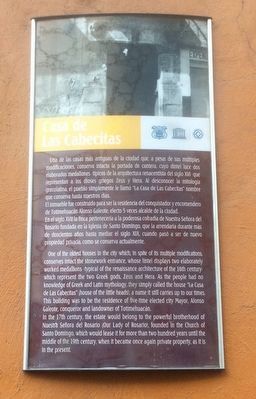
Casa de Las Cabecitas
Una de las casas más antiguas de la ciudad que, a pesar de sus múltiples modificaciones, conserva intacta la portada de cantera, cuyo dintel luce dos elaborados medallones - típicos de la arquitectura renacentista del siglo XVI – que representan a los dioses griegos Zeus y Hera. Al desconocer la mitología grecolatina, el pueblo simplemente le llamó "La Casa de Las Cabecitas" nombre que conserva hasta nuestros días.
El inmueble fue construido para ser la residencia del conquistador y encomendero de Totimehuacán Alonso Galeote, electo 5 veces alcalde de la ciudad.
En el siglo XVII la finca pertenecería a la poderosa cofradía de Nuestra Señora del Rosario fundada en la lglesia de Santo Domingo, que la arrendaría durante más de doscientos años hasta mediar el siglo XIX, cuando pasó a ser de nuevo propiedad privada, como se conserva actualmente.
English:
The House of the Little Heads
One of the oldest houses in the city which, in spite of its multiple modifications, conserves intact the stonework entrance, whose lintel displays two elaborately worked medallions - typical of the renaissance architecture of the 16th century - which represent the two Greek gods, Zeus and Hera. As the people had no knowledge of Greek and Latin mythology, they simply called the house "La Casa de Las Cabecitas" (house of the little heads), a name it still carries up to our times.
This building was to be the residence of five-time elected city Mayor, Alonso Galeote, conqueror and landowner of Totimehuacán.
In the 17th century, the estate would belong to the powerful brotherhood of Nuestra Señora del Rosario (Our Lady of Rosario), founded in the Church of Santo Domingo, which would lease it for more than two hundred years until the middle of the 19th century, when it became once again private property, as it is in
this page online
Topics. This historical marker is listed in these topic lists: Colonial Era • Government & Politics • Notable Buildings • Religion & Religious Structures.
Location. 19° 2.737′ N, 98° 12.162′ W. Marker is in Puebla. It is on Avenida 3 Poniente just west of Calle 5 Sur, on the right. Touch for map. Marker is at or near this postal address: Avenida 3 Poniente 514-516, Puebla 72000, Mexico. Touch for directions.

Regionally, this marker is in Central Mexico. Globally, it is in North America, specifically in Mesoamerica, on the Ring of Fire, and in the Western Hemisphere. Historically, it finds itself in what was once New Spain, a Spanish colony, and the Aztec Empire.
Other nearby markers. At least 8 other markers are within walking distance of this marker: The Saint Augustine Church (about 90 meters away, measured in a direct line); The José Luis Bello y González Museum (about 240 meters away); The Church of Guadalupe (approx. half a kilometer away); The Main Square and Fountain of San Miguel (approx. 0.6 kilometers away); The Municipal Palace (approx.
Photographed by J. Makali Bruton, December 1, 2017
2. The House of the Little Heads Marker
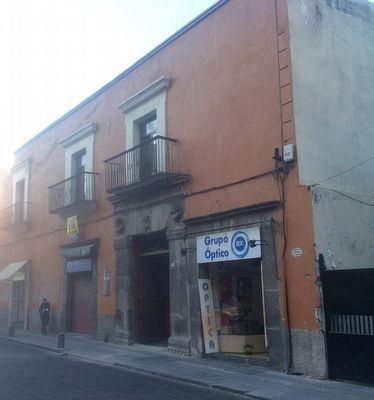
The marker is to the left of the original entrance to the building.
Credits. This page was last revised on October 3, 2022. It was originally submitted on January 16, 2018, by J. Makali Bruton of Washington, District of Columbia. This page has been viewed 186 times since then and 12 times this year. Photos: 1, 2. submitted on January 16, 2018, by J. Makali Bruton of Washington, District of Columbia.
