Astoria in Clatsop County, Oregon — The American West (Northwest)
"Ocian in view, O! the Joy..."
Photographed by Cosmos Mariner, July 9, 2015
1. "Ocian in view, O! the Joy..." Marker
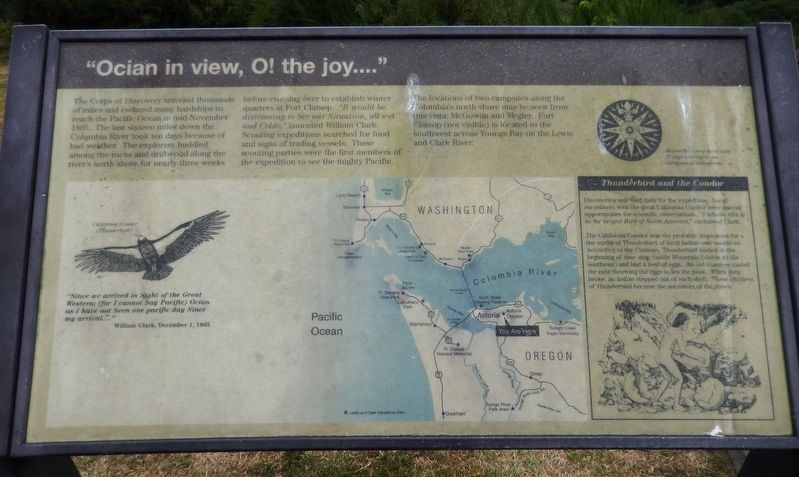
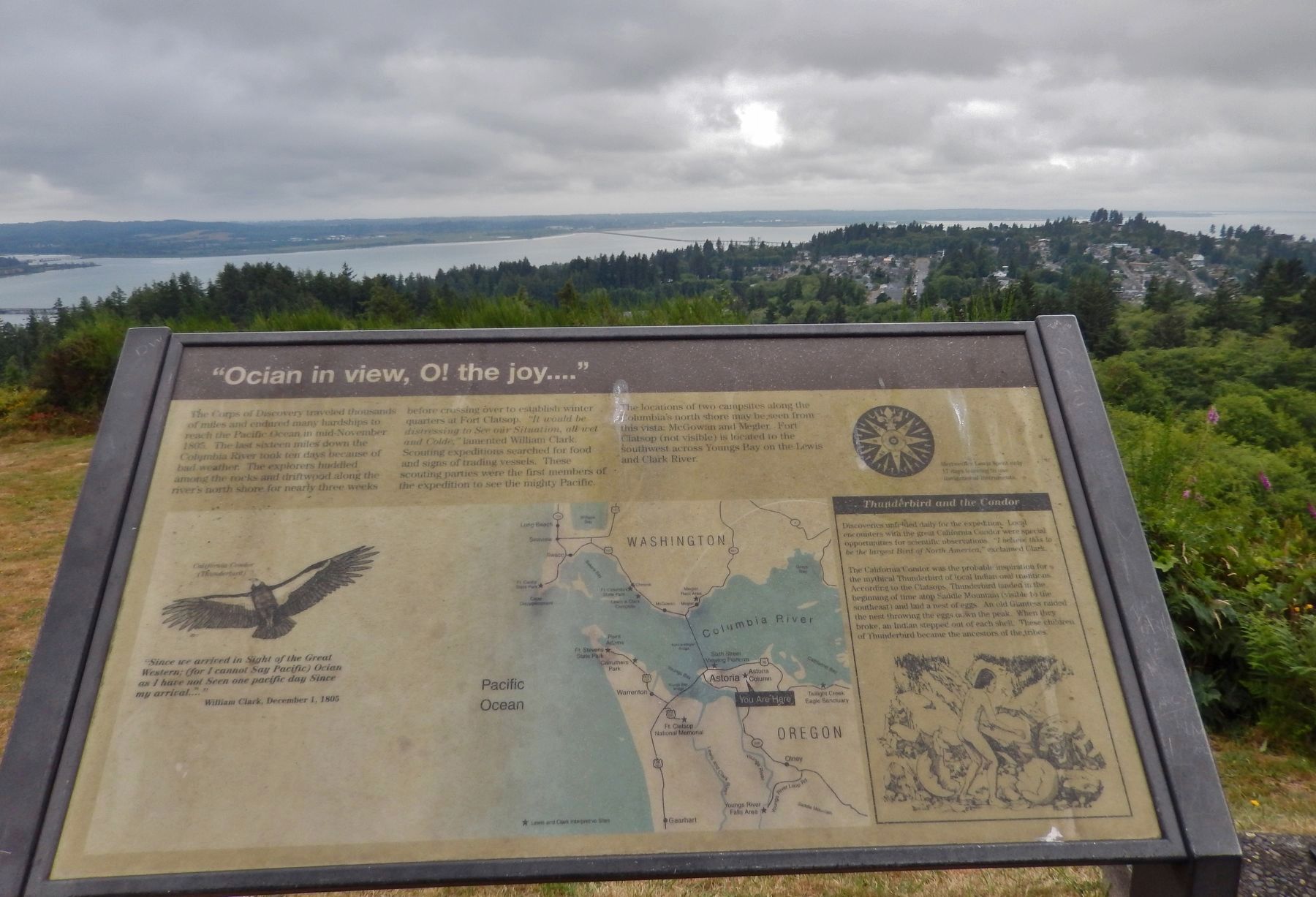
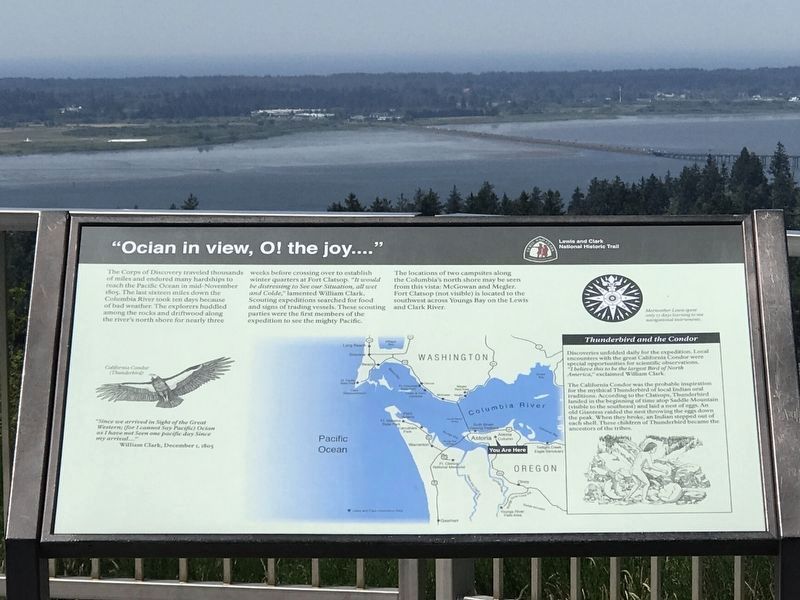
The Corps of Discovery traveled thousands of miles and endured many hardships to reach the Pacific Ocean in mid-November 1895. The last sixteen miles down the Columbia River took ten days because of bad weather. The explorers huddled among the rocks and drifted along the shore for nearly three weeks before crossing over to establish winter quarters at Fort Clatsop. ”It would be distressing to See our Situation, all wet and Colde,” lamented William Clark. Scouting expeditions searched for food and signs of trading vessels. These scouting parties were the first members of the expedition to see the mighty Pacific.
The locations of two campsites along the Columbia’s north shore may be seen from this vista: McGowan and Megler. Fort Clatsop (not visible) is located to the southwest across Youngs Bay on the Lewis and Clark River.
Erected by Lewis and Clark National Historic Trail.
Topics and series. This historical marker is listed in these topic lists: Exploration • Indigenous Peoples and Communities • Waterways & Vessels. In addition, it is included in the Lewis & Clark Expedition series list. A significant historical year for this entry is 1805.
Location. 46° 10.858′ N,
this page online

Regionally, this marker is on the Oregon Coast. It is also on the American Pacific Coast, in the Pacific Northwest, and in the Lewis & Clark Corridor. Globally, it is in North America, on the Pacific Rim, in the Western Hemisphere, in the Western World, and in the Anglosphere.
Other nearby markers. At least 8 other markers are within walking distance of this marker: The Lewis and Clark Expedition (here, next to this marker); Comcomly / Indian Burial Canoe (a few steps from this marker); Shively - McClure National Register Historic District (approx. 0.4 miles away); Columbia River Bar (approx. 0.6 miles away); Pilot Boat Peacock (approx. 0.6 miles away); Built by Capt. Hiram Brown (approx. 0.6 miles away); Site of Original Settlement of Astoria
Photographed by Cosmos Mariner, July 9, 2015
2. Marker detail: Thunderbird and the Condor
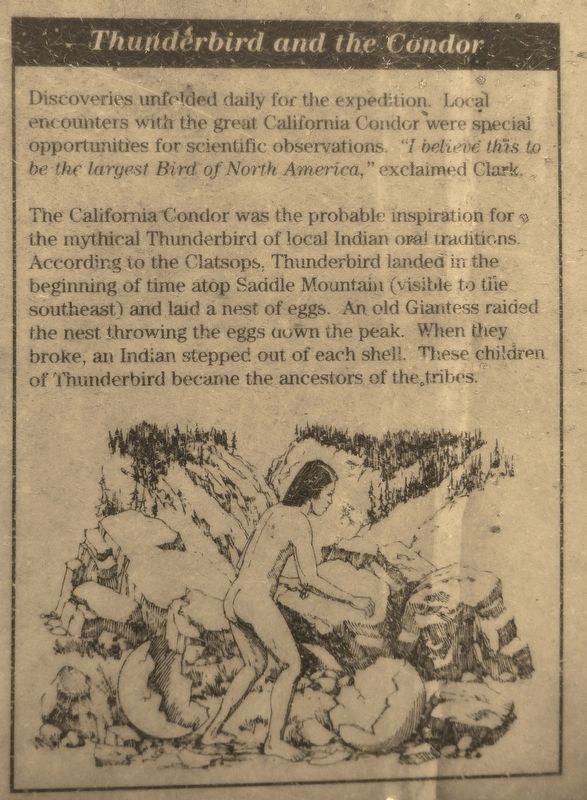
Discoveries unfolded daily for the expedition. Local encounters with the great California Condor were special opportunities for scientific observations. "I believed this to be the largest Bird of North America," exclaimed Clark.
The California Condor was the probable inspiration for the mythical Thunderbird of local Indian oral traditions. According to the Clatsops, Thunderbird landed in the beginning of time atop Saddle Mountain (visible to the southeast) and laid a nest of eggs. An old Giantess raided the nest throwing the eggs down the peak.
The California Condor was the probable inspiration for the mythical Thunderbird of local Indian oral traditions. According to the Clatsops, Thunderbird landed in the beginning of time atop Saddle Mountain (visible to the southeast) and laid a nest of eggs. An old Giantess raided the nest throwing the eggs down the peak.
Related markers. Click here for a list of markers that are related to this marker.
Also see . . .
1. Lewis and Clark Expedition reaches the Pacific Ocean on November 15, 1805. History Link website entry:
By the time they arrived at the ocean, Lewis and Clark knew that the Northwest Passage did not exist. Even if it had been possible to carry a canoe from the headwaters of the Missouri (in present-day Montana) and slide it into the nearest tributary of the Columbia, western rivers were not the slow, smooth waterways of the East. On the upper Missouri and on the Columbia, the explorers faced rapids and cataracts that were bigger, swifter, and more dangerous than anything they had ever experienced. (Submitted on January 19, 2018, by Cosmos Mariner of Cape Canaveral, Florida.)
2. Arrival at the Pacific Ocean. Discover Lewis and Clark website entry:
While the rest of the Corps huddled in the gale-driven rain at Station Camp, Clark and ten of his men, plus his servant York, set out overland,
Photographed by Cosmos Mariner, July 9, 2015
3. Marker detail: Astoria, Columbia River and Pacific Ocean Map
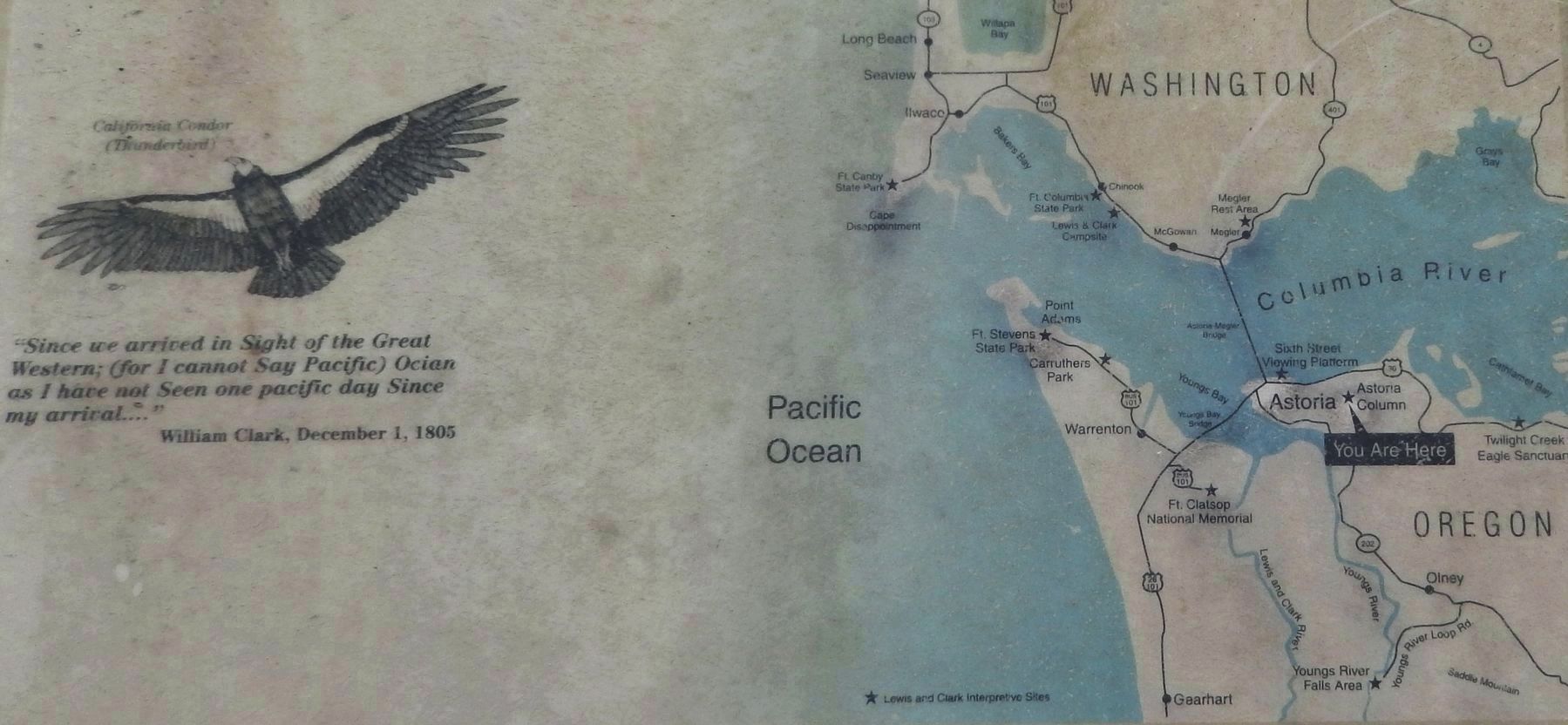
"Since we arrived in Sight of the Great Western; (for I cannot Say Pacific) Ocian as I have not Seen one pacific day Since my arrival..."
William Clark, December 1, 1805
William Clark, December 1, 1805
3. Astoria Column. Oregon Encyclopedia website entry (Submitted on October 15, 2024, by Larry Gertner of New York, New York.)
Photographed by Cosmos Mariner, July 9, 2015
4. "Ocian in view, O! the Joy..." Marker
Photographed by Duane and Tracy Marsteller, June 27, 2021
5. "Ocian in view, O! the Joy..." Marker
Photographed by Duane and Tracy Marsteller, June 27, 2021
6. "Ocian in view, O! the Joy..." Marker
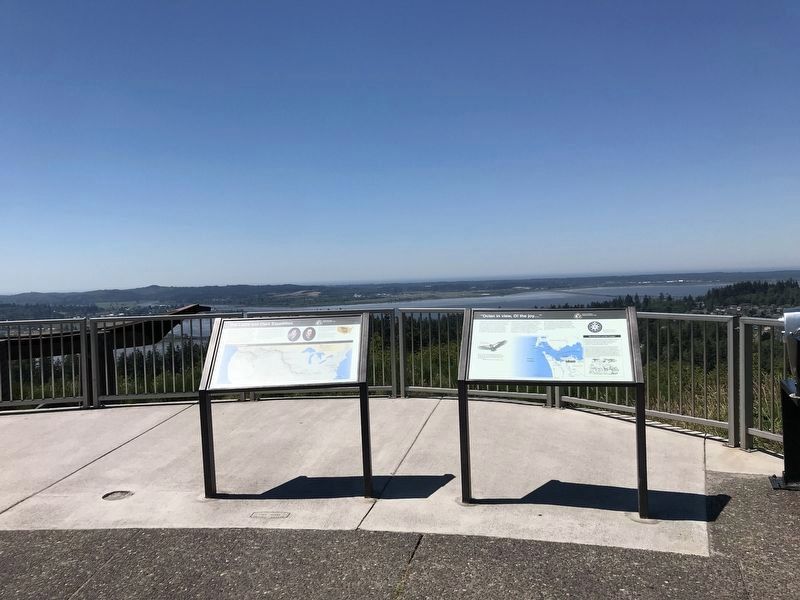
Marker is on the left.
Credits. This page was last revised on October 15, 2024. It was originally submitted on January 19, 2018, by Cosmos Mariner of Cape Canaveral, Florida. This page has been viewed 1,195 times since then and 94 times this year. Photos: 1, 2, 3, 4. submitted on January 19, 2018, by Cosmos Mariner of Cape Canaveral, Florida. 5, 6. submitted on July 14, 2021, by Duane and Tracy Marsteller of Murfreesboro, Tennessee. • Bill Pfingsten was the editor who published this page.
