Ninety Six in Greenwood County, South Carolina — The American South (South Atlantic)
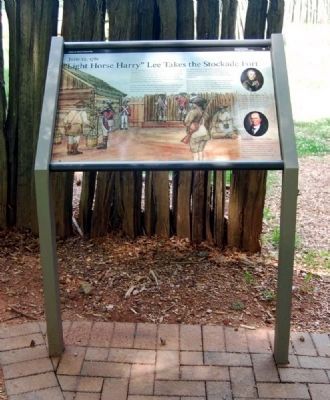
"Light Horse Harry" Lee Takes the Stockade Fort
June 12, 1781
Photographed by Brian Scott, May 13, 2010
1. "Light Horse Harry" Lee Takes the Stockade Fort Marker
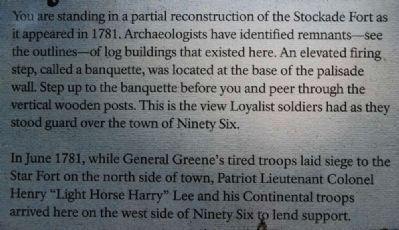
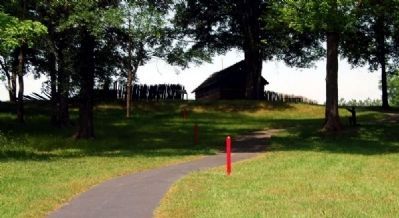
You are standing in a partial reconstruction of the Stockade Fort as it appeared in 1781. Archaeologists have identified remnants -- see the outlines -- of log buildings that existed here. An elevated firing step, called a banquette, was located at the base of the palisade wall. Step up to the banquette before you and peer through the vertical wooden posts. This is the view Loyalist soldiers had as they stood guard over the town of Ninety Six.
In June 1781, while General Greene's tired troops laid siege to the Star Fort on the north side of town, Patriot Lieutenant Colonel Henry "Light Horse Harry" Lee and his Continental troops arrived here on the west side of Ninety Six to lend support.
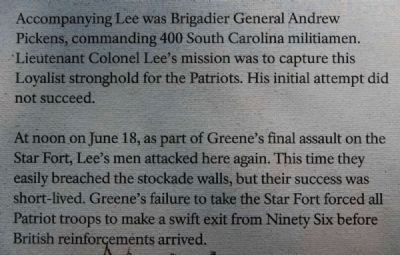
Accompanying Lee was Brigadier General Andrew Pickens, commanding 400 South Carolina militiamen. Lieutenant Colonel Lee's mission was to capture this Loyalists stronghold for the Patriots. His initial attempt did not succeed.
At noon on June 18, as part of Greene's final assault on the Star Fort, Lee's men attacked here again. This time they easily breached the stockade walls, but their success was short-lived. Greene's failure
this page online
Erected 2009 by National Park Service.
Topics. This historical marker is listed in these topic lists: Forts and Castles • War, US Revolutionary. A significant historical month for this entry is June 1781.
Location. 34° 8.682′ N, 82° 1.379′ W. Marker is in Ninety Six, South Carolina, in Greenwood County. It can be reached from South Cambridge Street (State Highway 248). Touch for map. Marker is in this post office area: Ninety Six SC 29666, United States of America. Touch for directions.

Regionally, this marker is in Upstate. It is also in the American South and specifically in the Deep South. Globally, it is in North America, the Western Hemisphere, the Western World, and the Anglosphere. Historically, it finds itself in what was once the territory of the Mississippian Culture, one of the original Thirteen Colonies, one of the Confederate States of America, and the Antebellum South.
Other nearby markers. At least 10 other markers are within walking distance of this marker: Sharpshooter (a few
Photographed by Brian Scott, May 13, 2010
2. "Light Horse Harry" Lee Takes the Stockade Fort Marker
More about this marker. The current marker is shown in Photo #1.
Also see . . .
1. Ninety Six National Historic Site (U.S. National Park Service). Here settlers struggled against the harsh backcountry to survive, Cherokee Indians hunted and fought to keep their land, two towns and a trading post were formed and abandoned to the elements, and two Revolutionary War battles that claimed over 100 lives took place here. (Submitted on September 9, 2008, by Brian Scott of Anderson, South Carolina.)
2. Ninety Six National Historic Site. The historic
Photographed by Brian Scott, May 13, 2010
3. "Light Horse Harry" Lee Takes the Stockade Fort Marker
3. Ninety Six National Historic Site. Ninety Six National Historic Site, also known as Old Ninety Six and Star Fort, is a United States National Historic Site located about 60 miles (96 kilometers) south of Greenville, South Carolina. (Submitted on August 26, 2010, by Brian Scott of Anderson, South Carolina.)
4. Henry Lee III. Henry Lee III (29 January 1756 – 25 March 1818) was an early American patriot who served as the ninth Governor of Virginia and as the Virginia Representative to the United States Congress. (Submitted on August 23, 2010, by Brian Scott of Anderson, South Carolina.)
5. Andrew Pickens. Andrew Pickens (September 13, 1739 – August 11, 1817) was a militia leader in the American Revolution and a member of the United States House of Representatives from South Carolina. (Submitted on August 25, 2010, by Brian Scott of Anderson, South Carolina.)
6. Nathanael Greene.
Photographed by Brian Scott, May 13, 2010
4. Lieutenant Colonel Henry Lee
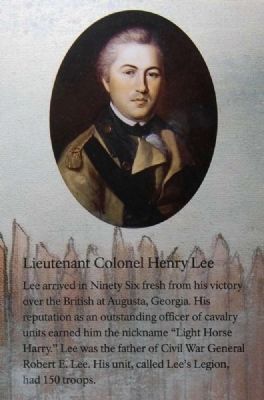
Lree arrived in Ninety Six fresh from his victory over the British at Augusta, Georgia. His reputation as an outstanding officer of cavalry units earned him the nickname "Light Horse Harry." Lee was the father of Civil War General Robert E. Lee. His unit, called Lee's Legion, had 150 troops.
Additional commentary.
1. Henry Lee (1756 - 1818)
Henry Lee, (brother of Richard Bland Lee and grandfather of William Henry Fitzhugh Lee), a Delegate and a Representative from Virginia; born at “Leesylvania,” in Prince William County, Va., January 29, 1756; pursued classical studies and was graduated from Princeton College in 1773; served in the Revolutionary War; commissioned captain of a company of Virginia Dragoons June 18, 1776, that became attached to and part of the First Continental Dragoons March 31, 1777; lieutenant colonel November 6, 1780, and served until the close of the war; commissioned major general, United States Army, July 19, 1798; honorably discharged June 15, 1800; became universally known as “Light Horse Harry”; Member of the Continental Congress 1786-1788; advocated the adoption of the Federal Constitution in the Virginia convention of 1788; Governor of Virginia 1791-1794;
Photographed by Brian Scott, May 13, 2010
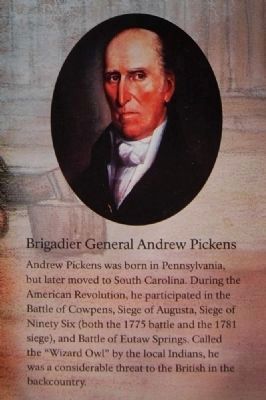
5. Brigadier General Andrew Pickens
Andrew Pickens was born in Pennsylvania, but later moved to South Carolina. During the American Revolution, he participated in the Battle of Cowpens, Siege of Augusta, Siege of Ninety Six (both the 1775 battle and the 1781 siege), and Battle of Eutaw Springs. Called the "Wizard Owl" by the local Indians, he was a considerable threat to the British in the backcountry.
— Submitted August 24, 2010, by Brian Scott of Anderson, South Carolina.
2. Andrew Pickens (1739 - 1817)
Andrew Pickens, (grandfather of Francis Wilkinson Pickens), a Representative from South Carolina; born in Paxton, Bucks County, Pa., September 13, 1739; attended the common schools; moved with his parents to the Waxhaw settlement in South Carolina in 1752; served in the provincial militia in the campaign against the Cherokee Indians in 1760; entered the Revolutionary Army as captain
Photographed by Brian Scott, May 13, 2010
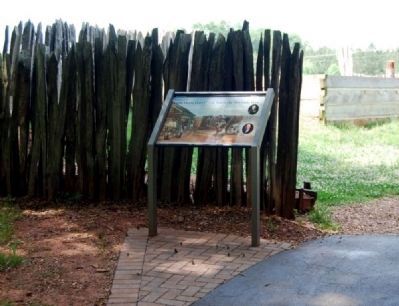
6. "Light Horse Harry" Lee Takes the Stockade Fort Marker
— Submitted August 25, 2010, by Brian Scott of Anderson, South Carolina.
Photographed by Brian Scott, September 5, 2008
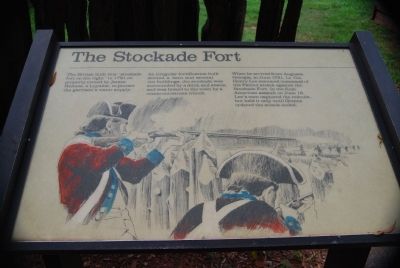
7. Original The Stockade Fort Marker
The British built this "stockade fort on the right" in 1781 on property owned by James Holmes, a Loyalist, to protect the garrison's water supply.
An irregular fortification built around a barn and several out buildings, the stockade was surrounded by a ditch and abatis, and was linked to the town by a communications trench.
When he arrived from Augusta, Georgia, in June 1781, Lt. Col. Henry Lee assumed command of the Patriot attack against the Stockade Fort. In the final American assault on June 18, Lee's men captured the redoubt, but held it only until Greene ordered the attack ended.
An irregular fortification built around a barn and several out buildings, the stockade was surrounded by a ditch and abatis, and was linked to the town by a communications trench.
When he arrived from Augusta, Georgia, in June 1781, Lt. Col. Henry Lee assumed command of the Patriot attack against the Stockade Fort. In the final American assault on June 18, Lee's men captured the redoubt, but held it only until Greene ordered the attack ended.
Photographed by Brian Scott, May 13, 2010
8. Reconstructed Stockade Fort from the Walking Path
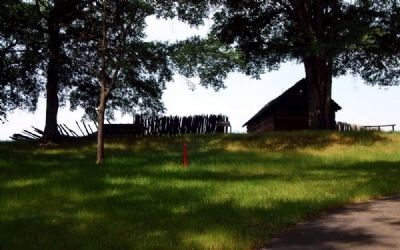
Photographed by Brian Scott, May 13, 2010
9. Reconstructed Stockade Fort from the Walking Path
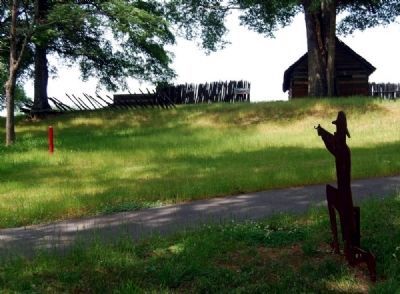
Photographed by Brian Scott, May 13, 2010
10. Reconstructed Stockade Fort from the Walking Path
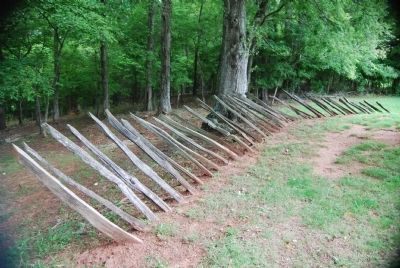
Photographed by Brian Scott, September 5, 2008
11. Abatis on the East Side of the Stockade Fort
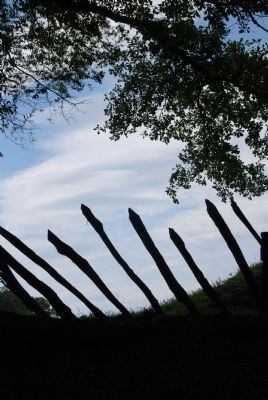
Photographed by Brian Scott, September 5, 2008
12. Abatis Against a Carolina Blue Sky
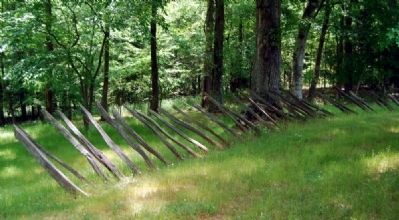
Photographed by Brian Scott, May 13, 2010
13. Reconstructed Abatis
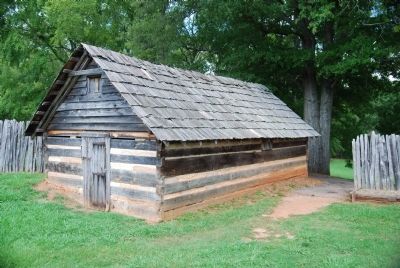
Photographed by Brian Scott, September 5, 2008
14. Structure Inside The Stockade Fort
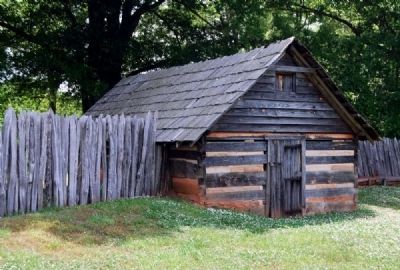
Photographed by Brian Scott, May 13, 2010
15. Reconstructed Structure Inside the Stockade
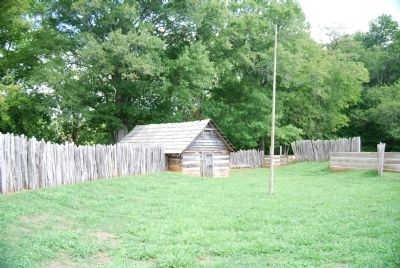
Photographed by Brian Scott, September 5, 2008
16. Interior of the Stockade Fort
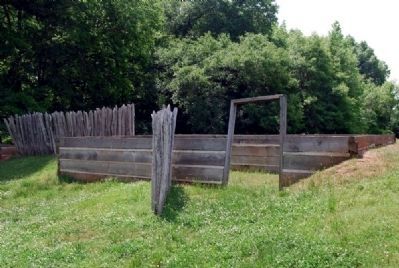
Photographed by Brian Scott, May 13, 2010
17. Interior of the Stockade Fort
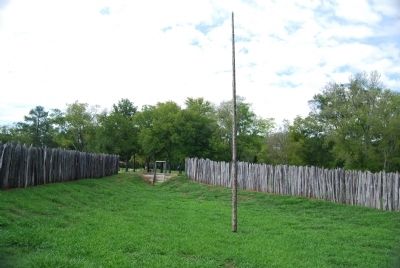
Photographed by Brian Scott, September 5, 2008
18. Stockade Flag Pole
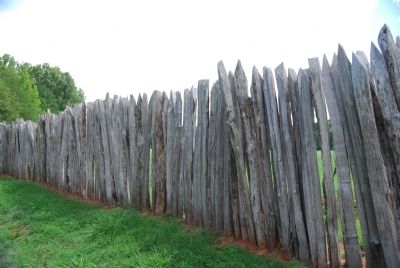
Photographed by Brian Scott, September 5, 2008
19. Stockade Fort Wall
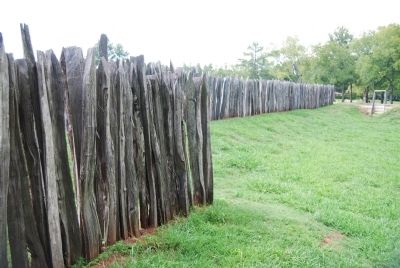
Photographed by Brian Scott, September 5, 2008
20. Stockade Fort Walls
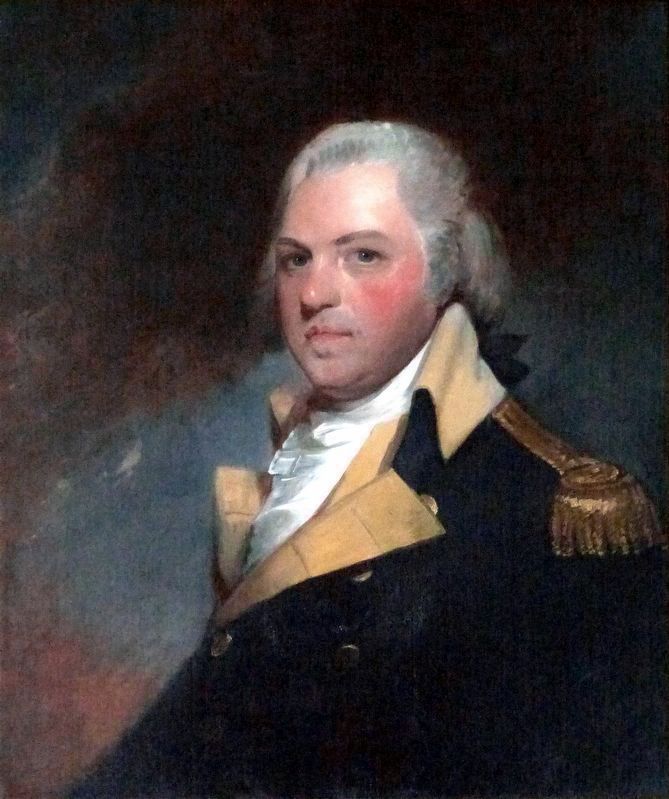
Photographed by Allen C. Browne, November 17, 2018
21. Henry Lee III, “Light Horse Harry”
Painting attributed to Gilbert Stuart, at Stratford mansion, Montross Virginia.
Credits. This page was last revised on November 22, 2021. It was originally submitted on September 9, 2008, by Brian Scott of Anderson, South Carolina. This page has been viewed 2,228 times since then and 62 times this year. Last updated on September 10, 2008, by M. L. 'Mitch' Gambrell of Taylors, South Carolina. Photos: 1, 2, 3, 4, 5, 6. submitted on August 23, 2010, by Brian Scott of Anderson, South Carolina. 7. submitted on September 9, 2008, by Brian Scott of Anderson, South Carolina. 8, 9, 10. submitted on August 23, 2010, by Brian Scott of Anderson, South Carolina. 11, 12. submitted on September 9, 2008, by Brian Scott of Anderson, South Carolina. 13. submitted on August 26, 2010, by Brian Scott of Anderson, South Carolina. 14. submitted on September 9, 2008, by Brian Scott of Anderson, South Carolina. 15. submitted on August 26, 2010, by Brian Scott of Anderson, South Carolina. 16. submitted on September 9, 2008, by Brian Scott of Anderson, South Carolina. 17. submitted on August 26, 2010, by Brian Scott of Anderson, South Carolina. 18, 19, 20. submitted on September 9, 2008, by Brian Scott of Anderson, South Carolina. 21. submitted on November 22, 2021, by Allen C. Browne of Silver Spring, Maryland. • Kevin W. was the editor who published this page.
