The National Mall in Southwest Washington in Washington, District of Columbia — The American Northeast (Mid-Atlantic)
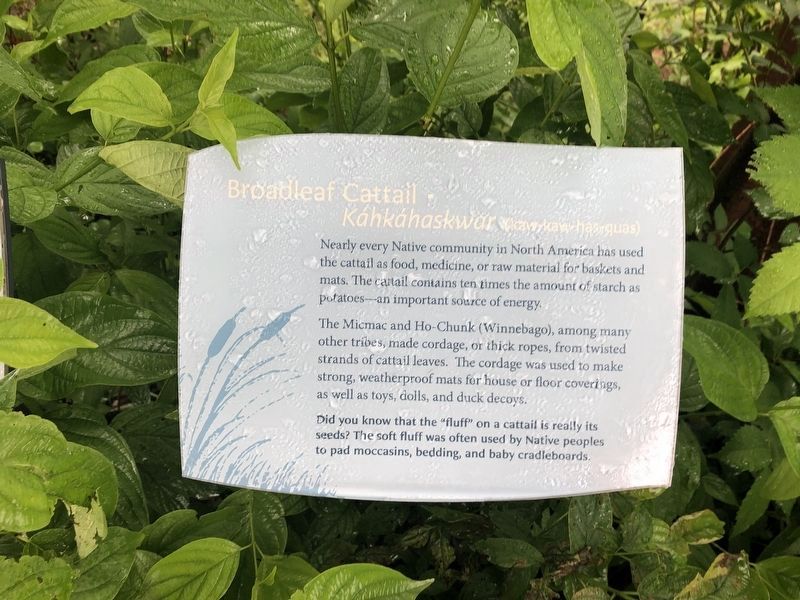
Broadleaf Cattail • Káhkáhaskwar (kaw-kaw-has-quar)
Photographed by Devry Becker Jones (CC0), May 13, 2019
1. Broadleaf Cattail • Káhkáhaskwar (kaw-kaw-has-quar) Marker
Nearly every Native community in North America has used the cattail as food, medicine, or raw material for baskets and mats. The cattail contains ten times the amount of starch as potatoes—an important source of energy.
The Micmac and Ho-Chunk (Winnebago), among many other tribes, made cordage or thick ropes, from twisted strands of cattail leaves. The cordage was used to make strong, weatherproof mats for house or floor coverings, as well as toys, dolls, and duck ,decoys.
Did you know that the "fluff" on a cattail is really its seeds? The soft fluff was often used by Native peoples to pad moccasins, bedding, and baby cradleboards.
Erected by Smithsonian Institution.
Topics. This historical marker is listed in these topic lists: Environment • Indigenous Peoples and Communities.
Location. Marker has been permanently removed. It was located near 38° 53.306′ N, 77° 0.955′ W. Marker was in Southwest Washington in Washington, District of Columbia. It was in The National Mall. It could be reached from Jefferson Drive Southwest west of 3rd Street Southwest, on
this page online
We have been informed that this marker is no longer there and will not be replaced. This page is an archival view of what was.
Regionally, this marker was in the Washington Metropolitan Area. It was also in the American Northeast, in the Upper South, in the Mid-Atlantic, in the Tidewater, and in the Chesapeake Bay Region. Globally, it was in North America, the Western Hemisphere, the Western World, and the Anglosphere.

Other nearby markers. At least 4 other markers are within walking distance of this location: National Native American Veterans Memorial (here, next to this marker); a different marker also named George Rivera (within shouting distance of this marker); Cardinal Direction Marker: East (within shouting distance of this marker); a different marker also named Cardinal Direction Marker: North (within shouting distance of this marker). Touch for a list and map of all markers in Southwest
Photographed by Devry Becker Jones (CC0), May 13, 2019
2. Broadleaf Cattail • Káhkáhaskwar (kaw-kaw-has-quar) Marker
Other markers no longer nearby. Bald Cypress • Ártu (ar-too) (was here, next to this marker but has been permanently removed); Wetlands (was a few steps from this marker but has been replaced with another marker now near it); What is a Grandfather Rock? (was a few steps from this marker but has been permanently removed); George Rivera (was a few steps from this marker but has been replaced with another marker now near it); Wingapo (was within shouting distance of this marker but has been replaced with another marker now near it); Witchhazel • Suhwe?t (suh-whet) (was within shouting distance of this marker but has been permanently removed); Swamp Milkweed • Wihsakán (wee-sah-quam) (was within shouting distance of this marker but has been permanently removed); Can you find symbols… (was within shouting distance of this marker but has been permanently removed); a different marker also named Cardinal Direction Marker: East (was within shouting distance of this marker but has been replaced with another marker now near it); Cardinal Direction Marker: North (was within shouting distance of this marker but has been replaced with another marker now near it); Sunflower • Wádxaweew (wah-ha-way-oh) (was within shouting distance of this marker but has been permanently removed); Cardinal Direction Markers (was within shouting distance of this marker but has been permanently removed).
Credits. This page was last revised on January 30, 2023. It was originally submitted on November 14, 2017, by Devry Becker Jones of Washington, District of Columbia. This page has been viewed 312 times since then and 15 times this year. Last updated on February 10, 2018, by Devry Becker Jones of Washington, District of Columbia. Photos: 1, 2. submitted on May 13, 2019, by Devry Becker Jones of Washington, District of Columbia. • Andrew Ruppenstein was the editor who published this page.
