Anadarko in Caddo County, Oklahoma — The American South (West South Central)
Chief Joseph
(Himnaton - Yalakit)
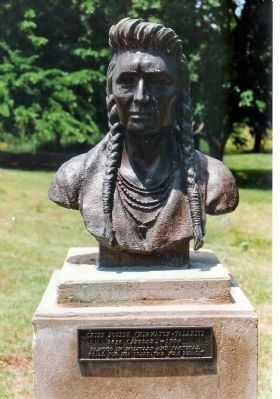
Photographed by Mike Stroud, June 1996
1. Chief Joseph Marker
Famous in Military and Tactical
skill for his tribe, The Nez Perce.
Erected by The National Hall Of Fame For Famous American Indians.
Topics. This historical marker is listed in these topic lists: Indigenous Peoples and Communities • Wars, US Indian. A significant historical year for this entry is 1838.
Location. 35° 4.382′ N, 98° 13.716′ W. Marker is in Anadarko, Oklahoma, in Caddo County. It can be reached from E Central Boulevard. The National Hall Of Fame For Famous American Indians. Touch for map. Marker is at or near this postal address: 851 East Central Boulevard, Anadarko OK 73005, United States of America. Touch for directions.

Regionally, this marker is in the Kiowa Tribe and in Southwest Oklahoma—Great Plains Country. It is also in the American South, specifically on the prairies, and on the Southern Plains. Globally, it is in North America, the Western Hemisphere, the Western World, and the Anglosphere. Historically, it finds itself in what was once the Comanchería, the territory of the Mississippian Culture, and the Louisiana Purchase.
Other nearby markers. At
this page online
Regarding Chief Joseph. Some sources have Year of Birth 1840
Also see . . . PBS Org. "Chief Joseph" was born in the Wallowa Valley in what is now northeastern Oregon in 1840 (Submitted on September 15, 2008, by Mike Stroud of Bluffton, South Carolina.)
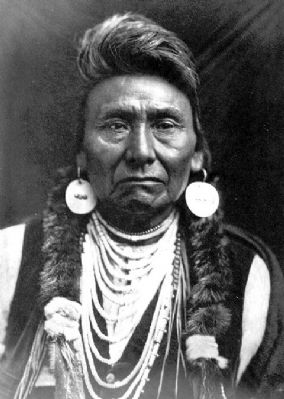
Photo PBS.com by Edward Curtis
2. Chief Joseph Marker
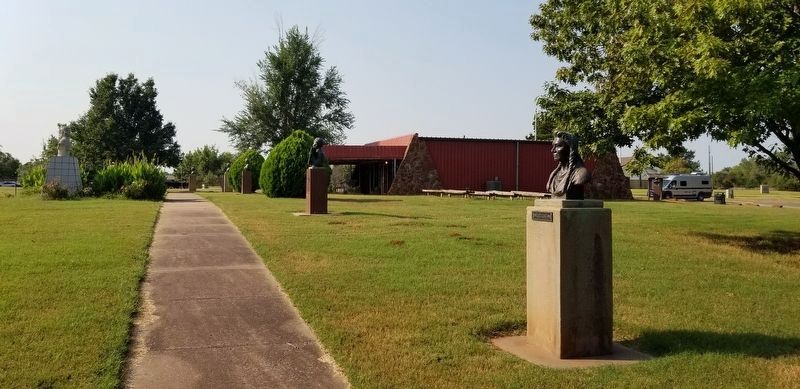
Photographed by James Hulse, September 9, 2021
3. The view of the Chief Joseph Marker in the park
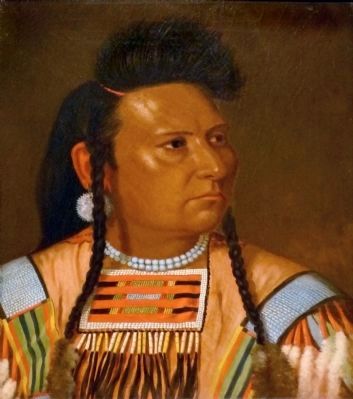
Photographed by Allen C. Browne, February 16, 2015
4. Chief Joseph
This 1878 painting of Chief Joseph by Cyrenius Hall hangs in the National Portrait Gallery in Washington, DC.
“Chief Joseph came to embody for many the tragic plight of Native Americans during the second half of the nineteenth century … His resistance to government efforts to move the Nez Perce people to a reservation drew anger from U.S. authorities, but also prompted widespread sympathy from many Americans. When troops were called in to speed the removal process in 1877, Joseph and 800 of his followers began a strategic retreat, seeking safety first among allied tribes in Montana and then heading toward Canada. Only thirty miles from the border, a command led by General Nelson Miles intercepted this band and forced Joseph to surrender. For the next eight years Joseph was imprisoned at several sites, including Fort Leavenworth in Kansas. It was there that artist Cyrenius Hall created this painting of the dispirited leader.” — National Portrait Gallery
“Chief Joseph came to embody for many the tragic plight of Native Americans during the second half of the nineteenth century … His resistance to government efforts to move the Nez Perce people to a reservation drew anger from U.S. authorities, but also prompted widespread sympathy from many Americans. When troops were called in to speed the removal process in 1877, Joseph and 800 of his followers began a strategic retreat, seeking safety first among allied tribes in Montana and then heading toward Canada. Only thirty miles from the border, a command led by General Nelson Miles intercepted this band and forced Joseph to surrender. For the next eight years Joseph was imprisoned at several sites, including Fort Leavenworth in Kansas. It was there that artist Cyrenius Hall created this painting of the dispirited leader.” — National Portrait Gallery
Credits. This page was last revised on September 25, 2024. It was originally submitted on September 15, 2008, by Mike Stroud of Bluffton, South Carolina. This page has been viewed 2,706 times since then and 44 times this year. Photos: 1, 2. submitted on September 15, 2008, by Mike Stroud of Bluffton, South Carolina. 3. submitted on September 17, 2021, by James Hulse of Medina, Texas. 4. submitted on May 25, 2015, by Allen C. Browne of Silver Spring, Maryland. • Bill Pfingsten was the editor who published this page.
