
Memphis in Shelby County, Tennessee — The American South (East South Central)
White Hall Plantation/Union, Louisiana/Point Houmas
Mississippi River Walk
Photographed by Jason Voigt, August 2, 2024
1. White Hall Plantation/Union, Louisiana/Point Houmas Marker
Marker was replaced by a newer one put up by Mud Island Park.
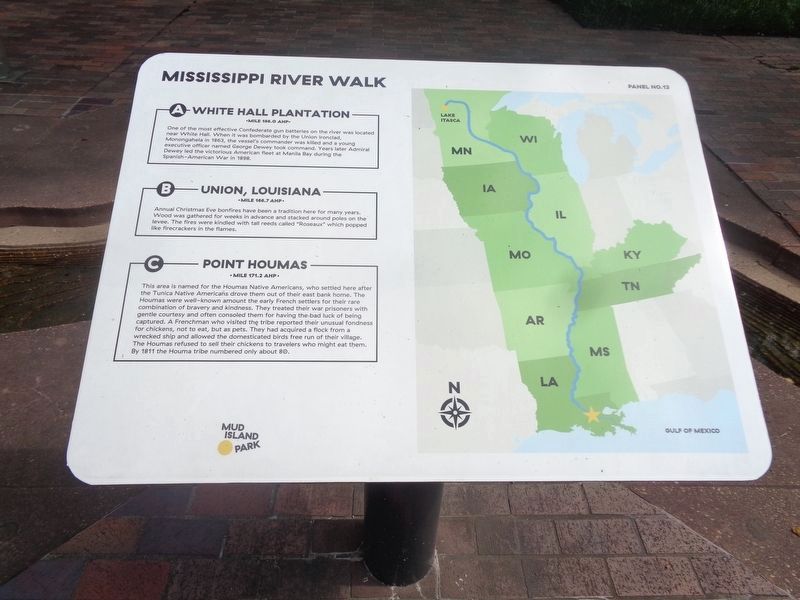
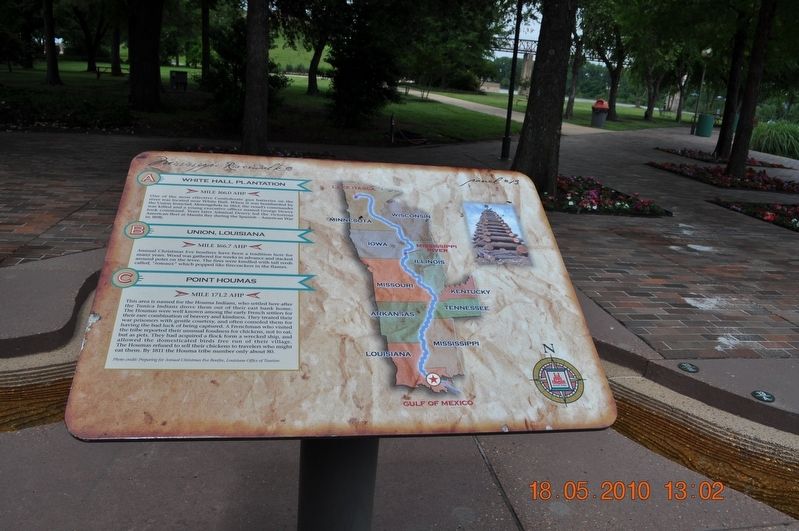
A) White Hall Plantation
Mile 166.0 AHP
One of the most effective Confederate gun batteries on the river was located near White Hall. When it was bombarded by the Union Ironclad, Monongahela in 1863, the vessel’s commander was killed and a young executive officer named George Dewey took command. Years later Admiral Dewey led the victorious American fleet at Manila Bay during the Spanish-American War in 1898.
B) Union, Louisiana
Mile 166.7 AHP
Annual Christmas Eve bonfires have been a tradition here for many years. Wood was gathered for weeks in advance and stacked around poles on the levee. The fires were kindled with tall reeds called “Roseaux” which popped like firecrackers in the flames.
C) Point Houmas
Mile 171.2 AHP
This area is named for the Human Indians, who settled here after the Tunica Indians drove them out of their east bank home. The Houmas were well-known amount the early French settlers for their rare combination of bravery and kindness. They treated their war prisoners with gentle courtesy and often consoled them for having the bad luck of being captured. A Frenchman who visited the tribe
this page online
Photo Credit: Preparing for Annual Christmas Eve Bonfire, Louisiana Office of Tourism
Erected by Mississippi Riverwalk. (Marker Number 13.)
Topics. This historical marker is listed in these topic lists: Disasters • Indigenous Peoples and Communities • War, US Civil • Waterways & Vessels. A significant historical year for this entry is 1898.
Location. 35° 8.785′ N, 90° 3.561′ W. Marker is in Memphis, Tennessee, in Shelby County. It can be reached from Island Drive 0.8 miles south of West A.W. Willis Avenue. Located in Mud Island Park. Touch for map. Marker is at or near this postal address: 25 Island Dr, Memphis TN 38103, United States of America. Touch for directions.

Regionally, this marker is in West Tennessee. It is also in the American South, specifically in the Deep South, in the Upper South, in the Mississippi
Photographed by Sandra Hughes, May 18, 2010
2. White Hall Plantation/Union, Louisiana/Point Houmas Marker
Other nearby markers. At least 8 other markers are within walking distance of this marker: Donaldsonville, Louisiana/Bayou Lafourche/Geismar, Louisiana (here, next to this marker); Lutcher, Louisiana/Oak Alley/St. James Landing, Louisiana (here, next to this marker); Claiborne Landing / Carville, Louisiana / Belle Grove (a few steps from this marker); Hymelia Crevasse/Bonnet Carre Crevasse/Laplace, Louisiana/Reserve, Louisiana (a few steps from this marker); Plaquemine, Louisiana/Manchac Bend (a few steps from this marker); Bonnet Carre Spillway/Lake Pontchartrain (within shouting distance of this marker); Baton Rouge, Louisiana (within shouting distance of this marker); Mulatto Bend/Springfield Bend/Profit Island (within shouting distance of this marker). Touch for a list and map of all markers in Memphis.
Also see . . .
1. White Hall Plantation House.
Photographed by Jason Voigt, August 2, 2024
3. White Hall Plantation/Union, Louisiana/Point Houmas Marker
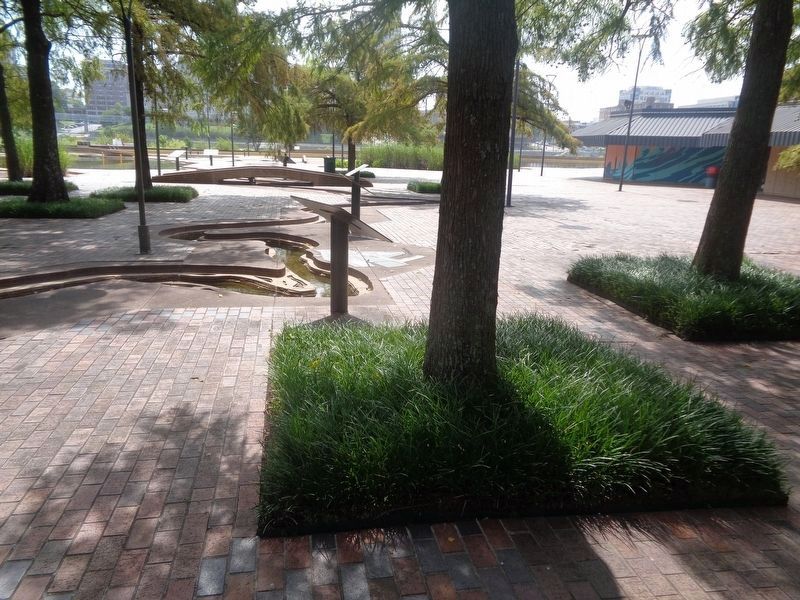
Marker is second from the front
2. USS Monongahela (1862). USS Monongahela (1862) was a barkentine–rigged screw sloop-of-war that served in the Union Navy during the American Civil War. Her task was to participate in the Union blockade of the Confederate States of America. Post-war, she continued serving her country in various roles, such as that of a storeship and schoolship. (Submitted on March 14, 2018, by Sandra Hughes Tidwell of Killen, Alabama, USA.)
3. Houma people. The Houma (/ˈhoʊmə/) are a historic Native American tribe located in Louisiana on the east side of the Red River of the South. Their descendants, the Houma people or organization ““The United Houma Nation””, have been a state recognized tribe since 1972.[1] According to the tribe, they have about 17,000 enrolled tribal citizens residing within a six-parish (county) service area, which encompasses 4,750 square miles. The six parishes are the following: St. Mary, Terrebonne, Lafourche, Jefferson, Plaquemines, and St. Bernard parishes. (Submitted on March 14, 2018, by Sandra Hughes Tidwell of Killen, Alabama, USA.)
Credits. This page was last revised on August 15, 2024. It was originally submitted on March 14, 2018, by Sandra Hughes Tidwell of Killen, Alabama, USA. This page has been viewed 573 times since then and 59 times this year. Photos: 1. submitted on August 15, 2024, by Jason Voigt of Glen Carbon, Illinois. 2. submitted on March 14, 2018, by Sandra Hughes Tidwell of Killen, Alabama, USA. 3. submitted on August 15, 2024, by Jason Voigt of Glen Carbon, Illinois. • Bernard Fisher was the editor who published this page.
