Memphis in Shelby County, Tennessee — The American South (East South Central)
Baton Rouge, Louisiana
Mississippi River Walk
| — | Mile 228.4 AHP | — |
Photographed by Jason Voigt, August 2, 2024
1. Baton Rouge, Louisiana Marker
Marker was replaced with one put up by Mud Island Park.
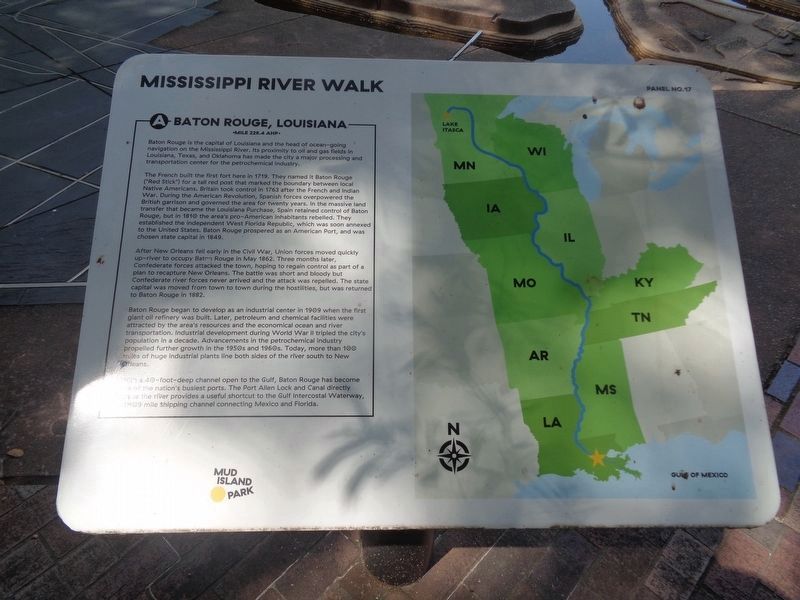
The French built the first fort here in 1819. They named it Baton Rouge (“Red Stick”) for a tall red post hat mad the boundary between local Native Americans. Britain took control in 1763 after the French and Indian War. During the American Revolution, Spanish forces overpowered the British garrison and governed the area for twenty years. In the massive land transfer that became the Louisiana Purchase Spain retained control of Baton Rouge, but in 1810 the area’s pro-American inhabitants rebelled. They established the Independent West Florida Republic, which was soon annoyed to the United States. Baton Rouge prospered as an American Port and was chosen state capital in 1849.
After New Orleans fell early in the Civil War, Union forces moved quickly up-river to occupy Baton Rouge in May 1862. Three months later, Confederate forces attacked the town,
this page online
Baton Rouge began to develop as an industrial center in 1909 when the first giant oil refinery was built. Later petroleum and chemical facilities were attracted by the area’s resources and the economical ocean and river transportation. Industrial development during World War II tripled the city’s population in a decade. Advancements in the petrochemical industry propelled further growth in the 1950’s and 1960’s. Today, more than 100 miles of huge industrial plants line both sides of the river south to New Orleans.
With a 40-foot-deep channel open to the Gulf, Baton Rouge has become one of the nation’s busiest ports. The Port Allen Lock and Canal directly across the river provides a useful shortcut to the Gulf Intercoastal Waterway, a 1,209-mile shipping channel connecting Mexico and Florida.
Erected by Mississippi River Walk. (Marker Number 17.)
Topics.

Photographed by Sandra Hughes, May 18, 2010
2. Baton Rouge, Louisiana Marker
Location. 35° 8.799′ N, 90° 3.566′ W. Marker is in Memphis, Tennessee, in Shelby County. It can be reached from Island Drive. Located at Mud Island Park. Touch for map. Marker is at or near this postal address: 25 Island Dr, Memphis TN 38103, United States of America. Touch for directions.

Regionally, this marker is in West Tennessee. It is also in the American South, specifically in the Deep South, in the Upper South, in the Mississippi Delta, and in the Great River Road Region. Globally, it is in North America, the Western Hemisphere, the Western World, and the Anglosphere. Historically, it finds itself in what was once the territory of the Mississippian Culture, one of the Confederate States of America, and the Antebellum South.
Other nearby markers. At least 8 other markers are within walking distance of this marker: Mulatto Bend/Springfield Bend/Profit Island (a few steps from this marker); Plaquemine, Louisiana/Manchac Bend

Photographed by Jason Voigt, August 2, 2024
3. Baton Rouge, Louisiana Marker
Marker is located at Mud Island Park.
Also see . . .
1. Baton Rouge, Louisiana. Baton Rouge is a major industrial, petrochemical, medical, research, motion picture,[9] and growing technology[10] center of the American South. It is also the location of Louisiana State University, the largest public university in the state.[11] The Port of Greater Baton Rouge is the tenth largest in the United States in terms of tonnage shipped, and is the farthest upstream Mississippi River port capable of handling Panamax ships (Submitted on March 14, 2018, by Sandra Hughes Tidwell of Killen, Alabama, USA.)
2. Louisiana Purchase. The Louisiana territory included land from fifteen present U.S. states and two Canadian provinces. The territory contained land that forms Arkansas, Missouri, Iowa, Oklahoma, Kansas, and Nebraska; the portion of Minnesota west of the Mississippi River; a large portion of North Dakota; a large portion of South Dakota; the northeastern section of New Mexico; the northern portion of Texas; the area of Montana, Wyoming, and Colorado east of the Continental Divide; Louisiana west of the Mississippi River (plus New Orleans); and small portions of land within the present Canadian provinces of Alberta and Saskatchewan. Its non-native population was around 60,000 inhabitants, of whom half were African slaves. (Submitted on March 14, 2018, by Sandra Hughes Tidwell of Killen, Alabama, USA.)
Credits. This page was last revised on September 10, 2024. It was originally submitted on March 14, 2018, by Sandra Hughes Tidwell of Killen, Alabama, USA. This page has been viewed 501 times since then and 49 times this year. Photos: 1. submitted on September 10, 2024, by Jason Voigt of Glen Carbon, Illinois. 2. submitted on March 14, 2018, by Sandra Hughes Tidwell of Killen, Alabama, USA. 3. submitted on September 10, 2024, by Jason Voigt of Glen Carbon, Illinois. • Bernard Fisher was the editor who published this page.
