
Hagerstown in Washington County, Maryland — The American Northeast (Mid-Atlantic)
Hager House and Museum
Photographed by Craig Swain, June 9, 2007
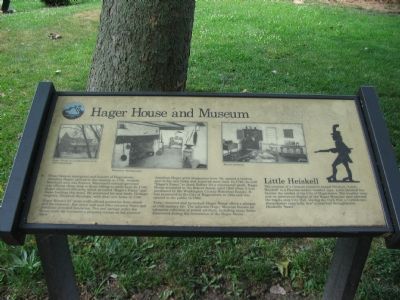
1. Interpretive Marker at the Hager House
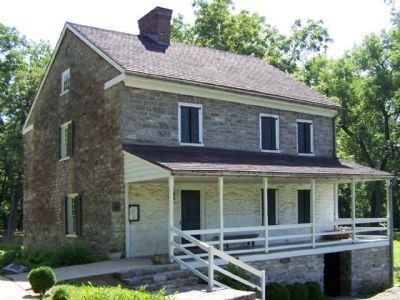
When German immigrant and founder of Hagerstown, Jonathan Hager, arrived in this country in 1736, western Maryland area was frontier. Maryland’s colonial governor was offering cheap land to those willing to settle here. In 1739, Hager obtained 200 acres which he called “Hager's Fancy” and began building this home. He presented his new bride, German neighbor Elizabeth Kershner, with their new home in 1740.
Hager House’s 22" stone walls offered protection from attack and the elements. Rye straw and mud filler between floors and partitions provided insulation. Two cool springs under the house made the basement a pleasant retreat on hot summer days.
Jonathan Hager grew prosperous here. He opened a trading post in his new home and acquired more land. In 1745, he sold “Hager’s Fancy” to Jacob Rohrer for a substantial profit. Hager House remained in the Rohrer family until 1944 when it was purchased by the Washington County Historical Society. It was presented to the City of Hagerstown in 1954 and was opened to the public in 1962.
Today, restored
this page online
Little Heiskell. The creation of a German tinsmith named Heiskell, “Little Heiskell" is a Hessian soldier weather vane. Little Heiskel has become the symbol of the City of Hagerstown. The weather vane, now on permanent display at the Hager Museum, once adorned the cupola atop City Hall. During the Civil War, a Confederate sharpshooter reportedly fired a mini-hall through Little Heiskell's “heart.”
Erected by Hagerstown City Park.
Topics. This historical marker is listed in these topic lists: Architecture • Colonial Era • Settlements & Settlers • War, US Civil. A significant historical year for this entry is 1736.
Location. This marker has been replaced by another marker nearby. It was located near 39° 38.382′ N, 77° 43.821′ W. Marker was in Hagerstown, Maryland, in Washington County. It was at the intersection of Key Street
Photographed by Craig Swain, June 9, 2007
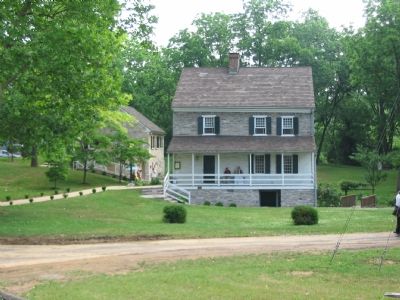
2. The Hager House
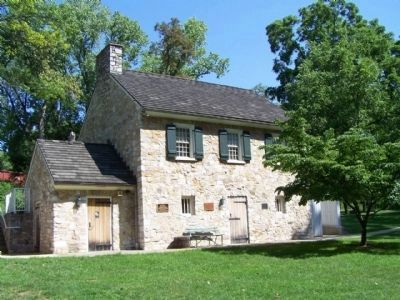
This uncut field stone house was built in the 1840s. With thick walls and a protected water supply, the house could also serve as a frontier fort in the event of an uprising. The museum is in the building to the left.

Regionally, this marker was in Western Maryland. It was also in the American Mid-Atlantic, in Appalachia, and specifically in Northern Appalachia. Globally, it was in North America, the Western Hemisphere, the Western World, and the Anglosphere. Historically, it found itself in what was once one of the original Thirteen Colonies.
Other nearby markers. At least 8 other markers are within walking distance of this location: Jonathan Hager (a few steps from this marker); Jonathan Hager House Museum (a few steps from this marker); Trial and Error at Mount Aetna Furnace (a few steps from this marker); Hager’s Fancy (a few steps from this marker); Hager House Museum (within shouting distance of this marker); The Springs at Hager's Fancy (within shouting distance of this marker); Founder's First Home (within shouting distance of this
HABS - Library of Congress, 1953
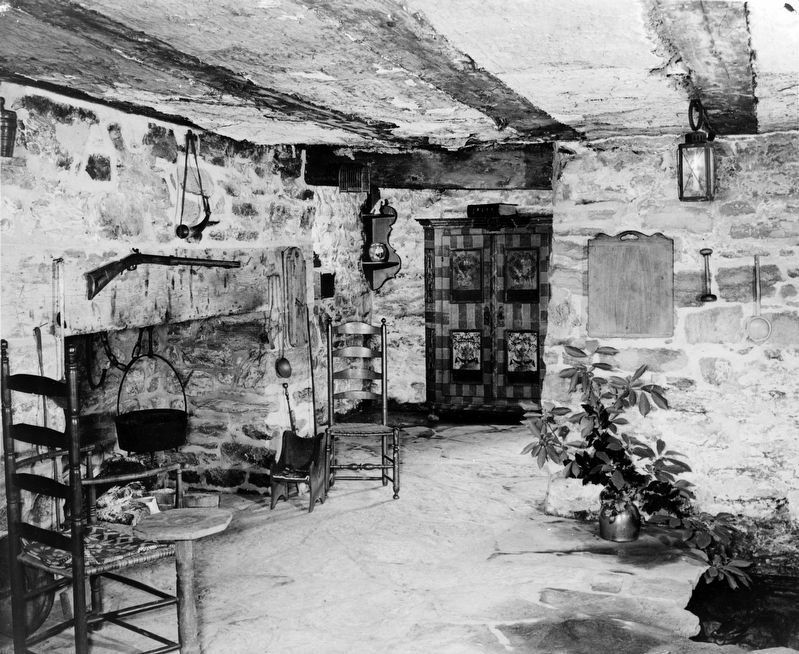
3. Springroom, 1953
Another marker is no longer nearby. Mt. Aetna Cannon (was within shouting distance of this marker but has been replaced with another marker now near it).
Regarding Hager House and Museum. The Hager House stands off Key Street, inside the city park.
Also see . . .
1. Hager House. (PDF) Ann Hill and Pamela James (August 1973). National Register of Historic Places Registration, Maryland Historical Trust. (Submitted on January 28, 2019, by Allen C. Browne of Silver Spring, Maryland.)
2. Jonathan Hager House & Museum. URL represented as a QR code on nearby signage. (Submitted on April 10, 2019, by Allen C. Browne of Silver Spring, Maryland.)
Photographed by Mike Stroud, 2011
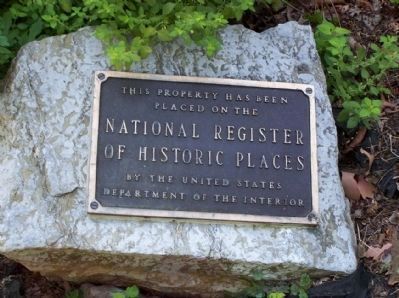
4. Hager House National Register of Historic Places:
Hager House ** (added 1974 - - #74000974)
♦ Also known as Hager's Fancy;Hager's Choice
♦ 19 Key St. , Hagerstown
♦ Historic Significance: Event, Architecture/Engineering
♦ Architect, builder, or engineer: Hager,Johanthan
♦ Architectural Style: No Style Listed
♦ Area of Significance: Architecture, Social History
♦ Period of Significance: 1700-1749
♦ Historic Sub-function: Single Dwelling
♦ Current Sub-function: Museum, Park
♦ Also known as Hager's Fancy;Hager's Choice
♦ 19 Key St. , Hagerstown
♦ Historic Significance: Event, Architecture/Engineering
♦ Architect, builder, or engineer: Hager,Johanthan
♦ Architectural Style: No Style Listed
♦ Area of Significance: Architecture, Social History
♦ Period of Significance: 1700-1749
♦ Historic Sub-function: Single Dwelling
♦ Current Sub-function: Museum, Park
Photographed by Mike Stroud, July 17, 2011
5. Hager House National Register Plaque (Stone) seen at far left
Photographed by Mike Stroud, 2011
6. Hager Museum Tribute plaques to former caretakers seen on wall

Photographed by Allen C. Browne, October 9, 2009
7. Little Heiskell
The creation of a German tinsmith named Heiskell, “Little Heiskell" is a Hessian soldier weather vane. Little Heiskel has become the symbol of the City of Hagerstown. The weather vane, now on permanent display at the Hager Museum, once adorned the cupola atop City Hall. During the Civil War, a Confederate sharpshooter reportedly fired a mini-ball through Little Heiskell's “heart.”Close-up of image on marker
Photographed by Allen C. Browne, April 7, 2019
8. Jonathan Hager House
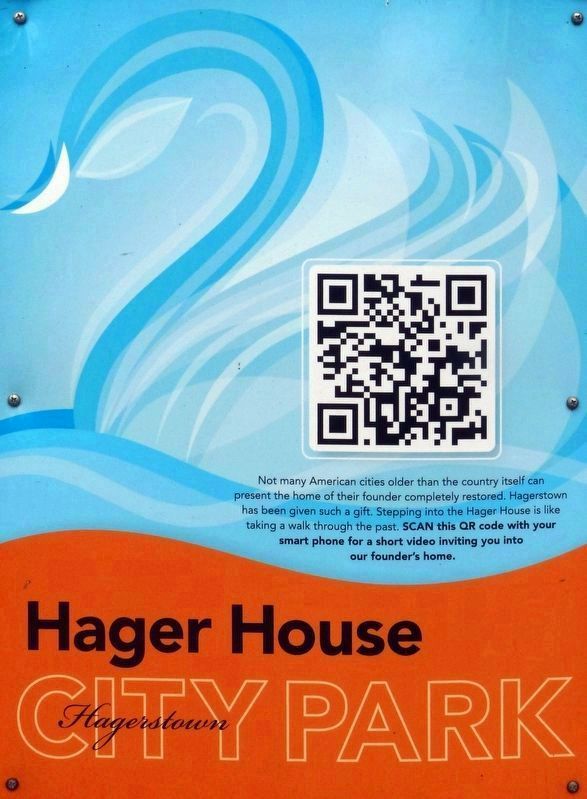
Not many American cities older than the country itself can present the home of their founder completely restored. Hagerstown has been given such a gift. Stepping into the Hager House is like taking a walk through the past. Scan this QR code with your smart phone for a short video inviting you into our founder’s home.Close-up of signage at Hager House and Museum.
Credits. This page was last revised on January 11, 2026. It was originally submitted on June 14, 2007, by Craig Swain of Leesburg, Virginia. This page has been viewed 3,509 times since then and 91 times this year. Photos: 1, 2. submitted on June 14, 2007, by Craig Swain of Leesburg, Virginia. 3. submitted on January 28, 2019, by Allen C. Browne of Silver Spring, Maryland. 4, 5, 6. submitted on July 21, 2011, by Mike Stroud of Bluffton, South Carolina. 7. submitted on January 28, 2019, by Allen C. Browne of Silver Spring, Maryland. 8. submitted on April 10, 2019, by Allen C. Browne of Silver Spring, Maryland. • J. J. Prats was the editor who published this page.
