Downtown Memphis in Shelby County, Tennessee — The American South (East South Central)
Naval Battle of Memphis, 1862
Photographed by Don Morfe, April 20, 2014
1. Naval Battle of Memphis, 1862 Marker
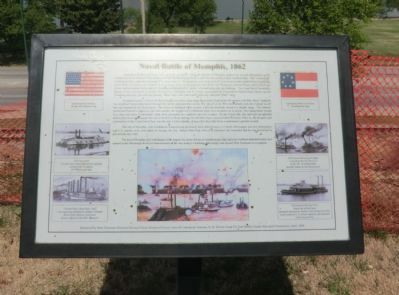
At approximately 5:30 a.m. the fleets engaged in a fierce long-range cannon duel, fighting for 90 minutes with little effect. Suddenly two unarmed Union rams darted through the smoke and joined the action. The Queen of the West immediately
this page online
The City of Memphis, with Confederate troops having previously been ordered away to Corinth, Mississippi, was now defenseless, and U.S. marines were sent ashore to occupy the city. Mayor John Park refused to surrender but conceded that he was powerless to prevent the city’s fall.
The loss of Memphis, the Confederacy’s fifth-largest city, home of a naval manufacturing yard, and a key Southern industrial center, now opened up the Mississippi River to
Photographed by Don Morfe, April 20, 2014
2. Naval Battle of Memphis, 1862 Marker
(captions)
(left: top to bottom) United States of America 34-star 1862 National Flag; USS Carondelet 542-ton Cairo-class ironclad river gunboat, Armed with 13 cannon, 251 officers and men; “Colonel Ellet’s Ram Fleet, 1862” Line engraving published in Harper’s Weekly
(right: top to bottom) Confederate States of America First National Flag; CSS General Beauregard (right) is struck by the ram Monarch (with “M” on smokestacks, partially hidden by the Beauregard); CSS General Sterling Price Notice the aft deck gun. Damaged and sunk in shallow water during the battle. Later raised by U.S. forces, repaired and renamed USS General Price.
Erected 2008 by West Tennessee Historical Society, Forrest Historical Society, Sons of Confederate Veterans, N. B. Forrest Camp 215 and Shelby County Historical Commission.
Topics. This historical marker is listed in these topic lists: War, US Civil • Waterways & Vessels. A significant historical date for this entry is June 6, 1885.
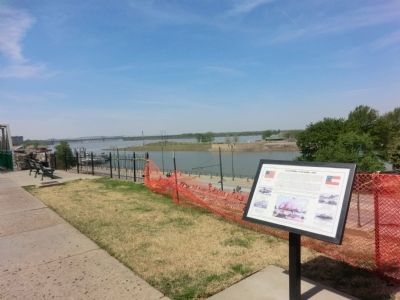
Location. 35° 8.802′ N, 90° 3.264′ W. Marker is
Photographed by Don Morfe, April 20, 2014
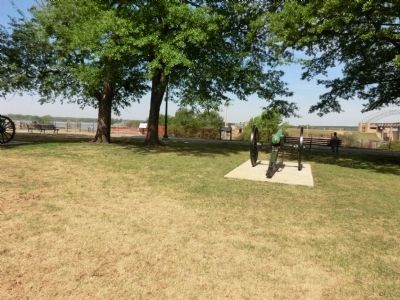
3. Naval Battle of Memphis, Cannon overlooking the bluff

Regionally, this marker is in West Tennessee. It is also in the American South, specifically in the Deep South, in the Upper South, in the Mississippi Delta, and in the Great River Road Region. Globally, it is in North America, the Western Hemisphere, the Western World, and the Anglosphere. Historically, it finds itself in what was once the territory of the Mississippian Culture, one of the Confederate States of America, and the Antebellum South.
Other nearby markers. At least 8 other markers are within walking distance of this marker: Confederate History of Memphis (a few steps from this marker); Confederate Park (a few steps from this marker); Memphis and Shelby County Medical Society (within shouting distance of this marker); Capt. J. Harvey Mathes (within shouting distance of this marker); Elizabeth Avery Meriwether (within shouting distance of this marker); Virginia ("Ginnie") Bethel Moon (within shouting distance of this marker); Ida B. Wells (about 300 feet away, measured in a direct line); Cobblestone Landing (about 300 feet away). Touch for a list and map of all markers in Memphis.
Also see . . . First Battle of Memphis. (Submitted on March 27, 2024, by Mike McKeown of Baltimore, Maryland.)
Credits. This page was last revised on March 27, 2024. It was originally submitted on June 24, 2014, by Don Morfe of Baltimore, Maryland. This page has been viewed 1,982 times since then and 94 times this year. Last updated on April 12, 2018, by T. Patton of Jefferson, Georgia. Photos: 1, 2, 3. submitted on June 24, 2014, by Don Morfe of Baltimore, Maryland. • Andrew Ruppenstein was the editor who published this page.
