East Cote Blanche Bay
Burns Point Park
| — | Atchafalaya Water Heritage Trail | — |

While deltas east of here are adding land, East Cote Blanche has been retreating due to erosion, subsidence and land loss-issues that are affecting mot of coastal Louisiana.
East Cote Blanche Bay is part of a remnant delta complex that was once the channel of the Mississippi River 5,000 to 7,500 years ago. This bay, along with West Cote Blanche Bay, Atchafalaya Bay, Marsh Island and a few offshore shoals (natural submerged ridges, banks or bars) are all that remain of the relict Maringouin Delta. East Cote Blanche is now an estuarine bay and receives a portion of its water from the Atchafalaya River. While deltas east of here are adding land, East Cote Blanche has been retreating due to erosion, subsidence and land loss—issues that are affecting most of coastal Louisiana. Oil industry infrastructure is visible from the shoreline, marking this area’s importance to Louisiana’s economy but also serving as a reminder of another factor that has led to wetland loss.
Rich bays and marshes like East Cote Blanche Bay are important for Louisiana’s coastal fisheries and the state’s seafood industry. They provide important
this page online
Salt domes, the highest points of land along the coast, are located on the perimeter of the bay. They are part of the Gulf Coast Salt Dome Basin—situated primarily along Texas and Louisiana—and provided vital high ground where animals congregated in prehistoric times and American Indians established villages. Large stands of mature live oak trees thrive on these domes, which still serve as a habitat for many species of wildlife, including the Louisiana black bear. Migratory birds also use this coastline as a refuge after a long trip across the Gulf of Mexico.
Cote Blanche (“White Coast” in French) is one of the five primary “islands” or domes that make up the Five Island Trend (the others are Jefferson, Avery, Weeks and Belle Isle). These islands rise an average of 150 to 200 feet above the

East Cote Blanche Bay provides access for sports fishermen and recreational boaters to Marsh Island, a wildlife refuge and popular recreational fishing and shrimping destination about 20 miles from the Louisiana coast. Although the island was 76,664 acres when originally deeded, it has since eroded to about 70,000 acres today.
Visit Atchafalaya.org for more information about this site.
This site’s geology/geomorphology: Holocene natural levee deposits of Teche delta lobe of the Mississippi River adjacent to Holocene deltaic deposits of same.
Erected by State of Louisiana and National Park Service.
Topics and series. This historical marker is listed in these topic lists: Environment • Waterways & Vessels. In addition, it is included in the Atchafalaya Water Heritage Trail series list.
Location. 29° 34.466′ N, 91° 32.268′ W. Marker is in Burns, Louisiana, in St. Mary Parish. It is on Burns Point Lane 0.3 miles north of State Highway 317, on the right when traveling north. Touch for map. Marker is in this post office


Regionally, this marker is in one of the River Parishes, in Acadiana — Cajun Country, and specifically in Bayou Country. It is also in the American South, specifically in the Deep South, on the Gulf Coast, and in the Great River Road Region. Globally, it is in North America, a Gulf of Mexico state, the Western Hemisphere, the Western World, and the Anglosphere. Historically, it finds itself in what was once New Spain, Acadia, the territory of the Mississippian Culture, the Louisiana Purchase, one of the Confederate States of America, and the Antebellum South.
Other nearby markers. At least 8 other markers are within 16 miles of this marker, measured as the crow flies: Bayou Teche (approx. 12½ miles away); a different marker also named Bayou Teche (approx. 12½ miles away); Cypress Trees (approx. 12.6 miles away); Swamps on the Cusp of Change (approx. 12.6 miles away); Battle Of Bisland (approx. 13.3 miles away); Murphy James Foster (approx. 14.2 miles away); Welcome to Centerville (approx. 14.8 miles away); Williams Memorial Airport (approx.
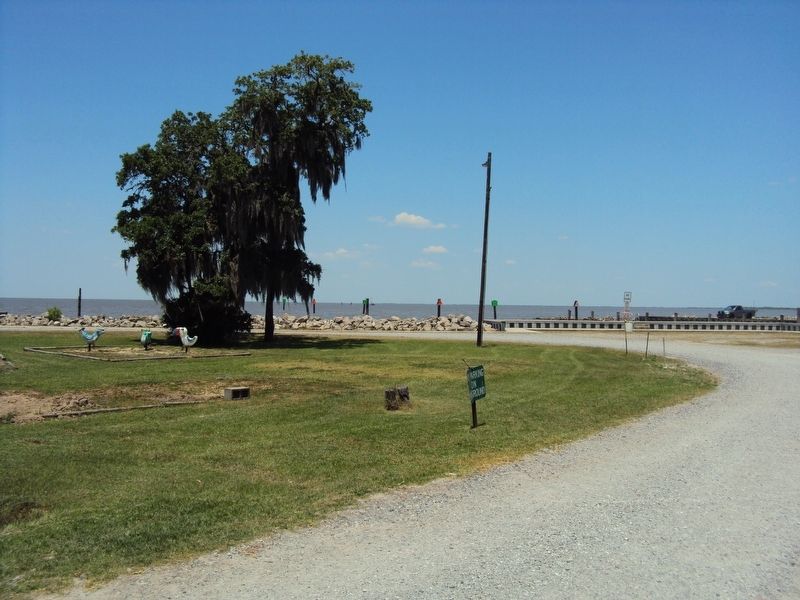
More about this marker. Located inside the Burns Point Park. Fee recommended, not required.
Credits. This page was last revised on February 25, 2024. It was originally submitted on May 8, 2018, by Cajun Scrambler of Assumption, Louisiana. This page has been viewed 778 times since then and 59 times this year. Photos: 1, 2, 3, 4. submitted on May 8, 2018.
