Mission Valley in El Paso in El Paso County, Texas — The American South (West South Central)
Site Of The First Mission In Texas
Corpus Christi de la Ysleta del Sur
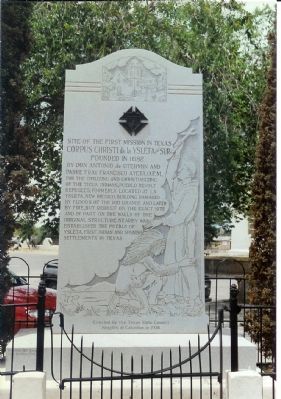
Photographed by Michael Stroud, June 1996
1. Site Of The First Mission In Texas Marker
Erected 1936 by Texas State Council , Knights of Columbus.
Topics. This historical marker is listed in these topic lists: Colonial Era • Indigenous Peoples and Communities • Religion & Religious Structures • Settlements & Settlers. A significant historical year for this entry is 1682.
Location. Marker has been reported missing. It was located near 31° 41.493′ N, 106° 19.656′ W. Marker was in El Paso, Texas, in El Paso County. It was in Mission Valley. It was at the intersection of South Zaragoza Road and Texas Highway 20 on South Zaragoza Road. Touch for map. Marker was at or near this postal address: 131 South Zaragoza Rd, El Paso TX 79907, United States of
this page online

Regionally, this marker was in Texas’ Trans-Pecos & Big Bend Region. It was also in the American Borderlands and in the Southwest. Globally, it was in North America, a Gulf of Mexico state, the Western Hemisphere, the Western World, and the Anglosphere. Historically, it found itself in what was once New Spain, the Republic of Texas, and one of the Confederate States of America.
Other nearby markers. At least 8 other markers are within 2 miles of this location, measured as the crow flies: First Mission and Pueblo in Texas (here, next to this marker); Oldest Mission in Texas (here, next to this marker); Ysleta Mission / Misión de Ysleta (about 300 feet away, measured in a direct line); Alderete-Candelaria House (about 600 feet away); Ysleta Plaza (about 600 feet away); Ysleta High School / La Preparatoria Ysleta (approx. one mile away); San Antonio de Senecú (approx. 1½ miles away); Captain Frank Jones (approx. 1½ miles away). Touch for a list and map of all markers in El Paso.
Additional commentary.
1. A fire
... in 1907 damaged the mission. In 1916, the Rio
Grande was dammed and
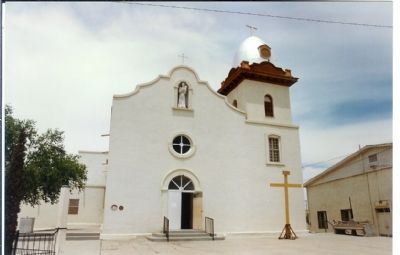
Photographed by Michael Stroud, June 1996
2. The Mission
The resulting rise in the water table brought salt to the surface and the land became suitable for only salt
tolerant crops such as cotton.
— Submitted January 13, 2008, by Mike Stroud of Bluffton, South Carolina.
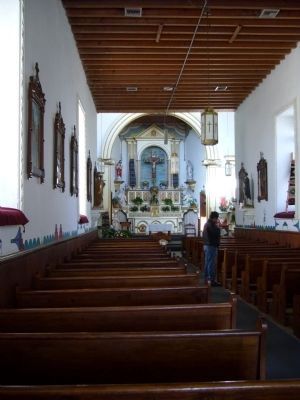
Photographed by Bill Kirchner, November 4, 2010
3. Corpus Christi de la Ysleta Del Sur Mission
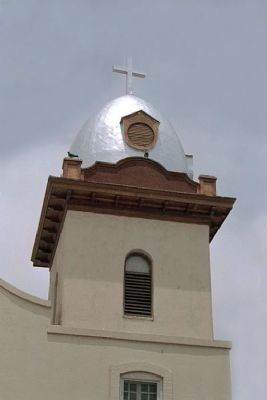
Photographed by Michael Stroud, June 1996
4. Mission detail
Credits. This page was last revised on August 27, 2020. It was originally submitted on January 13, 2008, by Mike Stroud of Bluffton, South Carolina. This page has been viewed 5,029 times since then and 55 times this year. Last updated on June 5, 2018, by Brian Anderson of New Albany, Ohio. Photos: 1, 2. submitted on January 13, 2008, by Mike Stroud of Bluffton, South Carolina. 3. submitted on November 14, 2010, by Bill Kirchner of Tucson, Arizona. 4. submitted on January 13, 2008, by Mike Stroud of Bluffton, South Carolina. • Bill Pfingsten was the editor who published this page.
