Corpus Christi in Nueces County, Texas — The American South (West South Central)
Capitán Blas María de la Garza Falcón
1712 - 1767
| — | First Colonist | — |
Photographed by Cosmos Mariner, May 16, 2018
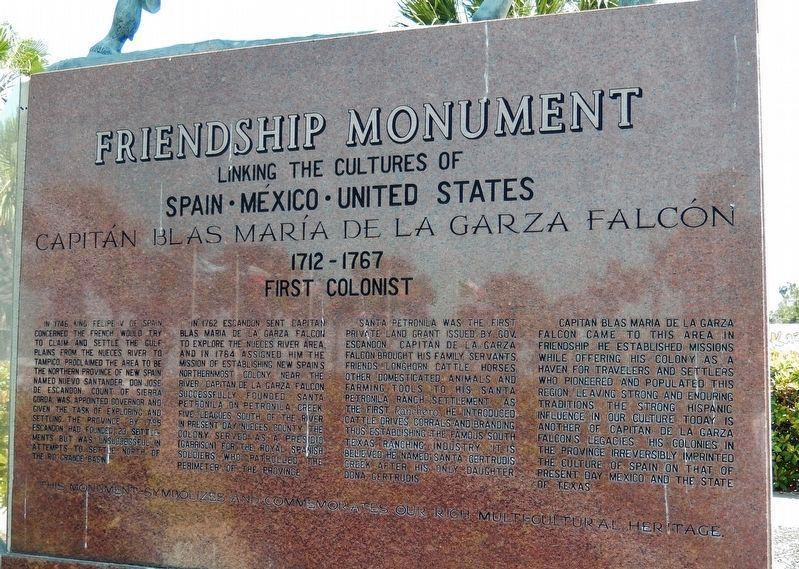
1. Capitán Blas María de la Garza Falcón Marker (front side)
Linking the Cultures of
Spain • México • United States
In 1746, King Felipe V of Spain, concerned the French would try to claim and settle the Gulf Plains from the Nueces River to Tampico, proclaimed the area to be the Northern Province of New Spain, named Nuevo Santander. Don Jose de Escandon, count of Sierra Gorda, was appointed Governor and given the task of exploring and settling the province. By 1755 Escandon had founded 23 settlements but was unsuccessful in attempts to settle north of the Rio Grande Basin.
In 1762, Escandon sent Capitan Blas María de la Garza Falcón to explore the Nueces River area, and in 1764 assigned him the mission of establishing New Spain’s northernmost colony near the river. Capitan Blas de las Garza Falcón successfully founded Santa Petronila on Petronila Creek, five leagues south of the river in present day Nueces county. The colony served as a presido (garrison) for the Royal Spanish soldiers who patrolled the perimeter of the province.
Santa Patronila was the first private land grant issued by Gov. Escandon. Capitan de las Garza Falcón brought
this page online
Capitan Blas María de la Garza Falcón came to this area in friendship. He established missions while offering his colony as a haven for travelers and settlers who pioneered and populated this region, leaving strong and enduring traditions. The strong Hispanic influence in our culture today is another of Capitan de la Garza Falcon’s legacies. His colonies in the province irreversibly imprinted the culture of Spain on that of present day Mexico and the State of Texas.
This monument symbolizes and commemorates our rich multicultural heritage.
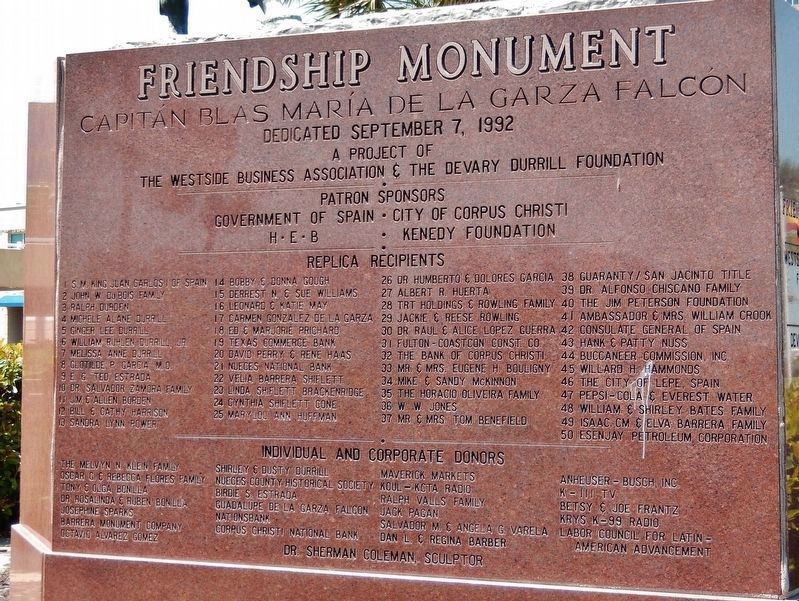
Dedicated September 7, 1992
A project of
The Westside Business Association & The Devary Durril Foundation
Patron Sponsors
Government of Spain • City of Corpus Christi • H-E-B • Kenedy Foundation
Replica Recipients
Photographed by Cosmos Mariner, May 16, 2018
2. Capitán Blas María de la Garza Falcón Marker (reverse side)
Photographed by Cosmos Mariner, May 16, 2018
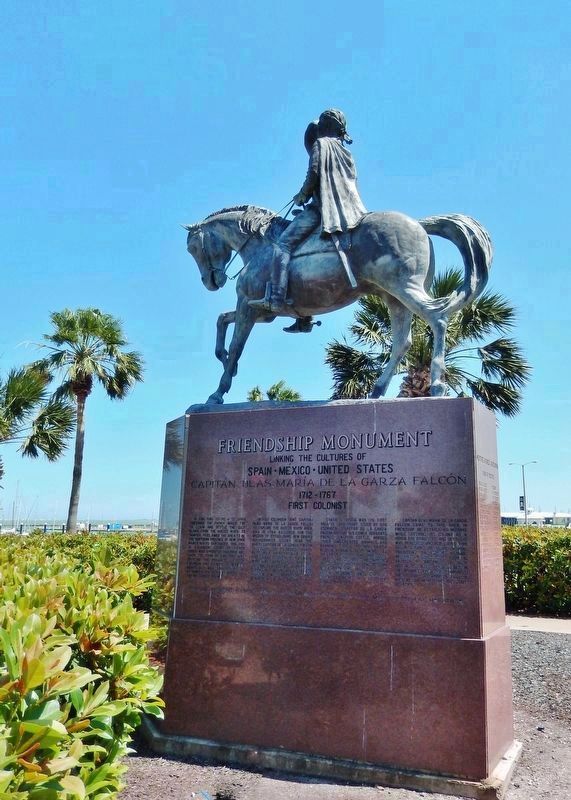
3. Capitán Blas María de la Garza Falcón Monument (tall view)
Individual and Corporate Donors
Dr. Sherman Coleman, Sculptor
Erected 1992 by The Westside Business Association & The Devary Durril Foundation.
Topics. This historical marker is listed in these topic lists: Colonial Era • Hispanic Americans •

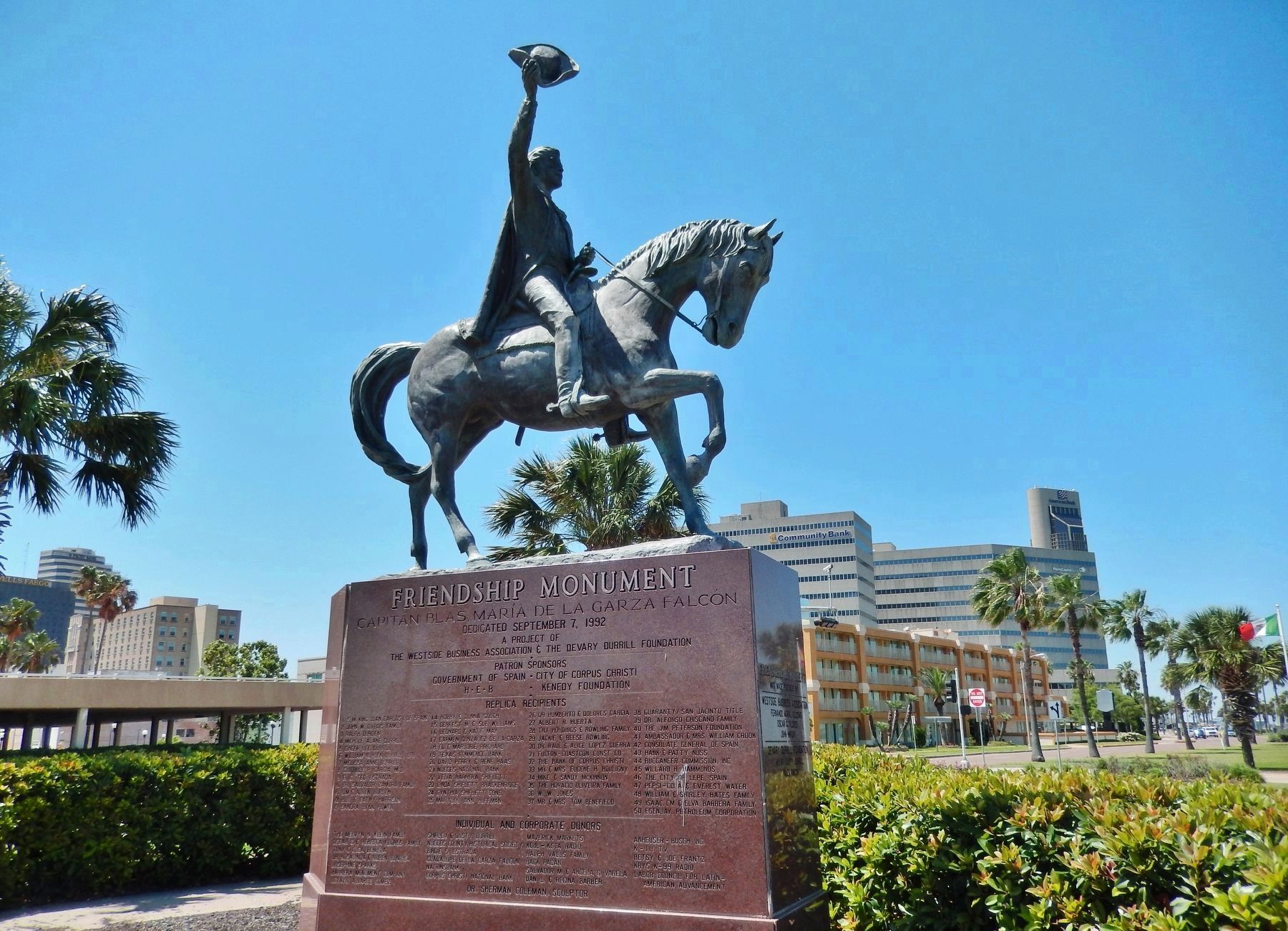
Dr. Sherman Coleman, sculptor. Photographed by Cosmos Mariner, May 16, 2018
4. Capitán Blas María de la Garza Falcón Monument (wide view)
Location. 27° 47.651′ N, 97° 23.51′ W. Marker is in Corpus Christi, Texas, in Nueces County. It is at the intersection of Lawrence Street and North Shoreline Boulevard, on the right when traveling east on Lawrence Street. Monument & Marker are located along the walkway, in the plaza, on the south side of Lawrence Street, between the south-bound and north-bound lanes of North Shoreline Boulevard. Touch for map. Marker is in this post office area: Corpus Christi TX 78401, United States of America. Touch for directions.

Regionally, this marker is in the American South and on the Gulf Coast. Globally, it is in North America, a Gulf of Mexico state, the Western Hemisphere, the Western World, and the Anglosphere. Historically, it finds itself in what was once New Spain, the Republic of Texas, and one of the Confederate States of America.
Other nearby markers. At least 8 other markers are within walking distance of this marker: Corpus Christi (about 600 feet away, measured in a direct line); Gutzon Borglum and the Corpus Christi Bayfront (about 600 feet away);
Photographed by Cosmos Mariner, May 16, 2018
5. Capitán Blas María de la Garza Falcón Monument (reverse side; wide view)
More about this marker. Monument consists of a large metal sculpture of Capitan Blas Maria de la Garza Falcon on his horse, mounted on a large, polished, purple granite pedestal. The marker consists of four panels inscribed on the pedestal.
Also see . . .
1. Cattle ranch near Petronila was the largest in the hemisphere.
Captain Falcón's Rancho Santa Petronila became the largest cattle and horse ranch in the hemisphere and its thousands of cattle and mustangs roamed the Wild Horse Desert from Padre Island to the Brush County. Falcón later brought the first longhorn cattle to South Texas as his herd of Spanish cattle grew to more than 20,000. The Spanish mustangs numbered in the thousands, as well. Mustang Island, now near present-day Port Aransas, was known as “La Isla de los Mesteños.” The horses used the dew that formed fresh water on top of the salty marshes to quench their thirst. (Submitted on June 7, 2018, by Cosmos Mariner of Cape Canaveral, Florida.)
2. Captitan Blas María de la Garza Falcón.
On March 5, 1749, Garza Falcón arranged for forty families from Nuevo León to settle at Camargo on the banks of the Rio Grande. He founded the villa of Camargo, a presidio for the military squadron, and a mission, San Agustín de Laredo, for the Indians. Escandón named him captain and chief justice of Camargo, the first settlement founded on the Rio Grande. In 1752 Garza Falcón established a ranch, Carnestolendas, now the site of Rio Grande City, Texas, on the north side of the river. In 1767 Garza Falcón returned to Camargo, where he died and was buried in his private chapel, Nuestra Señora de Guadalupe. After his death the land grants were distributed to the settlers; his family received land extending from the Rio Grande to the Nueces River in South Texas. (Submitted on June 7, 2018, by Cosmos Mariner of Cape Canaveral, Florida.)
3. Santa Petronila Ranch. Santa Petronila was the first Spanish settlement in what is now Nueces County, Texas. It was established in 1762 by Capt. Blás María de la Garza Falcón, founder of Camargo, Nuevo Santander, Mexico. The ranch was established as an outpost and way station for travelers between the provinces of Nuevo Santander and the missions of East Texas and served as headquarters for expeditions of soldiers who patrolled Isla Blanca (Padre Island), Mustang Island, and St. Joseph's Island searching for settlements by English or French soldiers. (Submitted on June 16, 2018, by Cosmos Mariner of Cape Canaveral, Florida.)
Additional commentary.
1. He's my ancestor!
I study geneology and am so happy to learn that I am a distant cousin! I'm directly related through his grandfather Captain Francisco De la Garza Falcon Gonzalez, who was the brother of my 8th great-grandmother Ines De la Garza Falcon! Thank you for this history.
— Submitted July 8, 2024, by Rosa Castillo of Los Angeles, California.
2. My 5th great-grandfather .
Capitan Blas Maria de la Garza Falcon was my 5th great-grandfather . My mom was Elva Falcon de Bullen from Guerra Texas near Roma. One of my first cousins and two cousins from Spain did the unveiling. Does anyone have any pictures or newspaper article about the ceremony? I have tried many times to get the article on the Corpus Christi Caller-Times archives with no luck. I have read it before but can’t seem to find it now.
— Submitted February 12, 2025, by Mary Bullen Ramirez of Laredo, Texas.
Credits. This page was last revised on April 17, 2026. It was originally submitted on June 7, 2018, by Cosmos Mariner of Cape Canaveral, Florida. This page has been viewed 13,324 times since then and 860 times this year. Photos: 1, 2, 3, 4, 5. submitted on June 7, 2018, by Cosmos Mariner of Cape Canaveral, Florida. • Andrew Ruppenstein was the editor who published this page.
