Gulf Breeze in Santa Rosa County, Florida — The American South (South Atlantic)
Live Oaks and Naval Ship Timbers
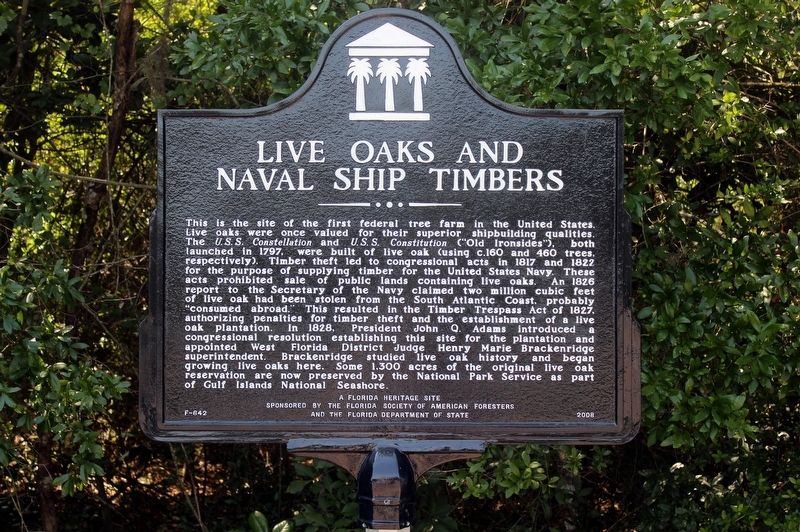
Photographed by Tim Fillmon, May 9, 2018
1. Live Oaks and Naval Ship Timbers Marker
this page online
Erected 2008 by The Florida Society of American Foresters and the Florida Department of State. (Marker Number F-642.)
Topics. This historical marker is listed in these topic lists: Horticulture & Forestry • Parks & Recreational Areas • Waterways & Vessels. A significant historical year for this entry is 1828.
Location. 30° 21.896′ N, 87° 7.9′ W. Marker is in Gulf Breeze, Florida, in Santa Rosa County. It is on Gulf Breeze Parkway (U.S. 98) 2.4 miles east of Pensacola Beach Boulevard (County Road 399), on the right when traveling east. Marker is at the entrance road to Gulf Islands National Seashore Naval Live Oaks Visitor Center and Park Headquarters. Touch for map. Marker is at or near this postal address: 1801 Gulf Breeze Parkway, Gulf Breeze FL 32561, United States of America. Touch for directions.

Regionally, this marker is in Greater Pensacola and on the Florida Panhandle. It is also in the American South, specifically in the Deep South, and on the Gulf Coast. Globally, it is in the North Atlantic Region, North America, a Gulf of Mexico state, the Western
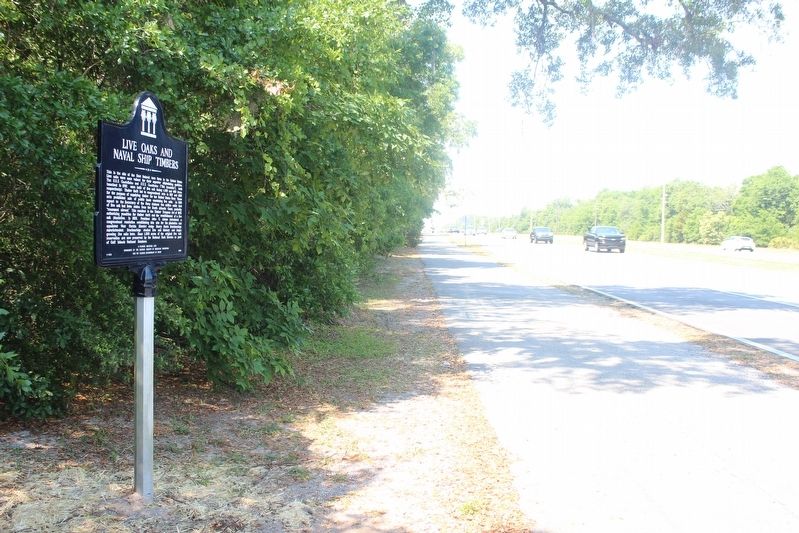
Photographed by Tim Fillmon, May 9, 2018
2. Live Oaks and Naval Ship Timbers Marker
Looking west on US 98 from visitor center entrance road.
Other nearby markers. At least 8 other markers are within 6 miles of this marker, measured as the crow flies: First Federal Tree Farm (about 400 feet away, measured in a direct line); Site of Pensacola - St. Augustine Road (approx. 2.3 miles away); First Religious Service in Pensacola (approx. 3 miles away); Emanuel Point Shipwrecks / Los Naufragios de Emanuel Point (approx. 5.2 miles away); Frascati (approx. 5.3 miles away); Maritime Prehistory (approx. 5.4 miles away); Spanish Exploration and Discovery (approx. 5.4 miles away); The Yonge House (approx. 5.4 miles away). Touch for a list and map of all markers in Gulf Breeze.
Also see . . . Naval Live Oaks Reservation. (Submitted on July 20, 2018, by Tim Fillmon of Webster, Florida.)
Credits. This page was last revised on July 22, 2018. It was originally submitted on July 20, 2018, by Tim Fillmon of Webster, Florida. This page has been viewed 878 times since then and 95 times this year. Photos: 1, 2. submitted on July 20, 2018, by Tim Fillmon of Webster, Florida. • Andrew Ruppenstein was the editor who published this page.
