Near Wisdom in Beaverhead County, Montana — The American West (Mountains)
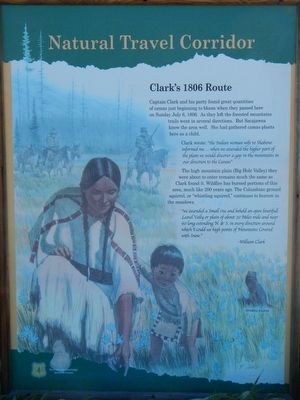
Natural Travel Corridor
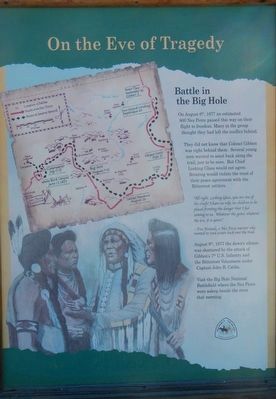
On the Eve of Tragedy
| — | Trail Creek | — |
Photographed by Barry Swackhamer, May 12, 2018
1. Natural Travel Corridor panel
Clark's 1806 Route
Clark wrote: "the Indian women wife to Shabono informed me ... when we ascended the higher part of the plain we would discover a gap in the mountains in our direction to the Canoes."
The high mountain plain (Big Hole Valley) they were about to enter remains much the same as Clark found it. Wildfire has burned portions of this area, much like 200 years ago. The Columbian ground squirrel, or "whistling squirrel," continues to burrow in the meadows.
"we ascended a Small rise and beheld an open boutifull Leavel Valley or plain of about 20 Miles wide and near 60 long extending N. & S. in every direction around which I could see high points of Mountains Covered with Snow." -- William Clark
Battle in the Big
this page online
They did not know that Colonel Gibbon was right behind them. Several young men wanted to scout back along the trail, just to be sure. But Chief Looking Glass would not agree. Scouting would violate the trust of their peace agreement with the Bitterroot settlers.
"All right, Looking Glass, you are one of the chiefs! I have no wife, no children to be placed fronting the danger that I feel coming to us. Whatever the gains, whatever the loss, it is yours" -- Five Wounds, a Nez Perce warrior who wanted to send scouts back over the trail.
August 9th, 1877 the dawn's silence was shattered by the attack of Gibbon's 7th U.S. Infantry and the Bitterroot Volunteers under Captain John B. Catlin.
Visit the Big Hole National Battlefield where the Nez Perce were asleep beside the river that morning.
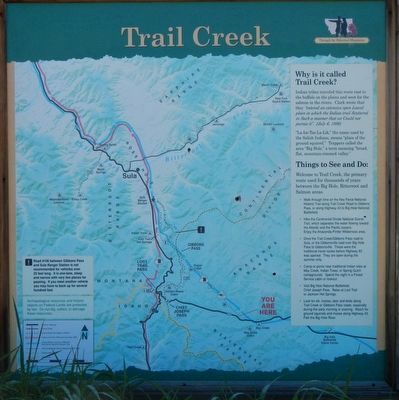
Why is it Called Trail Creek?
Photographed by Barry Swackhamer, May 12, 2018
2. On the Eve of Tragedy panel
Caption: (upper left) Map of the battles during the Flight of the Nez Perce.
"La-Im-Tse-La Lik," the name used by the Salish Indians, means "place of the ground squirrel." Trappers called the area "Big Hole," a term meaning "broad, flat, mountain-rimmed valley."
Things to See and Do:
Welcome to Trail Creek, the primary route used for thousands of years between the Big Hole, Bitterroot and Salmon areas.
•Walk through time on the Nez Perce Historic Trail along Trail Creek Road to Gibbon Pass, or along Highway 43 to Big Hole National Battlefield.
•Hike the Continental Divide National Scenic Trail, which separates the water flowing toward the Atlantic and the Pacific oceans. Enjoy the Anaconda-Pintler Wilderness area.
•Drive the Trail Creek/Gibbon Pass road to Sula, or the Gibbonsville road over Big Hole Pass to Gibbonsville. These were the traditional travel routes before Highway 93 was opened. They are open during the summer only.
•Camp or picnic near traditional Indian sites at May Creek, Indian Trees, of Spring Gulch campgrounds, Spend the night in a Forest Service cabin or lookout.
•Visit Big Hole National Battlefield, Chief Joseph Pass. Relax at Lost Trail or Jackson Hot Springs.
•Look for elk, moose, deer and birds along Trail Creek or Gibbons Pass roads, especially during the early morning or evening. Watch for ground squirrels and moose along Highway 43. Fish the Big Hole River.
Erected by U.S.
Photographed by Barry Swackhamer, May 12, 2018
3. Trail Creek panel
Caption: (background) Map of the Lewis & Clark 1805 and Wm. Clark 1806 routes.
Topics and series. This historical marker is listed in these topic lists: Exploration • Indigenous Peoples and Communities • Wars, US Indian. In addition, it is included in the Lewis & Clark Expedition, and the The Nez Perce Trail series lists. A significant historical date for this entry is July 6, 1806.
Location. 45° 39.582′ N, 113° 48.744′ W. Marker is near Wisdom, Montana, in Beaverhead County. It is at the intersection of State Highway 43 and Bitterroot-Big Hole Road, on the left when traveling east on State Highway 43. Touch for map. Marker is in this post office area: Wisdom MT 59761, United States of America. Touch for directions.

Regionally, this marker is in andspecifically outhwest Montana, in Gold West Country, in Mining Country. It is also in the American Mountain West and in the Lewis & Clark Corridor. Globally, it is in North America, the Rocky Mountains, the Western Hemisphere, the Western World, and the Anglosphere. Historically, it finds itself in what was once Rupert’s Land and also the Louisiana Purchase.
Other nearby markers. At least 8 other markers are
Photographed by Barry Swackhamer, May 12, 2018
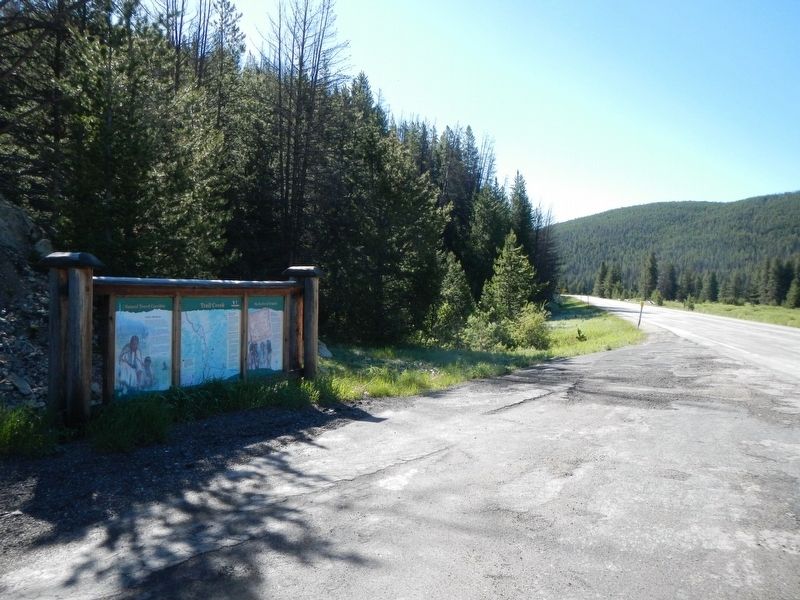
4. Natural Travel Corridor Marker
Credits. This page was last revised on September 24, 2018. It was originally submitted on September 24, 2018, by Barry Swackhamer of Brentwood, California. This page has been viewed 1,266 times since then and 112 times this year. Photos: 1, 2, 3, 4. submitted on September 24, 2018, by Barry Swackhamer of Brentwood, California.
