Fort Pierre in Stanley County, South Dakota — The American Midwest (Upper Plains)
Verendrye Explorers
Photographed by Cosmos Mariner, August 19, 2016
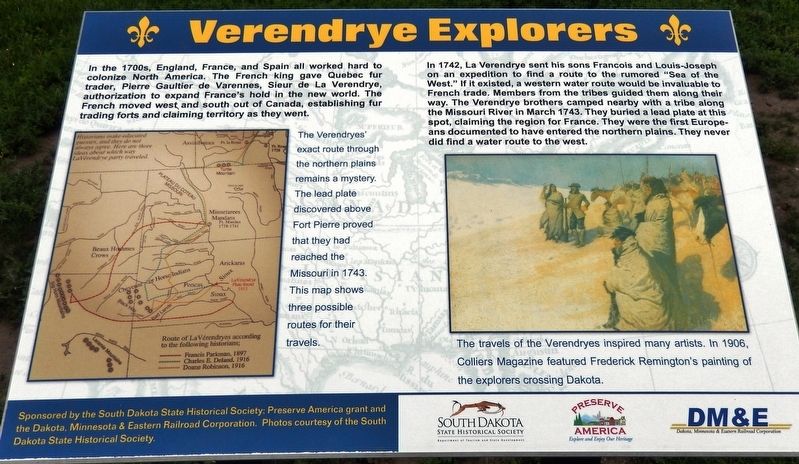
1. Verendrye Explorers Marker
In 1742, La Verendrye sent his sons Francois and Louis-Joseph on an expedition to find a route to the rumored “Sea of the West.” If it existed, a western water route would be invaluable to French trade. Members from the tribes guided them along their way. The Verendrye brothers camped nearby with a tribe along the Missouri River in March 1743. They buried a lead plate at this spot, claiming the region for France. They were the first Europeans documented to have entered the northern plains. They never did find a water route to the west.
Erected by The South Dakota State Historical Society; a Preserve America grant and the Dakota, Minnesota and Eastern Railroad Corporation.
Topics. This historical marker is listed in these topic lists: Colonial Era •
this page online
Location. 44° 21.321′ N, 100° 22.695′ W. Marker is in Fort Pierre, South Dakota, in Stanley County. It is on Verendrye Drive (2nd Street) 0.4 miles north of West 2nd Avenue. Marker is located at the Verendrye National Historic Site, on the hilltop overlooking Fort Pierre and the Missouri River. Touch for map. Marker is in this post office area: Fort Pierre SD 57532, United States of America. Touch for directions.

Regionally, this marker is in the Crow Creek Sioux Tribe and in East River. It is also in the American Lewis & Clark Corridor, on the prairies, and on the Northern Plains. Globally, it is in North America, the Western Hemisphere, the Western World, and the Anglosphere. Historically, it finds itself in what was once Rupert’s Land and also the Louisiana Purchase.
Other nearby markers. At least 8 other markers are within walking distance of this marker: Translation of the Verendrye Plate (here, next to this marker); The Verendrye Site (a few steps from this marker); Verendrye Tablet Site (within shouting distance
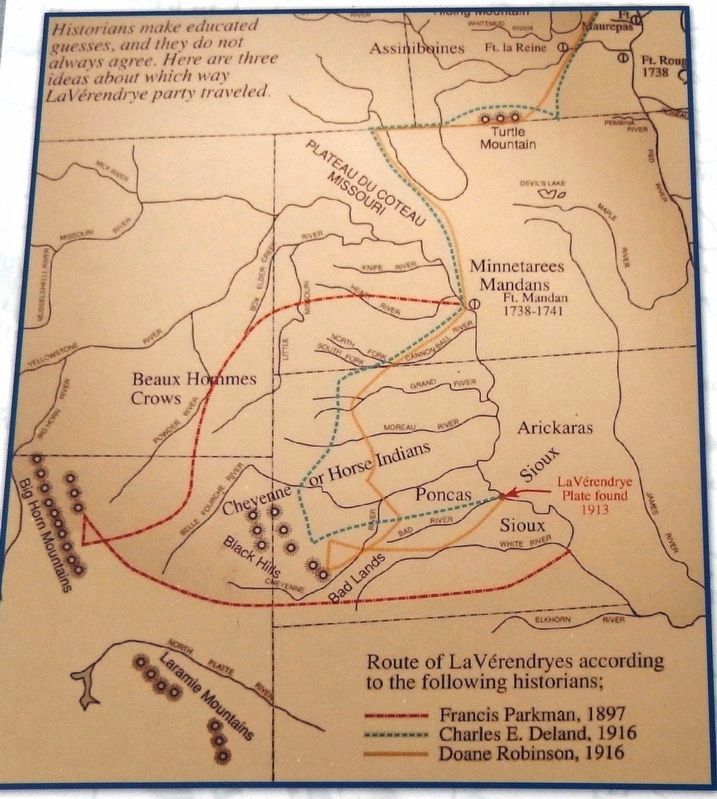
2. Marker detail: La Verendryes' route according to the historians: Parkman, Deland and Robinson
The Verendryes' exact route through the northern plains remains a mystery. The lead plate discovered above Fort Pierre proved that they had reached the Missouri in 1743. This map shows three possible routes for their travels.
More about this marker. Marker is a large composite plaque, mounted horizontally, on waist-high posts.
Regarding Verendrye Explorers. National Historic Landmark (1991)
Related markers. Click here for a list of markers that are related to this marker. The Verendrye National Historic Site
Also see . . . Verendrye brothers' journey to the Rocky Mountains. The Vérendrye brothers were the first Europeans to cross the northern Great Plains and see the Rocky Mountains. All we know comes from a journal found in the French archives in 1851, another document in the French archives and a lead plate found buried near Pierre, South Dakota. The journal is difficult to interpret. The mountains they saw were probably the Big Horn Mountains of Wyoming,
Photographed by Frederick Remington
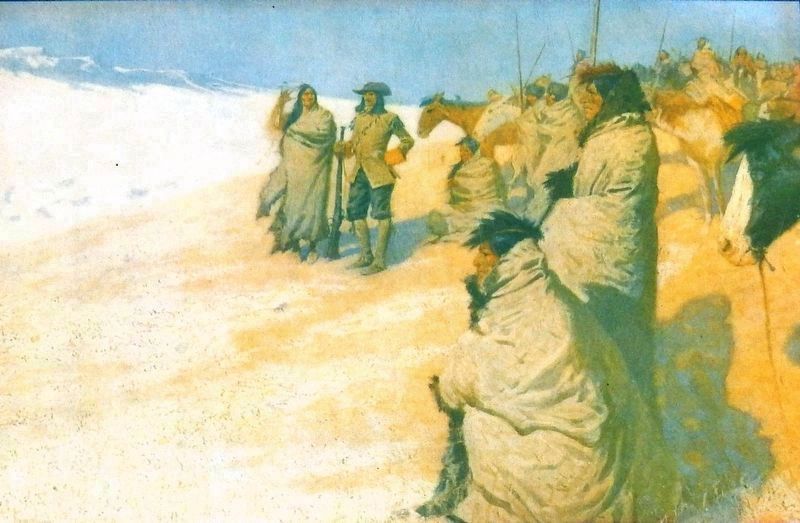
3. Marker detail: Frederick Remington’s painting of the explorers crossing Dakota
The travels of the Verendryes inspired many artists. In 1906, Colliers Magazine featured Frederick Remington’s painting of the explorers crossing Dakota.
Photographed by Cosmos Mariner, August 19, 2016
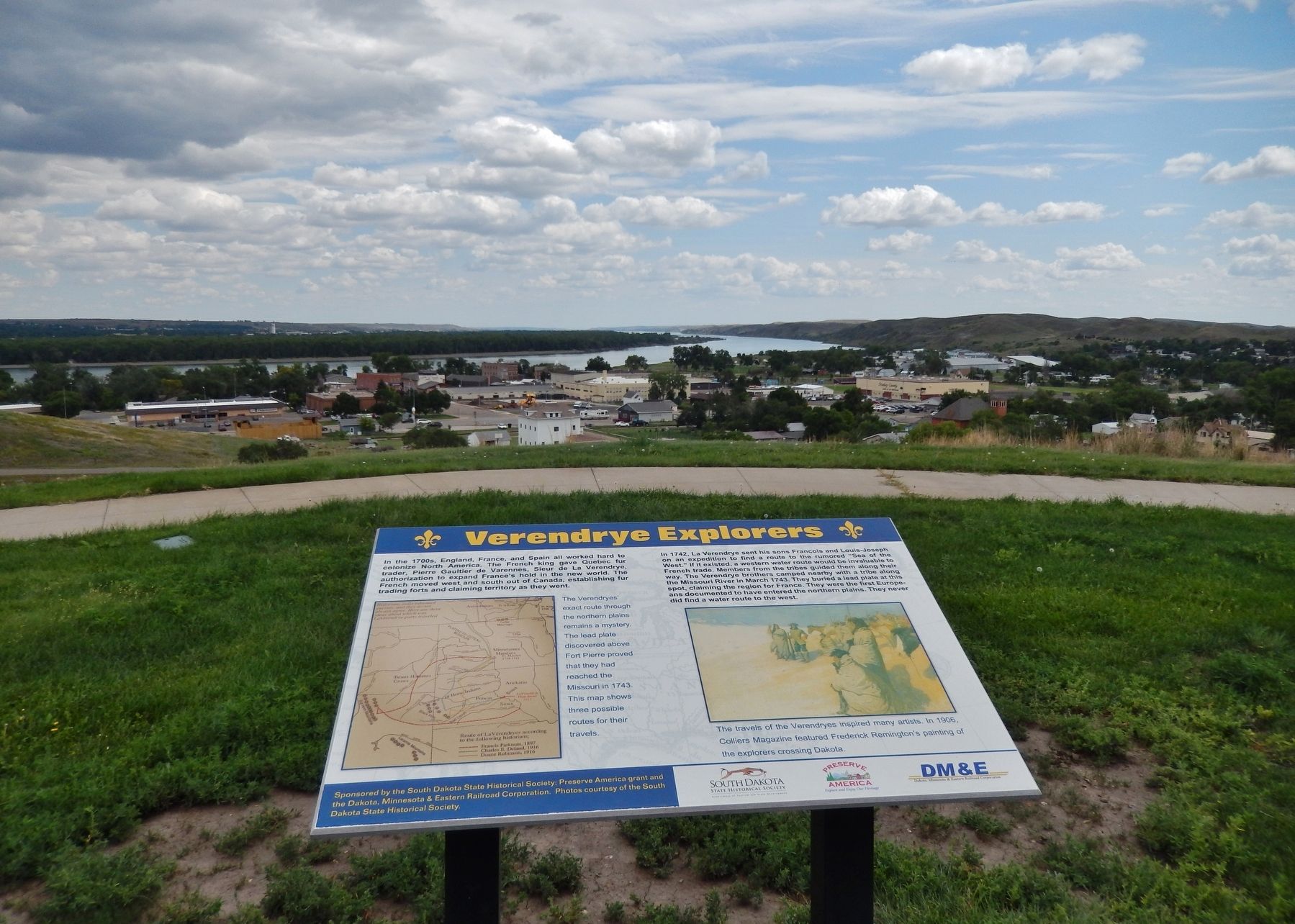
4. Verendrye Explorers Marker (wide view; Fort Pierre & Missouri River in background)
Credits. This page was last revised on October 14, 2018. It was originally submitted on October 11, 2018, by Cosmos Mariner of Cape Canaveral, Florida. This page has been viewed 1,074 times since then and 114 times this year. Photos: 1, 2, 3, 4. submitted on October 13, 2018, by Cosmos Mariner of Cape Canaveral, Florida. • Andrew Ruppenstein was the editor who published this page.
