Walker in Cass County, Minnesota — The American Midwest (Upper Plains)
Sugar Point Battle
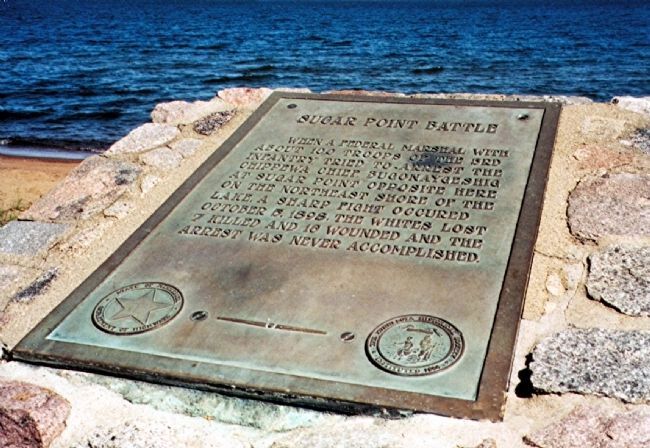
Photographed by Cosmos Mariner, July 3, 2003
1. Sugar Point Battle Marker
Erected by Minnesota Historical Society & State of Minnesota Department of Highways.
Topics and series. This historical marker is listed in these topic lists: Indigenous Peoples and Communities • Wars, US Indian. In addition, it is included in the Minnesota Historical Society series list. A significant historical date for this entry is October 5, 1869.
Location. 47° 3.005′ N, 94° 21.426′ W. Marker is in Walker, Minnesota, in Cass County. It is on Whipholt Beach Road (Maple Leaf Drive) (State Highway 200) 0.4 miles east of 16th Avenue (Pine Lake Road) (County Road 2108), on the left when traveling east. The marker is located in the Whipholt Roadside Parking Area, overlooking Leach Lake to the north. Touch for map. Marker is in this post office area: Walker MN 56484, United States of America. Touch for directions.

Regionally, this
this page online
Other nearby markers. At least 3 other markers are within 12 miles of this marker, measured as the crow flies: Gaa-zagaskwaajimekaag (a few steps from this marker); The Battle of Sugar Point (a few steps from this marker); Lucette Diana Kensack (approx. 11.4 miles away).
More about this marker. A rehabilitation of this site was completed in 2020, including rebuilding of the rock wall and battle monument.
Related markers. Click here for a list of markers that are related to this marker. The Battle of Sugar Point
Also see . . .
1. Battle of Sugar Point. Excerpt:
The Battle of Sugar Point, or the Battle of Leech Lake, was fought on October 5, 1898 between the 3rd U.S. Infantry and members of the Pillager Band of Chippewa Indians in a(Submitted on October 13, 2018, by Cosmos Mariner of Cape Canaveral, Florida.)failed attempt to apprehend Pillager Ojibwe Bugonaygeshig ("Old Bug" or "Hole-In-The-Day"), as the result of a dispute with Indian Service officials on the Leech Lake Reservation in Cass County, Minnesota. Often referred to as "the last Indian Uprising in the United States", the engagement was also the first battle to be fought in the area of the United States known as the Old Northwest since the Black Hawk War in 1832. It is sometimes considered to be the last battle fought between Native Americans and the U.S. Army.Photographed by Cosmos Mariner, July 3, 20032. Sugar Point Battle Marker
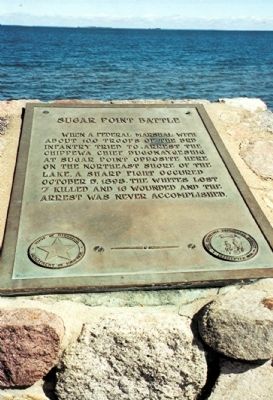
2. The Battle of Sugar Point. Excerpt:
The 1898 Battle of Sugar Point is generally agreed to be the last battle between the United States and Native American tribes. The battle was small and quick. Still, it is sobering to think a battle between the United States and members of a sovereign nation occurred on this peaceful lake within the lifetime of your great grandparents.(Submitted on October 13, 2018, by Cosmos Mariner of Cape Canaveral, Florida.)
3. The Battle of Sugar Point. Excerpt:
In the late 19th century, tensions were high between many Ojibwe in northern Minnesota and the government, including conflicts over logging on reservations. Timber companies often violated the law, taking more trees than allowed and were late with tribal payments for the wood. On Sept. 25, 1898, less than two weeks before the Battle of Sugar Point, several Ojibwe leaders petitioned President William McKinley, writing, “We now have only the pine lands of our reservations for our future subsistence and support, but the manner in which we are being defrauded out of these has alarmed us.”(Submitted on October 13, 2018, by Cosmos Mariner of Cape Canaveral, Florida.)

Photographed by Cosmos Mariner, June 26, 2024
3. Sugar Point Battle Marker

Photographed by Cosmos Mariner, June 26, 2024
4. Sugar Point Battle Marker
Looking north across Leech Lake toward the battle site on the opposite side.
Credits. This page was last revised on February 25, 2025. It was originally submitted on September 26, 2012, by Cosmos Mariner of Cape Canaveral, Florida. This page has been viewed 3,318 times since then and 238 times this year. Last updated on October 13, 2018, by Cosmos Mariner of Cape Canaveral, Florida. Photos: 1, 2. submitted on September 26, 2012, by Cosmos Mariner of Cape Canaveral, Florida. 3, 4. submitted on February 25, 2025, by Cosmos Mariner of Cape Canaveral, Florida. • Andrew Ruppenstein was the editor who published this page.
