Centro Histórico in Ciudad de México, Mexico — The Valley of Mexico (The Central Highlands)
Teatro Principal
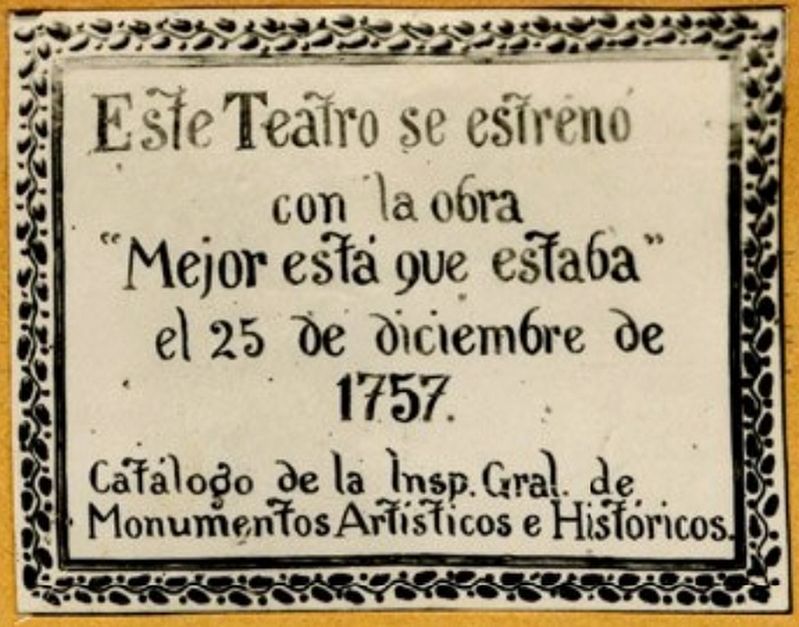
1. Teatro Principal Marker
The marker is now missing, but this image of the marker is provided courtesy of the INAH Mediateca. Previously the street was known as 3a Calle de Bolívar or Coliseo.

Este Teatro se estrenó con la obra “Mejor está que estaba” el 25 de diciembre de 1757.
Catálogo de la Insp. Gral. de Monumentos Artísticos e Históricos.
The Teatro Principal opened with the play “Mejor está que estaba” (It’s better than it was) on December 25, 1757.
Catalog of the Inspector General of Artistic and Historic Monuments
Erected by Catálogo de la Inspección General de Monumentos Artísticos e Históricos.
Topics. This historical marker is listed in these topic lists: Arts, Letters, Music • Colonial Era • Man-Made Features. A significant historical date for this entry is December 25, 1757.
Location. Marker has been reported missing. It was located near 19° 25.979′ N, 99° 8.303′ W. Marker was in Ciudad de México. It was in Centro Histórico. It was on Calle Bolívar just south of Avenida Francisco I. Madero, on the left when traveling south. Touch for map. Marker was at or near this postal address: Calle Bolívar 30, Ciudad de México 06000, Mexico. Touch for directions.

Regionally, this marker was in Central Mexico and specifically in Mexico City Metropolitan
this page online
Other nearby markers. At least 8 other markers are within walking distance of this location: Museum and Cultural Center “El Borceguí” (a few steps from this marker); House of José de la Borda (within shouting distance of this marker); José de la Borda (about 90 meters away, measured in a direct line); Teatro Colón (about 90 meters away); House of José y Francisco Fagoaga y Villaurruña (about 90 meters away); Portal del Coliseo (about 90 meters away); House of José de Borda (about 90 meters away); Calle de Motolinia (about 120 meters away). Touch for a list and map of all markers in Ciudad de México.
Another marker is no longer nearby. Mariano Galván (was about 90 meters away but has been confirmed missing).
Regarding Teatro Principal. The first play at the theater (originally known as the Coliseo Nuevo or New Colosseum) was by Spanish playwright Pedro Calderón de la Barca (1600-1681).
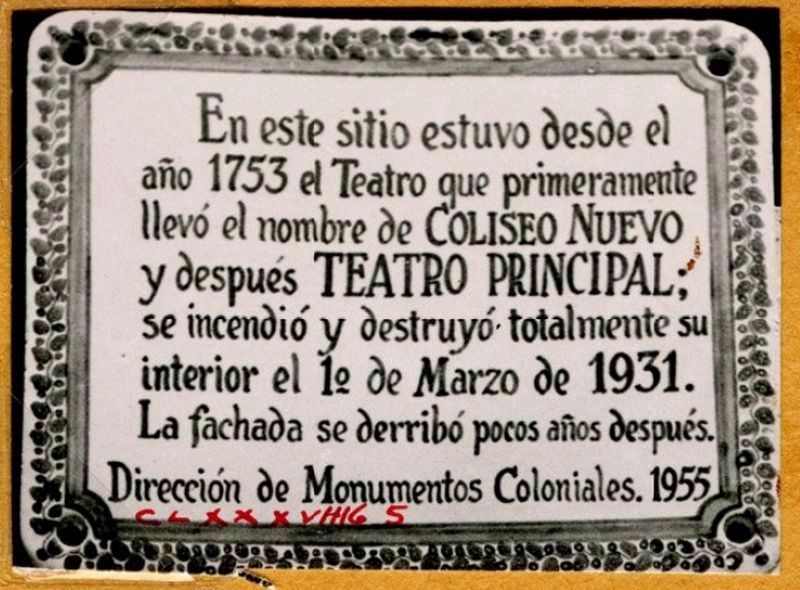
2. An additional missing Teatro Principal Marker
This additional marker from 1955, also missing, is provided courtesy of the INAH Mediateca. It reads:
En este sitio estuvo desde el año 1753 el Teatro que primeramente llevó el nombre de Coliseo Nuevo y después Teatro Principal; se incendió y destruyó totalmente su interior el 1º de Marzo de 1931. La fachada se derribó pocos años después.
Dirección de Monumentos Coloniales. 1955
English translation:
In this place since 1753 was the theater first known as the New Colosseum and later as the Principal Theater; It burned down and its interior completely destroyed on March 1, 1931. The facade was demolished a few years later.
Office of Colonial Monuments. 1955
En este sitio estuvo desde el año 1753 el Teatro que primeramente llevó el nombre de Coliseo Nuevo y después Teatro Principal; se incendió y destruyó totalmente su interior el 1º de Marzo de 1931. La fachada se derribó pocos años después.
Dirección de Monumentos Coloniales. 1955
In this place since 1753 was the theater first known as the New Colosseum and later as the Principal Theater; It burned down and its interior completely destroyed on March 1, 1931. The facade was demolished a few years later.
Office of Colonial Monuments. 1955
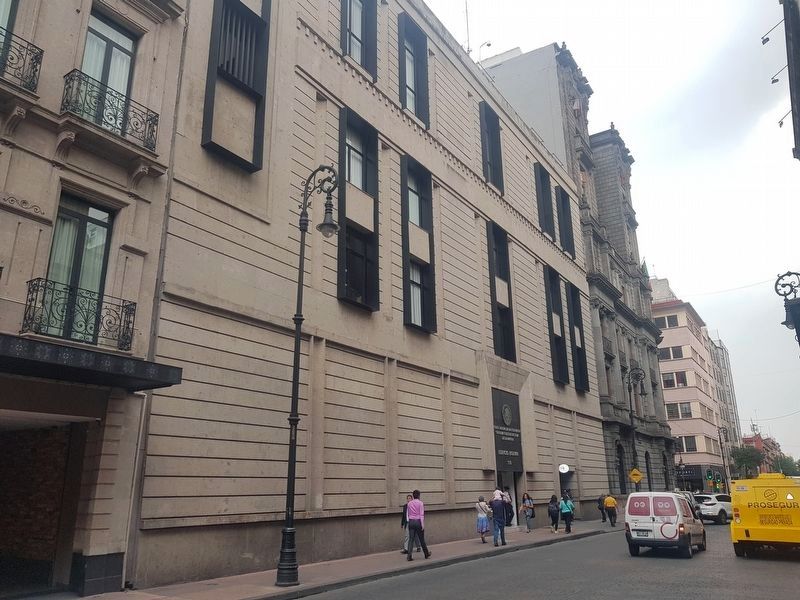
Photographed by J. Makali Bruton, October 10, 2018
3. Teatro Principal Marker
The wording on the featured marker implies that the theater still existed at the time of its placement, although it later burned and was demolished in 1931. The building at the current site is for the Mexican Supreme Court.
Credits. This page was last revised on April 17, 2020. It was originally submitted on October 25, 2018, by J. Makali Bruton of Washington, District of Columbia. This page has been viewed 239 times since then and 20 times this year. Photos: 1, 2, 3. submitted on October 25, 2018, by J. Makali Bruton of Washington, District of Columbia.
