Central Park South in Manhattan in New York County, New York — The American Northeast (Mid-Atlantic)
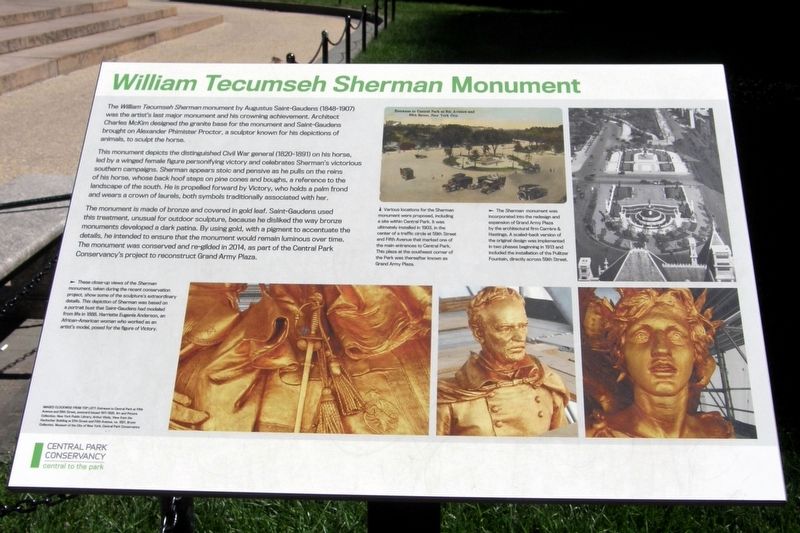
William Tecumseh Sherman Monument
Photographed by Larry Gertner, July 8, 2018
1. William Tecumseh Sherman Monument
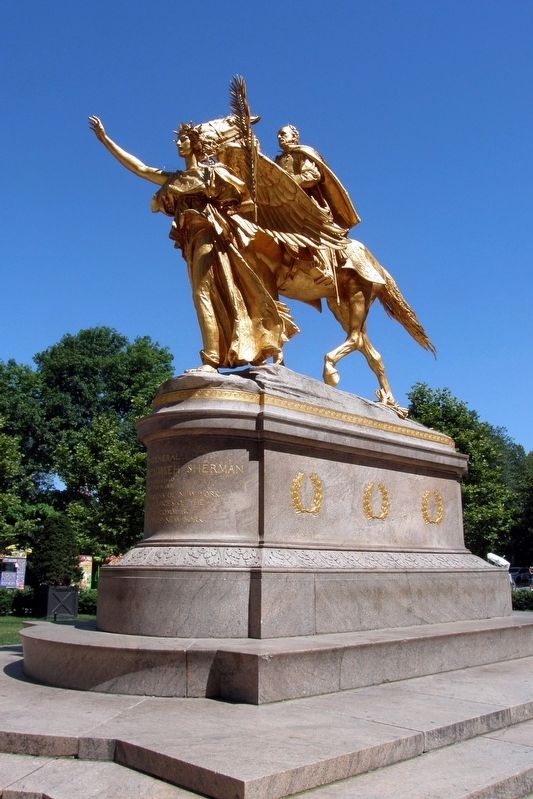
The William Tecumseh Sherman monument by August Saint-Gaudens (1848-1907) was the artist’s last major monument and his crowning achievement. Architect Charles McKim designed the granite base for the monument and Saint-Gaudens brought on Alexander Phimister Proctor, a sculptor known for his depictions of animals, to sculpt the horse.
The monument depicts the distinguished Civil War general (1820-1891) on his horse, led by a winged female figure personifying victory and celebrates Sherman’s victorious southern campaigns. Sherman appears stoic and pensive as he pulls on the reins of his horse, whose back hoof steps on pine cones and boughs, a reference to the landscape of the south. He is propelled forward by Victory, who holds a palm frond and wears a crown of laurels, both symbols traditionally associated with her.
The monument is made of bronze and covered in gold leaf. Saint-Gaudens used this treatment, unusual for outdoor sculpture, because he disliked the way bronze monuments developed a dark patina. By using gold, with a pigment to accentuate the details, he intended to ensure that the monument would remain luminous
this page online
Erected by Central Park Conservancy.
Topics. This historical marker and monument is listed in these topic lists: Arts, Letters, Music • Parks & Recreational Areas • War, US Civil. A significant historical year for this entry is 2014.
Location. Marker has been permanently removed. It was located near 40° 45.882′ N, 73° 58.389′ W. Marker was in Manhattan, New York, in New York County. It was in Central Park South. It was at the intersection of Fifth Avenue and West 59th Street, on the right when traveling south on Fifth Avenue. The "Grand Army Plaza" mentioned in the text is not to be confused with Grand Army Plaza in Brooklyn, near Prospect Park. Touch for map. Marker was in this post office area: New York NY 10022, United States of America.
We have been informed that this marker is no longer there and will not be replaced. This page is an archival view of what was.
Regionally, this marker and monument was in New York City. It was also in the American Northeast, in the Mid-Atlantic,

Photographed by Larry Gertner, July 8, 2018
2. The William Tecumseh Sherman Monument
Other nearby markers. At least 8 other markers are within walking distance of this location: William Tecumseh Sherman (a few steps from this marker); Grand Army Plaza (a few steps from this marker); Lombard Lamp (within shouting distance of this marker); Doris C. Freedman Plaza (within shouting distance of this marker); The Metropolitan Club (within shouting distance of this marker); The Plaza Hotel (within shouting distance of this marker); a different marker also named Plaza Hotel (about 300 feet away, measured in a direct line); ההגנה / Haganah (about 400 feet away). Touch for a list and map of all markers in Manhattan.
Regarding William Tecumseh Sherman Monument. The statue is mentioned in the Grand Army Plaza entry in the AIA (American Institute of Architects) Guide to New York City, Fifth Edition.
Also see . . . Saint-Gaudens' 1903 Gen'l Wm. Tecumseh Sherman Statue.
Photographed by Larry Gertner, July 8, 2018
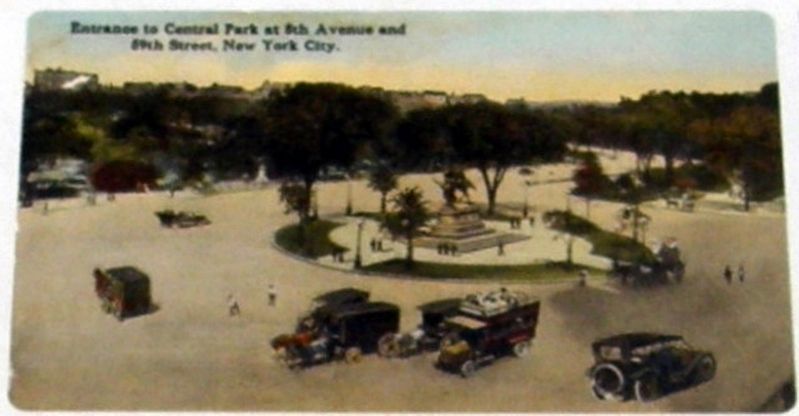
3. Inset
Accompanying text: Various locations for the Sherman monument were proposed, including a site within Central Park. It was ultimately installed in 1903, in the center of a traffic circle at 59th Street and Fifth Avenue that marked one of the main entrances to Central Park. This plaza at he southeast corner of the Park was thereafter known as Grand Army Plaza.
Photographed by Larry Gertner, July 8, 2018
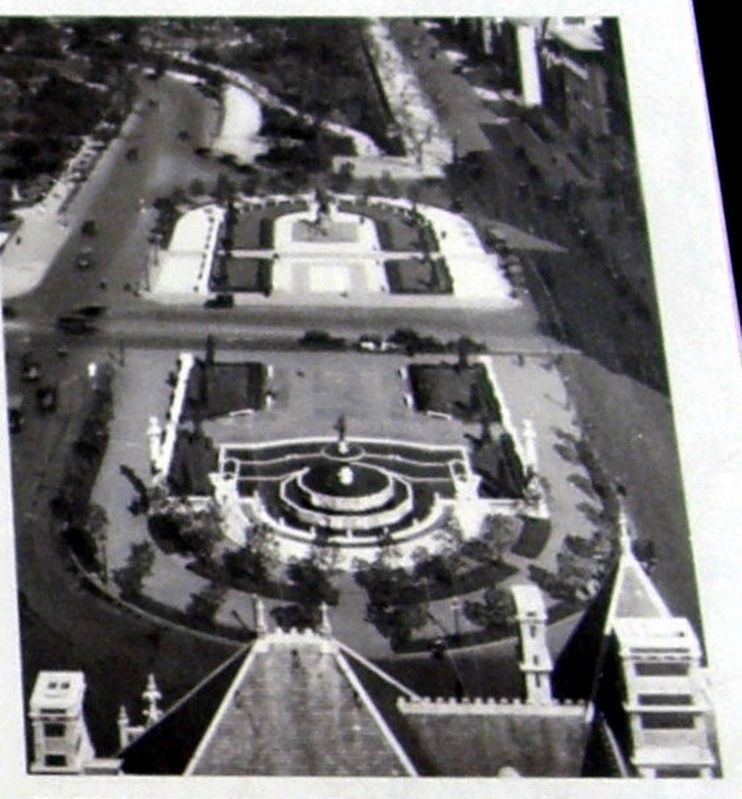
4. Inset
Accompanying text: The Sherman monument was incorporated into the redesign and expansion of Grand Army Plaza by the architectural firm Carrere & Hastings. A scaled-back version of the original design was implemented in two phases beginning in 1913 and included the installation of the Pulitzer Fountain, directly across 59th Street.
Photographed by Larry Gertner, July 8, 2018
5. Inset
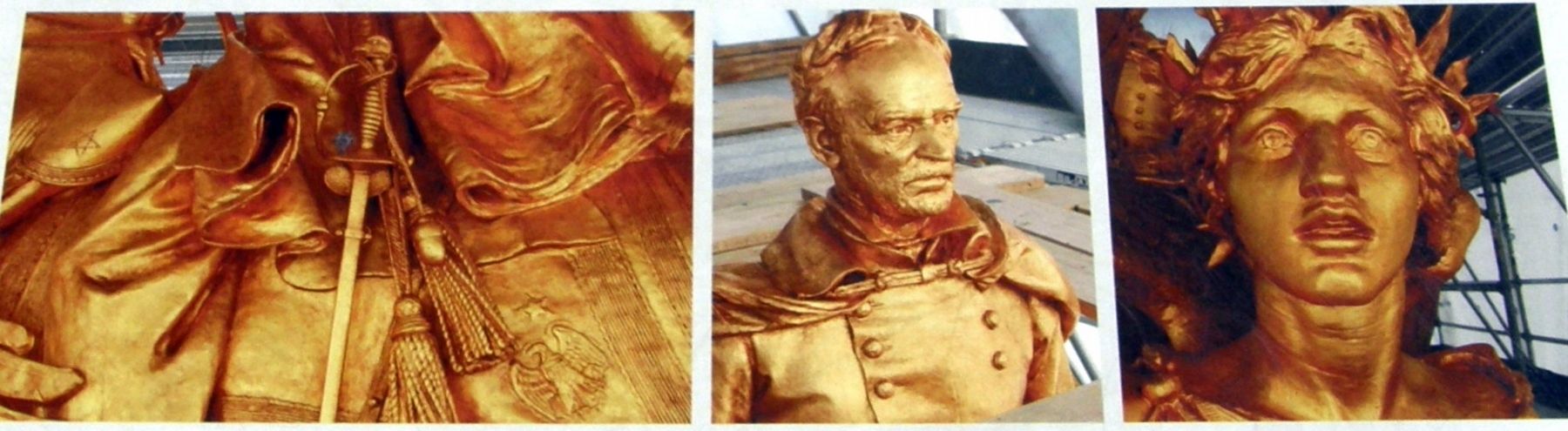
Accompanying text: These close-up views of the Sherman monument, taken during the recent conservation project, show some of the sculpture’s extraordinary details. The depiction of Sherman was based on a portrait bust the Saint-Gaudens had modeled from life in 1888. Harriette Eugenia Anderson, an African-American woman who worked as an artist’s model, posed for the figure of Victory.
Photographed by Larry Gertner, June 19, 2014
6. New York Times article, June 19, 2014
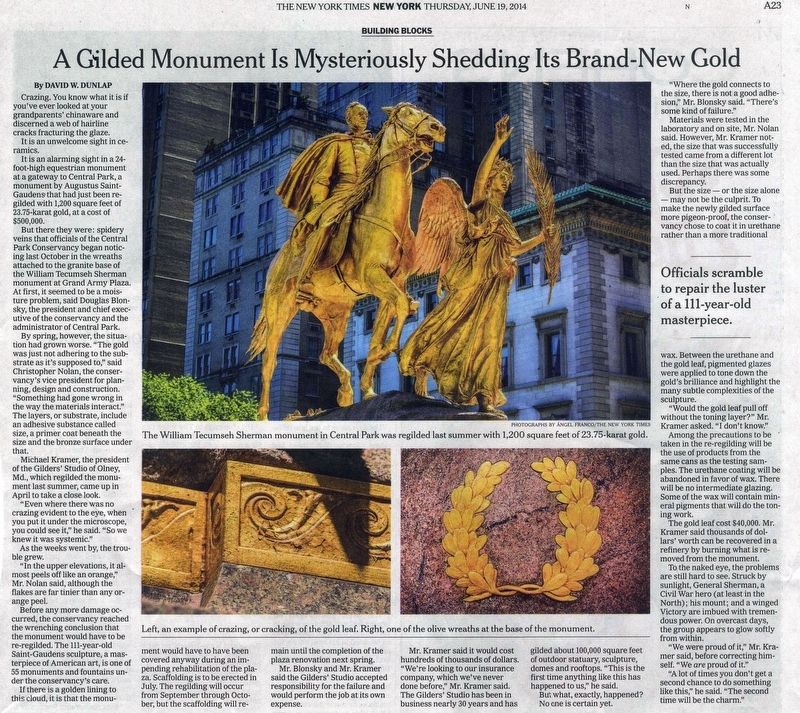
The article details how the original regilding effort failed, something not mentioned in the wayside.
Credits. This page was last revised on July 4, 2025. It was originally submitted on November 13, 2018, by Larry Gertner of New York, New York. This page has been viewed 1,162 times since then and 112 times this year. Photos: 1, 2, 3, 4, 5, 6. submitted on November 13, 2018, by Larry Gertner of New York, New York. • Bernard Fisher was the editor who published this page.
Editor’s want-list for this marker. Wide view photo of the marker showing its location in context. • Can you help?
