St. Augustine in St. Johns County, Florida — The American South (South Atlantic)
Bloody Mose
| — | Fort Mose Historic State Park | — |
Photographed by Cosmos Mariner, December 10, 2014
1. Bloody Mose Marker
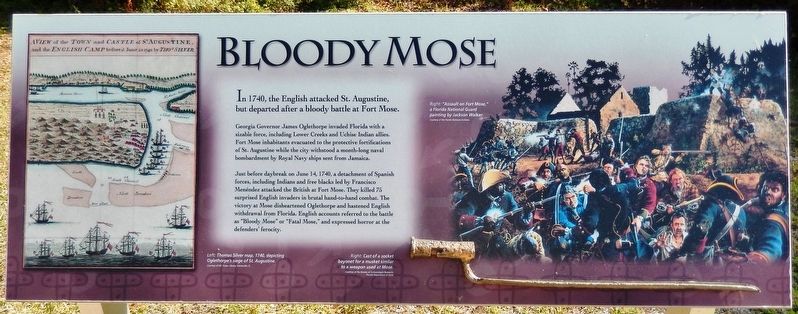
In 1740, the English attacked St. Augustine, but departed after a bloody battle at Fort Mose.
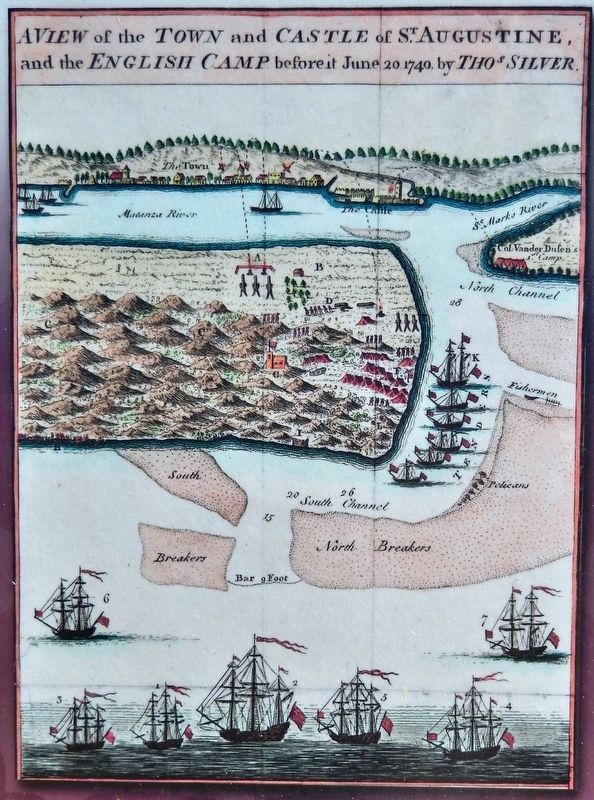
Georgia Governor James Oglethorpe invaded Florida with a sizable force, including Lower Creeks and Uchise Indian allies. Fort Mose inhabitants evacuated to the protective fortifications of St. Augustine while the city withstood a month-long naval bombardment by Royal Navy ships sent from Jamaica.
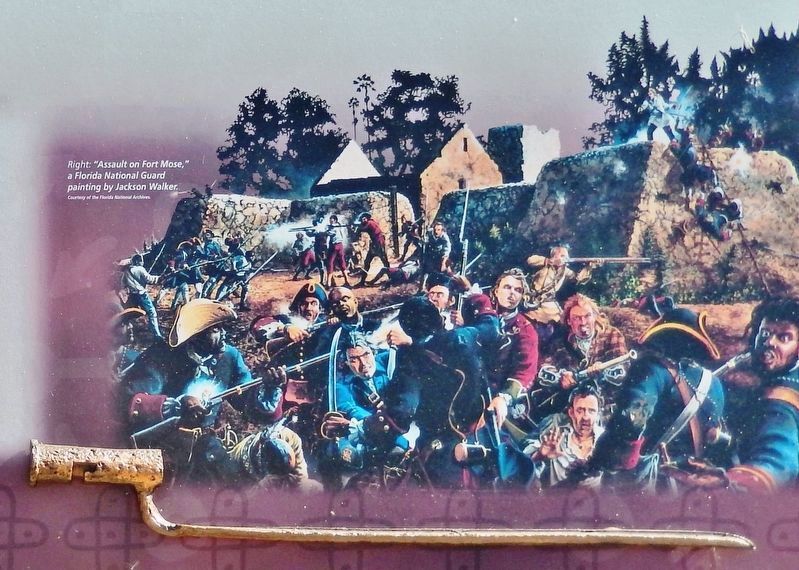
Just before daybreak on June 14, 1740, a detachment of Spanish forces, including Indians and free blacks led by Francisco Menéndez attacked the British at Fort Mose. They killed 75 surprised English invaders in brutal hand-to-hand combat. The victory at Mose disheartened Oglethorpe and hastened English withdrawal from Florida. English accounts referred to the battle as “Bloody Mose” or “Fatal Mose,” and expressed horror at the defenders' ferocity.
Erected by Fort Mose Historic State Park.
Topics. This historical marker is listed in these topic lists: African Americans • Colonial Era • Forts and Castles • Notable Events. A significant historical date for this entry is June 14, 1740.
Location. 29° 55.735′ N, 81° 19.511′ W.
this page online

Regionally, this marker is in First Coast and in Greater Jacksonville. It is also in the American South and on the Eastern Seaboard. Globally, it is in the North Atlantic Region, North America, a Gulf of Mexico state, the Western Hemisphere, the Western World, and the Anglosphere. Historically, it finds itself in what was once New Spain, the territory of the Mississippian Culture, one of the Confederate States of America, and the Antebellum South.
Other nearby markers. At least 8 other markers are within walking distance of this marker: El Pueblo de Gracia Real de Santa Teresa de Mose (here, next to this marker); Escape & Flight (a few steps from this marker); Fort Mose Site (within
Courtesy of P.K. Yonge Library, Gainesville, Florida
2. Marker detail: Thomas Silver map, 1740, depicting Oglethorpe's siege of St. Augustine
Other markers no longer nearby. Fort Mose II (was here, next to this marker but has been permanently removed); Fort Mose I (was a few steps from this marker but has been permanently removed); Evacuation (was a few steps from this marker but has been permanently removed); British Enslavement (was within shouting distance of this marker but has been permanently removed); Middle Passage (was within shouting distance of this marker but has been permanently removed); African Origins (was within shouting distance of this marker but has been permanently removed).
Related markers. Click here for a list of markers that are related to this marker. Fort Mose Historic State Park
Also see . . .
1. Bloody Battle of Fort Mose. Florida Historical Society website
Courtesy of the Florida National Archives
3. Marker detail: ”Assault on Fort Mose” - Florida National Guard painting by Jackson Walker
Bottom: Cast of a socket bayonet for a musket similar to a weapon used at Mose. Courtesy of the Bureau of Archaeological Research, Florida Department of State.
Historic reenactors depict the Bloody Battle of Fort Mose where Spanish soldiers, free black militiamen, and Yamasee Indians joined forces to defeat British invaders on June 26, 1740. The Bloody Battle of Fort Mose successfully ended Oglethorpe’s siege of St. Augustine, and returned control of Florida to the Spanish. Fort Mose was destroyed during the battle, and it would take twelve years to rebuild the outpost. (Submitted on December 2, 2018, by Cosmos Mariner of Cape Canaveral, Florida.)
2. The journey of Africans to St. Augustine, Florida. On June 26 a 300-man force of Spanish troops, black militiamen, and Yamasee Indians took back Fort Mose, killing 68 of Oglethorpe’s men and taking another 34 prisoner. It wasn’t very long until it was no longer safe to live in Fort Mose, and many returned to the safety of St. Augustine. Others tried living in the nearby Native American villages, and still others would return from time to time to try and live at the fort. Eventually, the fort was destroyed during the bloody battle of Fort Mose on June 26, 1740. (Submitted on December 2, 2018, by Cosmos Mariner of Cape Canaveral, Florida.)
3. Fort Mose Historic State Park.
Photographed by Cosmos Mariner, December 10, 2014
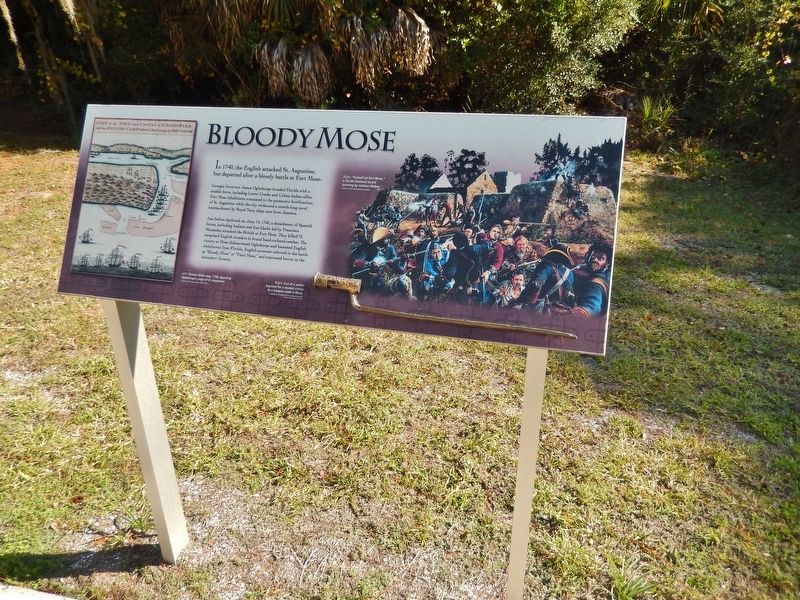
4. Bloody Mose Marker (wide view)
Credits. This page was last revised on December 4, 2025. It was originally submitted on December 1, 2018, by Cosmos Mariner of Cape Canaveral, Florida. This page has been viewed 1,048 times since then and 78 times this year. Photos: 1. submitted on December 1, 2018, by Cosmos Mariner of Cape Canaveral, Florida. 2, 3, 4. submitted on December 2, 2018, by Cosmos Mariner of Cape Canaveral, Florida. • Bernard Fisher was the editor who published this page.
