St. Augustine in St. Johns County, Florida — The American South (South Atlantic)
El Pueblo de Gracia Real de Santa Teresa de Mose
| — | Fort Mose Historic State Park | — |
Photographed by Richard E. Miller, May 25, 2013
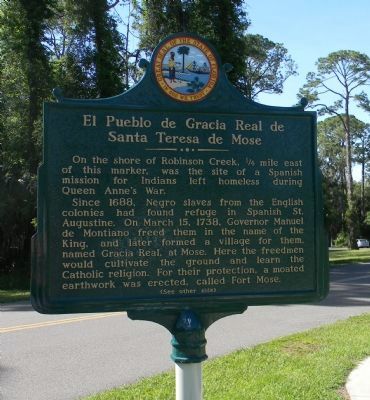
1. El Pueblo de Gracia Real de Santa Teresa de Mose Marker (obverse)
On the shore of Robinson Creek, ¼ mile east of this marker, was the site of a Spanish mission for Indians left homeless during Queen Anne's War.
Since 1688, Negro slaves from the English colonies had found refuge in Spanish St. Augustine. On March 15, 1738, Governor Manuel de Montiano freed them in the name of the King, and later formed a village for them named Gracia Real, at Mose. Here the freedmen would cultivate the ground and learn the Catholic religion. For their protection, a moated earthwork was erected, called Fort Mose.
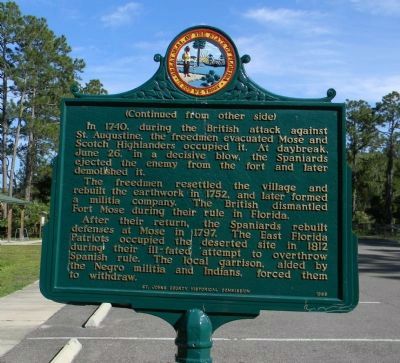
In 1740, during the British attack against St. Augustine, the freedmen evacuated Mose and Scotch Highlanders occupied it. At daybreak, June 26, in a decisive blow, the Spaniards ejected the enemy from the fort and later demolished it.
The freedmen resettled the village and rebuilt the earthwork in 1752, and later formed a militia company. The British dismantled Fort Mose during their rule in Florida.
After their return, the Spaniards rebuilt defenses at Mose in 1797. The East Florida Patriots occupied the deserted site in 1812 during their ill-fated attempt to overthrow Spanish rule.
this page online
Erected 1965 by St. Johns County Historical Commission.
Topics and series. This memorial is listed in these topic lists: Abolition & Underground RR • African Americans • Colonial Era • Forts and Castles. In addition, it is included in the National Historic Landmarks series list. A significant historical month for this entry is March 1874.
Location. 29° 55.734′ N, 81° 19.513′ W. Memorial is in St. Augustine, Florida, in St. Johns County. It is on Fort Mose Trail east of N. Ponce de Leon Blvd. (U.S. 1). Touch for map. Memorial is at or near this postal address: 15 Fort Mose Trail, Saint Augustine FL 32084, United States of America. Touch for directions.

Regionally, this memorial is in First Coast and in Greater Jacksonville. It is also in the American South and on the Eastern Seaboard. Globally, it is in the North Atlantic Region, North America, a Gulf of Mexico state, the Western Hemisphere, the Western World, and the Anglosphere. Historically, it finds itself in what was once New Spain, the territory of the Mississippian Culture,
Photographed by Richard E. Miller, May 25, 2013
2. El Pueblo de Gracia Real de Santa Teresa de Mose Marker reverse
Other nearby markers. At least 8 other markers are within walking distance of this marker: Bloody Mose (here, next to this marker); Escape & Flight (a few steps from this marker); Fort Mose Site (within shouting distance of this marker); Women of Fort Mose (within shouting distance of this marker); Barca Chata (within shouting distance of this marker); On Watch (within shouting distance of this marker); “Slave Catchers” (about 300 feet away, measured in a direct line); Conclusion (about 400 feet away). Touch for a list and map of all markers in St. Augustine.
Other markers no longer nearby. Fort Mose II (was a few steps from this marker but has been permanently removed); Fort Mose I (was a few steps from this marker but has been permanently removed); Evacuation (was a few steps from this marker but has been permanently removed); British Enslavement (was within shouting distance of this marker but has been permanently removed); Middle Passage (was within shouting distance of this marker but has been permanently removed); African Origins (was within shouting
Photographed by Richard E. Miller, May 26, 2013
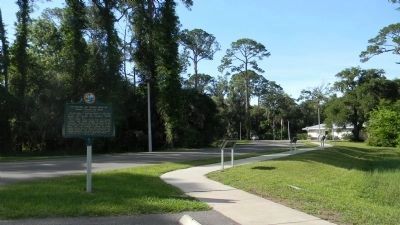
3. El Pueblo de Gracia Real de Santa Teresa de Mose marker
Also see . . . America's Black Colonial Fortress of Freedom. (Submitted on May 29, 2013, by Richard E. Miller of Oxon Hill, Maryland.)
Additional keywords. maroons
Photographed by Richard E. Miller, May 25, 2013
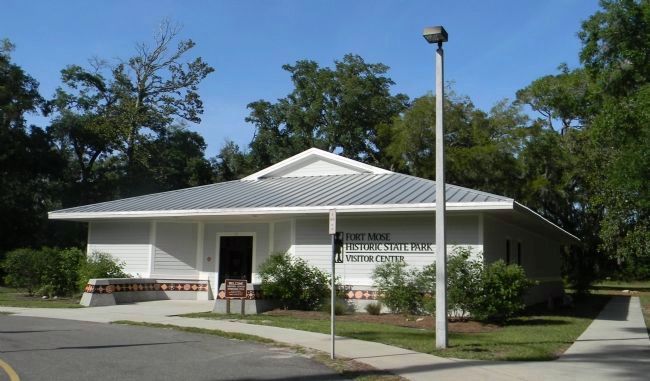
4. Visitors Center, Fort Mose Historic State Park
Credits. This page was last revised on December 4, 2025. It was originally submitted on May 28, 2013, by Richard E. Miller of Oxon Hill, Maryland. This page has been viewed 1,697 times since then and 94 times this year. Last updated on December 1, 2018, by Cosmos Mariner of Cape Canaveral, Florida. Photos: 1, 2, 3, 4. submitted on May 29, 2013, by Richard E. Miller of Oxon Hill, Maryland. • Bernard Fisher was the editor who published this page.
