Old Town in Alexandria, Virginia — The American South (Mid-Atlantic)
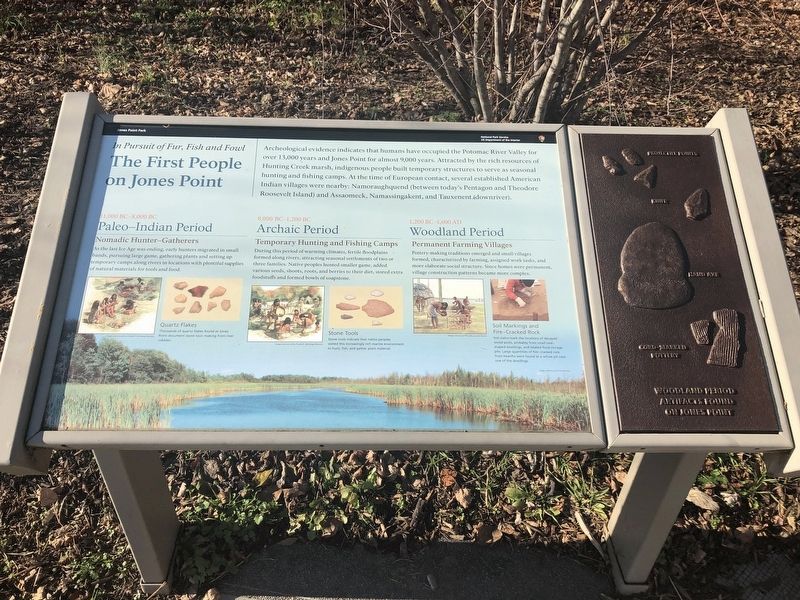
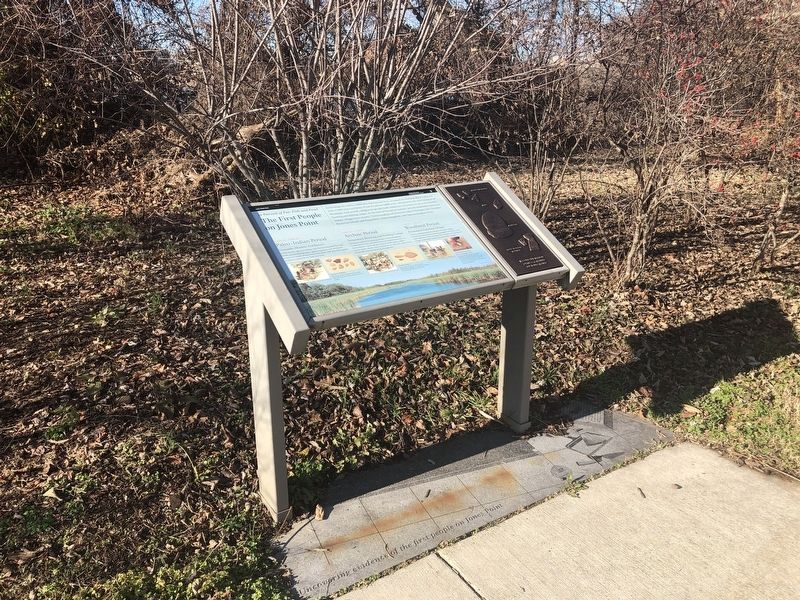
The First People on Jones Point
In Pursuit of Fur, Fish and Fowl
| — | Jones Point Park | — |
Photographed by Devry Becker Jones (CC0), December 22, 2018
1. The First People on Jones Point Marker
11,000 BC-8,000 BC
Paleo-Indian Period
Nomadic Hunter-Gatherers
As the last Ice Age was ending, early hunters migrated in small bands, pursuing large game, gathering plants and setting up temporary camps along rivers in locations with plentiful supplies of natural materials for tools and food.
Quartz Flakes
Thousands of quartz flakes found at Jones Point document stone tool-making from river cobbles.
8,000-1,200 BC
Archaic Period
Temporary Hunting and Fishing Camps
During this period of warming climates, fertile floodplains formed along rivers, attracting seasonal settlements of two or three families.
this page online
Stone Tools
Stone tools indicate that native peoples visited this increasingly rich marine environment to hunt, fish, and gather plant material.
1,200 BC-1,600 AD
Woodland Period
Permanent Farming Villages
Pottery-making traditions emerged and small villages formed, characterized by farming, assigned work tasks, and more elaborate social structure. Since homes were permanent, village construction patterns became more complex.
Soil Markings and Fire-Cracked Rock
Soil stains mark the locations of decayed wood posts, probably from small oval-shaped dwellings, and related food storage pits. Large quantities of fire-cracked rock from hearths were found at a refuse pit near one of the dwellings.
Erected by National Park Service, U.S. Department of the Interior.
Topics. This historical marker is listed in these topic lists: Anthropology & Archaeology • Indigenous Peoples and Communities.
Location. 38° 47.526′ N, 77° 2.564′ W.
Photographed by Devry Becker Jones (CC0), December 22, 2018
2. The First People on Jones Point Marker
PLEASE NOTE: The automated “Touch for directions” link at the end of this paragraph, when used in driving mode, takes you to I-95’s Wilson Bridge, where you cannot park, much less stop, and then seems to indicate that you should jump off the bridge and walk to the marker. You will surely break your neck—among many other bones—if you jump off the bridge. Instead, set your destination to “Jones Point Park Parking” in order to obtain driving directions to where you can park and walk to the marker. . Touch for map. Marker is at or near this postal address: 100 Jones Point Dr, Alexandria VA 22314, United States of America. Touch for directions.

Regionally, this marker is in the Washington Metropolitan Area and in Northern Virginia. It is also in the American South, specifically in the Upper South, in the Mid-Atlantic, and on the Eastern Seaboard. Globally, it is in the North Atlantic Region, North America, the Western Hemisphere, the Western World, and the Anglosphere. Historically, it finds itself in what was once the territory of the Mississippian Culture, one of the original Thirteen Colonies, one of the Confederate States of America, and the Antebellum South.
Other nearby markers. At least 8 other markers are within walking distance of this marker: World Wars to the Present (within shouting distance of this marker); The Emerging Nation (within shouting distance of this marker); Prehistory to Colonial Settlement (within shouting distance of this marker); A World War I Shipyard Transforms Jones Point (about 400 feet away, measured in a direct line); World War I-Era Rudder (about 400 feet away); Mount Vernon Trail (about 400 feet away); Potomac Connections (about 500 feet away); Welcome to Jones Point Park (about 500 feet away). Touch for a list and map of all markers in Alexandria.
Credits. This page was last revised on January 28, 2023. It was originally submitted on December 24, 2018, by Devry Becker Jones of Washington, District of Columbia. This page has been viewed 768 times since then and 44 times this year. Photos: 1, 2. submitted on December 24, 2018, by Devry Becker Jones of Washington, District of Columbia. • Andrew Ruppenstein was the editor who published this page.
