Old Town in Alexandria, Virginia — The American South (Mid-Atlantic)
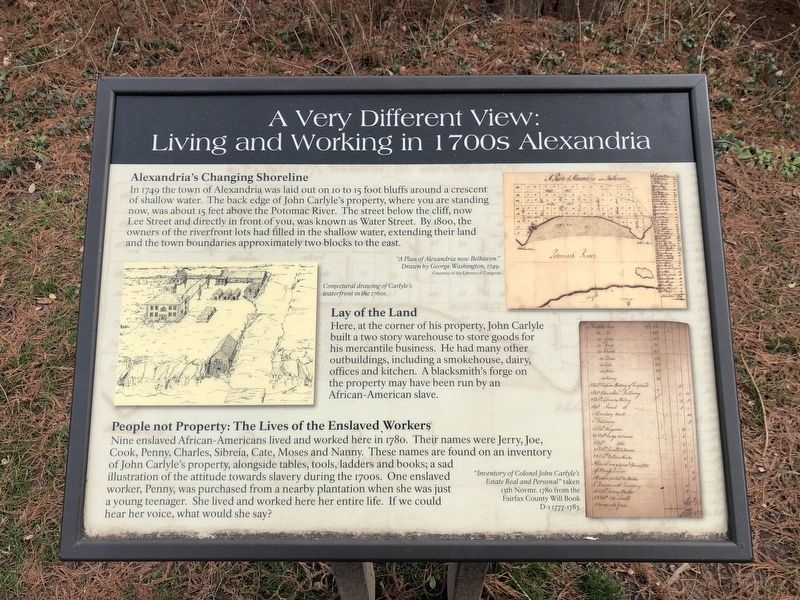
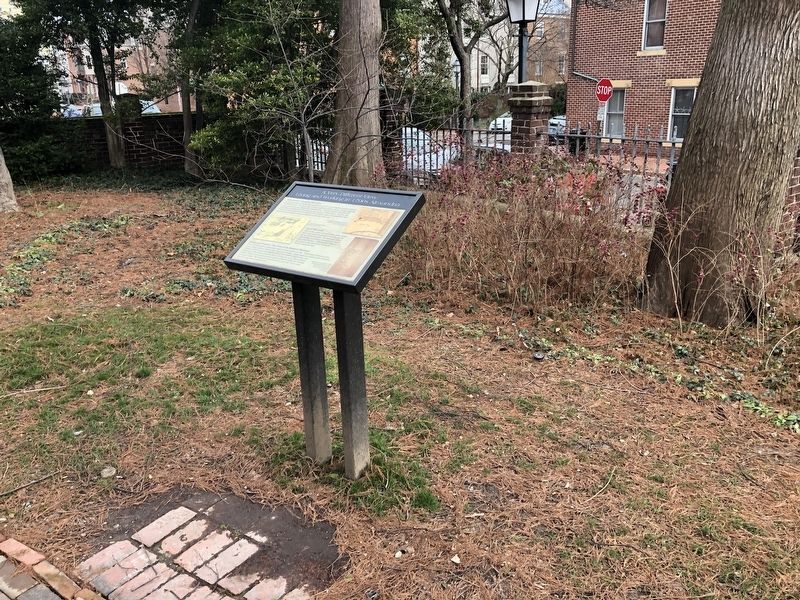
A Very Different View: Living and Working in 1700s Alexandria
Photographed by Devry Becker Jones (CC0), January 26, 2019
1. A Very Different View: Living and Working in 1700s Alexandria Marker
Alexandria's Changing Shoreline
In 1749 the town of Alexandria was laid out on 10 to 15 foot bluffs around a crescent of shallow water. The back edge of John Carlyle's property, where you are standing now, was about 15 feet above the Potomac River. The street below the cliff, now Lee Street and directly in front of you, was known as Water Street. By 1800, the owners of the riverfront lots had filled in the shallow water, extending their land and the town boundaries approximately two blocks to the east.
Lay of the Land
Here, at the corner of his property, John Carlyle built a two story warehouse to store goods for his mercantile business. He had many other outbuildings, including a smokehouse, dairy, offices and kitchen. A blacksmith's forge on the property may have been run by an African-American slave.
People not Property: The Lives of the Enslaved Workers
Nine enslaved African Americans lived and worked here in 1780. Their names were Jerry, Joe, Cook, Penny, Charles, Sibreia, Cate, Moses and Nanny. These names are found on an inventory of John Carlyle's property, alongside tables, tools, ladders and books; a
this page online
Erected by Northern Virginia Regional Park Authority.
Topics and series. This historical marker is listed in these topic lists: African Americans • Colonial Era • Settlements & Settlers • Women. In addition, it is included in the NOVA Parks series list. A significant historical year for this entry is 1749.
Location. 38° 48.32′ N, 77° 2.487′ W. Marker is in Alexandria, Virginia. It is in Old Town. It can be reached from North Lee Street south of Cameron Street, on the left when traveling north. Touch for map. Marker is at or near this postal address: 133 North Fairfax Street, Alexandria VA 22314, United States of America. Touch for directions.

Regionally, this marker is in the Washington Metropolitan Area and in Northern Virginia. It is also in the American South, specifically in the Upper South, in the Mid-Atlantic, and on the Eastern Seaboard. Globally,
Photographed by Devry Becker Jones (CC0), January 26, 2019
2. A Very Different View: Living and Working in 1700s Alexandria Marker
Other nearby markers. At least 8 other markers are within walking distance of this marker: The Lynching of Joseph H. McCoy (a few steps from this marker); Site of the First Lot Sold at Auction (within shouting distance of this marker); Civil War and Restoration (within shouting distance of this marker); Fairfax County Resolves (within shouting distance of this marker); Bank of Alexandria (within shouting distance of this marker); Braddock Road Mile "0" (within shouting distance of this marker); Carlyle House Historic Park (within shouting distance of this marker); Wise's Tavern (within shouting distance of this marker). Touch for a list and map of all markers in Alexandria.
Other markers no longer nearby. The Garden — Past and Present (was within shouting distance of this marker but has been confirmed missing); The Braddock Campaign and Carlyle House (was within shouting distance of this marker but has been reported to have been replaced with another marker now near it); The Carlyle House and the 18th-Century Site (was within shouting distance of this marker but has been replaced with another marker now near it).
Credits. This page was last revised on January 28, 2023. It was originally submitted on January 26, 2019, by Devry Becker Jones of Washington, District of Columbia. This page has been viewed 821 times since then and 26 times this year. Photos: 1, 2. submitted on January 26, 2019, by Devry Becker Jones of Washington, District of Columbia. • Bill Pfingsten was the editor who published this page.
