Downtown Memphis in Shelby County, Tennessee — The American South (East South Central)
The Lee Sisters
Photographed by Steve Masler, January 27, 2019
1. The Lee Sisters Marker
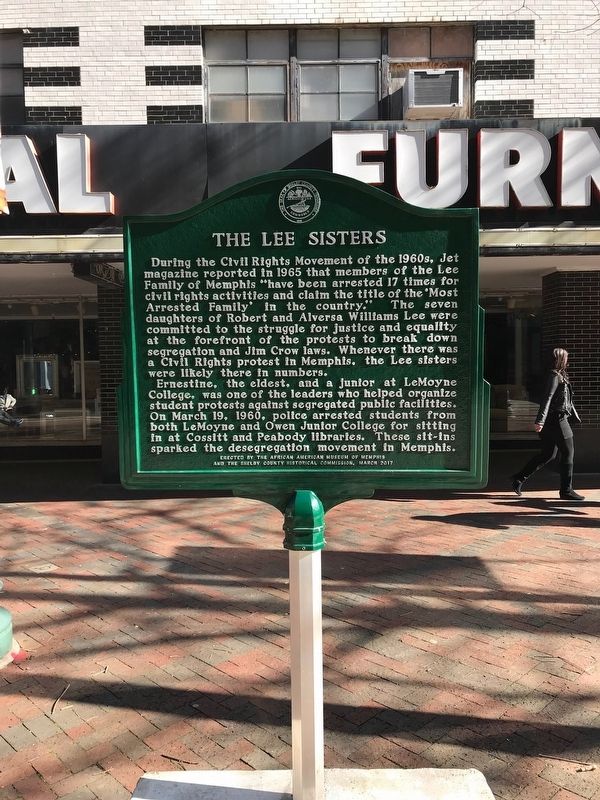
During the Civil Rights Movement of the 1960s, Jet magazine reported in 1965 that members of the Lee Family of Memphis "have been arrested 17 times for civil rights activities and claim the title of the Most Arrested Family" in the country.” The seven daughters of Robert and Alversa Williams Lee were committed to the struggle for justice and equality at the forefront of the protests to break down segregation and Jim Crow laws. Whenever there was a Civil Right protest in Memphis, the Lee sisters were likely there in numbers.
Ernestine, the eldest, and a junior at LeMoyne College, was one of the leaders who helped organize student protests against segregated public facilities. On March 19, 1960, police arrested students from both LeMoyne and Owen Junior College for sitting in at Cossitt and Peabody libraries. These sit-ins sparked the desegregation movement in Memphis.Erected by the African American Museum of Memphis and the Shelby County Historical Society.
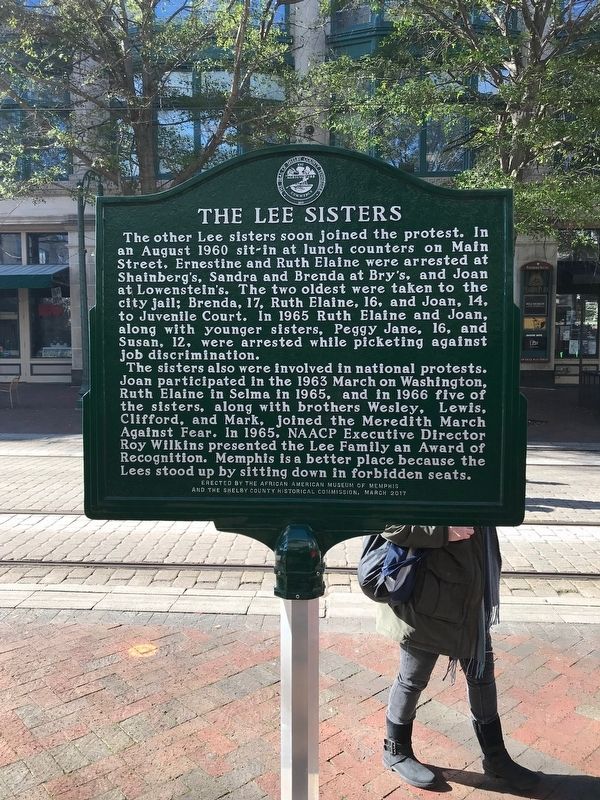
The other Lee sisters soon joined the protest. In an August 1960 sit-in at the lunch counters on Main Street, Ernestine and Ruth Elaine were arrested at Shainberg's,
this page online
Erected 2017 by The African American Museum of Memphis and the Shelby County Historical Society.
Topics and series. This historical marker is listed in these topic lists: African Americans • Civil Rights • Women. In addition, it is included in the Historically Black Colleges and Universities series list. A significant historical year for this entry is 1965.
Location. 35° 8.507′ N, 90° 3.249′ W.
Photographed by Steve Masler, January 27, 2019
2. The Lee Sisters Marker

Regionally, this marker is in West Tennessee. It is also in the American South, specifically in the Deep South, in the Upper South, in the Mississippi Delta, and in the Great River Road Region. Globally, it is in North America, the Western Hemisphere, the Western World, and the Anglosphere. Historically, it finds itself in what was once the territory of the Mississippian Culture, one of the Confederate States of America, and the Antebellum South.
Other nearby markers. At least 8 other markers are within walking distance of this marker: Heroic Hooker (within shouting distance of this marker); 19th Century Architecture (within shouting distance of this marker); Cora James (about 300 feet away, measured in a direct line); Barboro Grocery (about 300 feet away); Opera House Fire (about 400 feet away); Gayoso Hotel (about 500 feet away); Union Avenue (about 500 feet away); Schools For Freedmen

Photographed by Duane and Tracy Marsteller, April 25, 2020
3. The Lee Sisters Marker
Credits. This page was last revised on August 13, 2025. It was originally submitted on February 3, 2019, by Steve Masler of Memphis, Tennessee. This page has been viewed 2,337 times since then and 198 times this year. Photos: 1, 2. submitted on February 3, 2019, by Steve Masler of Memphis, Tennessee. 3. submitted on April 27, 2020, by Duane and Tracy Marsteller of Murfreesboro, Tennessee. • Bill Pfingsten was the editor who published this page.
