Centro histórico de Morelia , Michoacán, Mexico — The Pacific Coast (and Central Highlands)
José Rubén Romero Theater
Photographed by J. Makali Bruton, January 27, 2019
1. José Rubén Romero Theater Marker

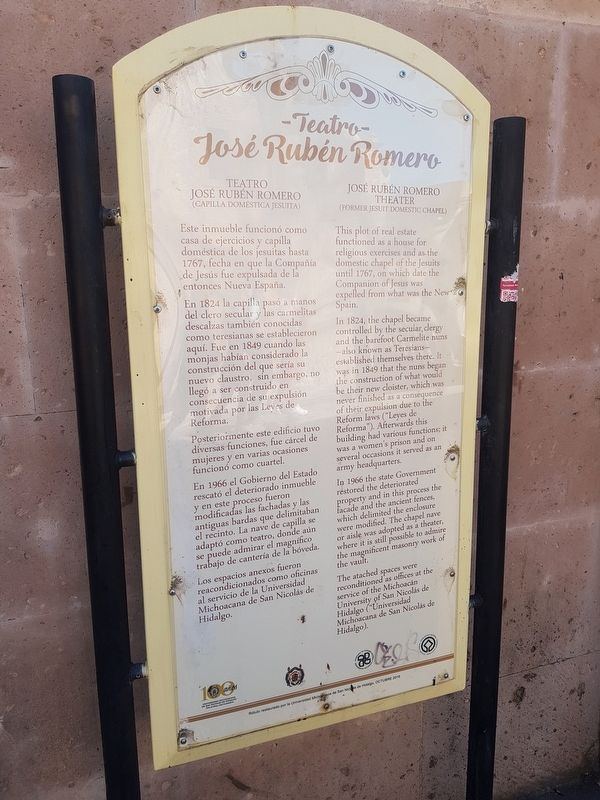
Teatro José Rubén Romero
(Capilla Doméstica Jesuita)
Este inmueble funcionó como casa de ejercicios y capilla doméstica de los jesuitas hasta 1767, fecha en que la Compañía de Jesús fue expulsada de la entonces Nueva España.
En 1824 la capilla pasó a manos del clero secular y las carmelitas descalzas también conocidas como teresianas se establecieron aquí. Fue en 1849 cuando las monjas habían considerado la construcción del que sería su nuevo claustro, sin embargo, no llegó a ser construido en consecuencia de su expulsión motivada por las Leyes de Reforma.
Posteriormente este edificio tuvo diversas funciones, fue cárcel de mujeres y en varias ocasiones funciónó como cuartel.
En 1966 el Gobierno del Estado rescató el deteriorado inmueble y en este proceso fueron modificadas las fachadas y las antiguas bardas que delimitaban el recinto. La nave de capilla se adaptó como teatro, donde aún se puede admirar el magnífico trabajo de cantería de la bóveda.
Los espacios anexos fueron reacondicionados como oficinas al servicio de la Universidad Michoacana de San Nicolás de Hidalgo.
José Rubén Romero Theater
(Former Jesuit Domestic Theater)
This
this page online
In 1824, the chapel became controlled by the secular clergy and the barefoot Carmelite nuns - also known as Teresians - established themselves there. It was in 1849 that the nuns began the construction of what would be their new cloister, which was never finished as a consequence of their expulsion due to the Reform laws ("Leyes de Reforma"). Afterwards this building had various functions; it was a women's prison and on several occasions it served as an army headquarters.
In 1966 the state Government restored the deteriorated property and in this process the arcade and the ancient fences, which delimited the enclosure were modified. The chapel nave or aisle was adopted as a theater, where it is still possible to admire the magnificent masonry work of the vault.
The attached spaces were reconditioned as offices at the service of the Michoacán University of San Nicolás de Hidalgo ("Universidad Michoacana de San Nicolás de Hidalgo).
Erected by UNESCO,
Photographed by J. Makali Bruton, January 27, 2019
2. José Rubén Romero Theater and Marker
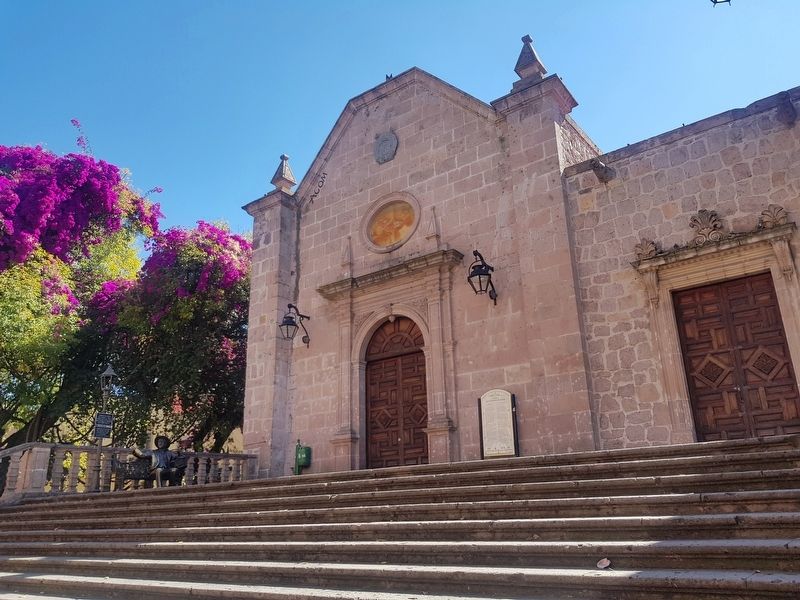
The marker is to the right of the entrance to the theater.
Topics. This historical marker is listed in these topic lists: Arts, Letters, Music • Colonial Era • Man-Made Features • Religion & Religious Structures. A significant historical year for this entry is 1767.
Location. 19° 42.277′ N, 101° 11.707′ W. Marker is in Morelia, Michoacán. It is in Centro histórico de Morelia. It is at the intersection of El Nigromante and Calle de Santiago Tapia, on the right when traveling south on El Nigromante. Touch for map. Marker is in this post office area: Morelia MIC 58000, Mexico. Touch for directions.

Regionally, this marker is in Western Mexico, in the Bajío, and on the Pacific Coast. Globally, it is in North America, specifically in Mesoamerica, on the Ring of Fire, on the Pacific Rim, and in the Western Hemisphere. Historically, it finds itself in what was once New Spain, a Spanish colony, and the Aztec Empire.
Other nearby markers. At least 8 other markers are within walking distance of this marker: Garden of the Roses (within shouting distance of this marker); Dr. Ignacio Chávez (about 150 meters away, measured in a direct
Photographed by J. Makali Bruton, January 27, 2019
3. Statue of "Pito Pérez" near the entrance to the José Rubén Romero Theater
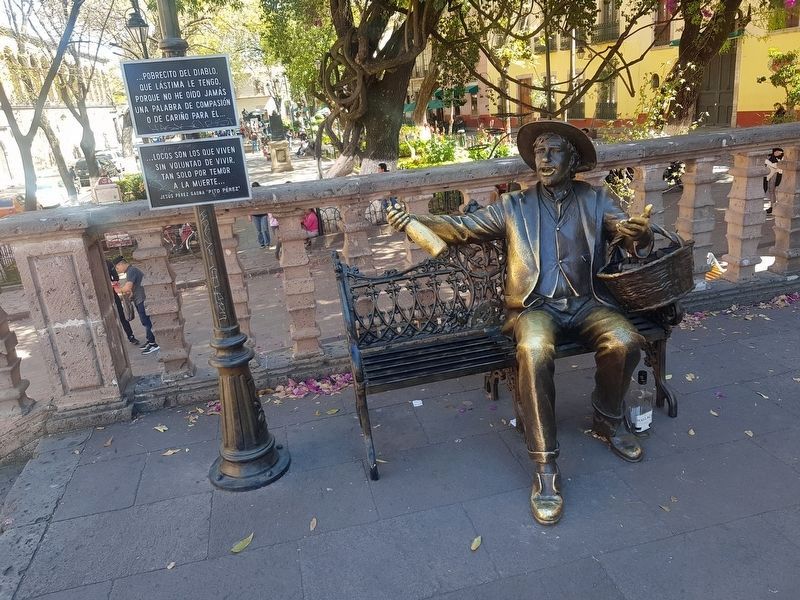
The statue depicts the main character of the novel La vida inútil de Pito Pérez (The Futile Life of Pito Pérez) by José Rubén Romero (1938). The statue's tablet reads:
…pobrecito del diablo. Que lástima le tengo, porque no he oído jamás una palabra de compasión o de cariño para él…
…locos son los que viven sin voluntad de vivir, tan solo por temor a la muerte…
Jesús Pérez Gaona “Pito Pérez”
English translation:
... poor thing the devil. What pity I have for him, because I have never heard a word of compassion or affection for him ...
... crazy are those who live without the will to live, only for fear of death ...
Jesús Pérez Gaona "Pito Pérez"
…locos son los que viven sin voluntad de vivir, tan solo por temor a la muerte…
Jesús Pérez Gaona “Pito Pérez”
... poor thing the devil. What pity I have for him, because I have never heard a word of compassion or affection for him ...
... crazy are those who live without the will to live, only for fear of death ...
Jesús Pérez Gaona "Pito Pérez"
Credits. This page was last revised on April 4, 2025. It was originally submitted on February 10, 2019, by J. Makali Bruton of Washington, District of Columbia. This page has been viewed 360 times since then and 27 times this year. Photos: 1, 2, 3. submitted on February 10, 2019, by J. Makali Bruton of Washington, District of Columbia.
