Iberville in New Orleans in Orleans Parish, Louisiana — The American South (West South Central)
Homer Adolph Plessy
1862-1925
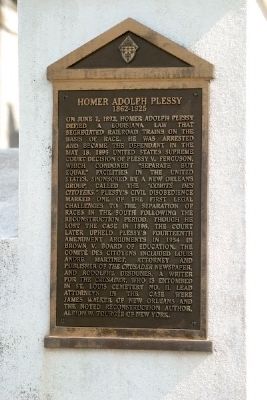
Photographed by R. E. Smith, March 1, 2008
1. Homer Adolph Plessy Marker
Topics. This historical marker is listed in these topic lists: African Americans • Cemeteries & Burial Sites • Civil Rights • Communications • Railroads & Streetcars. A significant historical date for this entry is May 18, 1896.
Location. 29° 57.553′ N, 90° 4.311′ W. Marker is in New Orleans, Louisiana, in Orleans Parish. It is in Iberville. It can be reached from Basin Street. Marker is in St. Louis Cemetery Number One. Touch for map. Marker is in this post office area: New Orleans LA 70112, United States of America. Touch for directions.

Regionally, this marker is in one of Louisiana’s River Parishes. It is also in the American South, specifically in the Deep South, on the Gulf Coast, and in the Great River Road Region. Globally, it is in North America, a Gulf of Mexico state, the Western Hemisphere, the Western World,
this page online
Other nearby markers. At least 8 other markers are within walking distance of this marker: Bernard de Marigny (here, next to this marker); General Humbert (a few steps from this marker); Pons Family (a few steps from this marker); Louisiana Revolutionary War Patriots (a few steps from this marker); Probably The Oldest Extant Wall Vaults (a few steps from this marker); Italian Mutual Benevolent Society Tomb (a few steps from this marker); Barthélémy Lafon (within shouting distance of this marker); Orleans Battalion of Artillery (within shouting distance of this marker). Touch for a list and map of all markers in New Orleans.
Also see . . . Wikipedia entry for St. Augustine Church (New Orleans). (Submitted on August 13, 2009, by Richard E. Miller of Oxon Hill, Maryland.)
Additional keywords. Plessy v. Ferguson
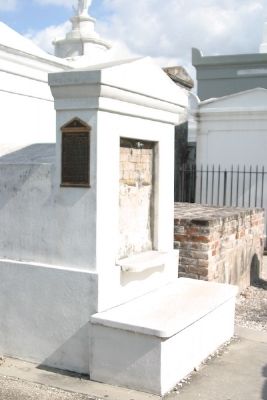
Photographed by R. E. Smith, March 1, 2008
2. Homer Adolph Plessy Marker
Credits. This page was last revised on February 12, 2023. It was originally submitted on October 27, 2008, by R. E. Smith of Nashville, Tennessee. This page has been viewed 4,385 times since then and 33 times this year. Photos: 1, 2. submitted on October 27, 2008, by R. E. Smith of Nashville, Tennessee. • Kevin W. was the editor who published this page.
