Saratoga Springs in Saratoga County, New York — The American Northeast (Mid-Atlantic)
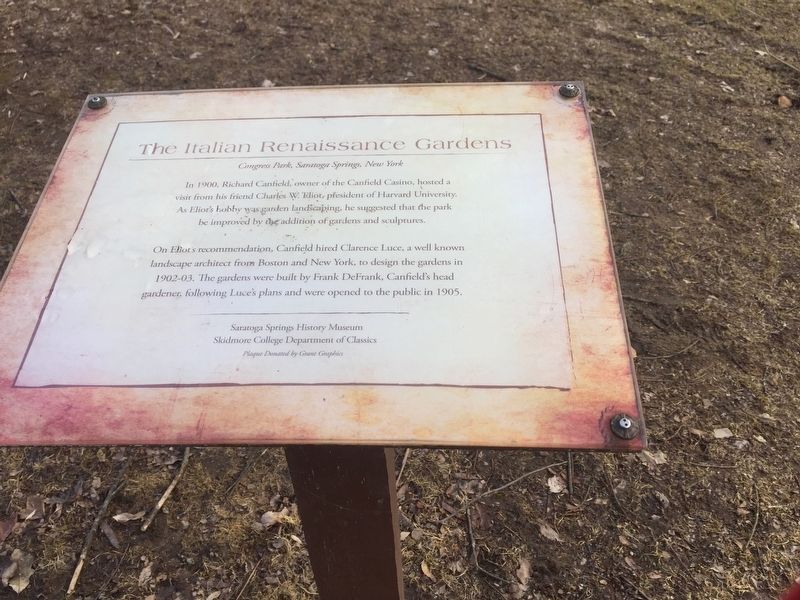
The Italian Renaissance Gardens
Congress Park, Saratoga Springs, New York
Photographed by Steve Stoessel, March 29, 2019
1. The Italian Renaissance Gardens Marker
In 1900, Richard Canfield, owner of the Canfield Casino, hosted a visit from his friend Charles W Eliot, president of Harvard University. As Eliot's hobby was garden landscaping, he suggested that the park be improved by the addition of gardens and sculptures
On Eliot's recommendation, Canfield hired Clarence Luce, a well known landscape architect from Boston and New York, to design the gardens in 1902-03. The gardens were built by Frank DeFrank, Canfield's head gardener, following Luce's plans and were opened to the public in 1905.
Erected by Saratoga Springs History Museum, Skidmore College Department of Classics, Grant Graphics.
Topics. This historical marker is listed in these topic lists: Man-Made Features • Parks & Recreational Areas. A significant historical year for this entry is 1900.
Location. 43° 4.749′ N, 73° 46.989′ W. Marker is in Saratoga Springs, New York, in Saratoga County. It can be reached from Spring Street. In Congress Park. Touch for map. Marker is in this post office area: Saratoga Springs NY 12866, United States of America. Touch for directions.

Regionally, this marker is in Upstate New
this page online
Other nearby markers. At least 8 other markers are within walking distance of this marker: M.C. Illions Carousel (within shouting distance of this marker); “The Gut” or “The Valley” (about 600 feet away, measured in a direct line); Congress Park (about 600 feet away); The 77th Regiment, New York Volunteers (about 600 feet away); Congress Spring (about 700 feet away); These Gates (about 700 feet away); World War Memorial Pavillion (about 700 feet away); Columbian Spring (about 800 feet away). Touch for a list and map of all markers in Saratoga Springs.
More about this marker. A series of three signs explaining the gardens
Photographed by Steve Stoessel, March 29, 2019
2. The Triton Pool
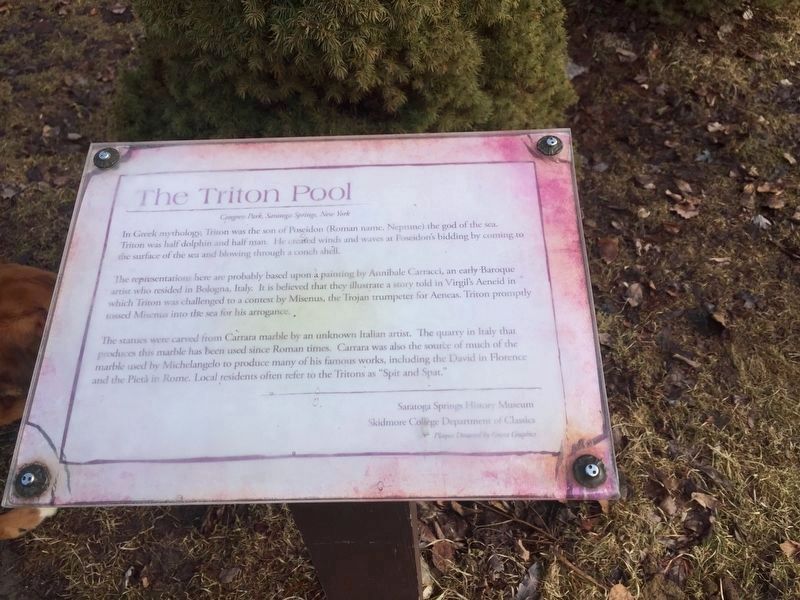
In Greek mythology, Triton was the son of Poseidon (Roman name, Neptune), the god of the sea. Triton was half dolphin and half man. He created winds at Poseidon's bidding by coming tothe surface of the sea and blowing through a conch shell.
The representations here are probably based upon a painting by Annibale Carrafi, an early Baroque artist who resided in Bologna, Italy. It is believed that they illustratea story told in Virgil's Aeneid in which Triton was challenged to a contest by Misenus, the Trojan trumpeter for Aeneas. Triton promptly tossed Misenus into the sea for his arrogance.
The statues were carved from Carrara marble by an unknown Italian artist.The quarry in Italy that produces this marble has been used since Roman times. Carrara was also the source of much of the marble used by Michelangelo to produce many of his famous works, including the David in Florence and the Pieta in Rome. Local residents often refer to the Tritons as "Spit and Spat."
The representations here are probably based upon a painting by Annibale Carrafi, an early Baroque artist who resided in Bologna, Italy. It is believed that they illustratea story told in Virgil's Aeneid in which Triton was challenged to a contest by Misenus, the Trojan trumpeter for Aeneas. Triton promptly tossed Misenus into the sea for his arrogance.
The statues were carved from Carrara marble by an unknown Italian artist.The quarry in Italy that produces this marble has been used since Roman times. Carrara was also the source of much of the marble used by Michelangelo to produce many of his famous works, including the David in Florence and the Pieta in Rome. Local residents often refer to the Tritons as "Spit and Spat."
Photographed by Steve Stoessel, March 29, 2019
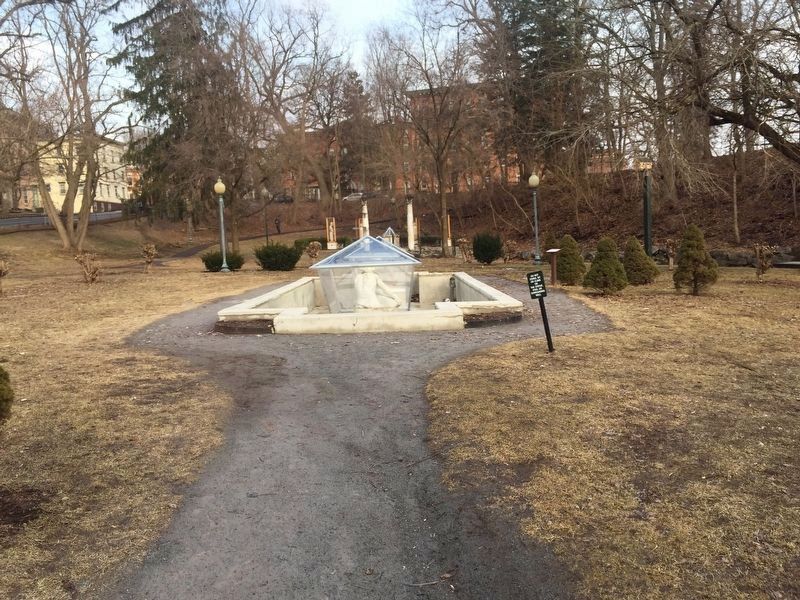
3. Looking up path to Triton Pool and Circle
Photographed by Steve Stoessel, March 29, 2019
4. The Palladian Circle
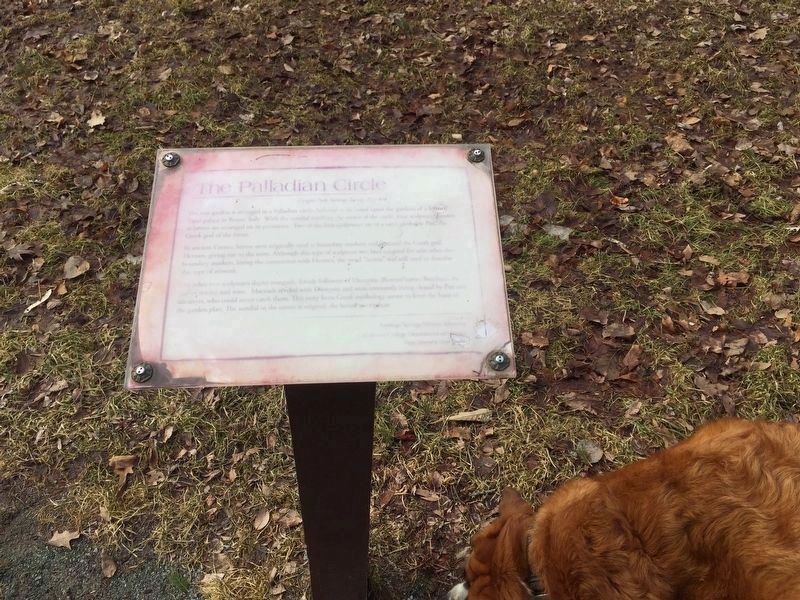
The rear garden is arranged on a Palladian Circle, believed to be based upon the gardens of a former Papal palace in Rome, Italy. With the sundial marking the center of the circle, four sculptures known as herms are arranged on the perimeter. Two of the four sculptures are of a satyr, probably Pan, the Greek god of the forest.
In ancient Greece, herms were originally used as boundary markers and featured the Greek god Hermes, giving rise to the term. Although this type of sculpture was later adapted for uses other than boundary markers, losing the connection with Hermes, the word "herms" was still used to describe this type of artwork.
The other two sculptures depict maenads, female followers of Dionysus (Roman name, Bachuus), the god of revelry and wine. Maenads reveled with Dionysus and were constantly being chased by Pan and his satyrs, who could never catch them. This story from Greek mythology seems to form the basis of the garden plan. The sundial in the center is original, the herms are replicas.
In ancient Greece, herms were originally used as boundary markers and featured the Greek god Hermes, giving rise to the term. Although this type of sculpture was later adapted for uses other than boundary markers, losing the connection with Hermes, the word "herms" was still used to describe this type of artwork.
The other two sculptures depict maenads, female followers of Dionysus (Roman name, Bachuus), the god of revelry and wine. Maenads reveled with Dionysus and were constantly being chased by Pan and his satyrs, who could never catch them. This story from Greek mythology seems to form the basis of the garden plan. The sundial in the center is original, the herms are replicas.
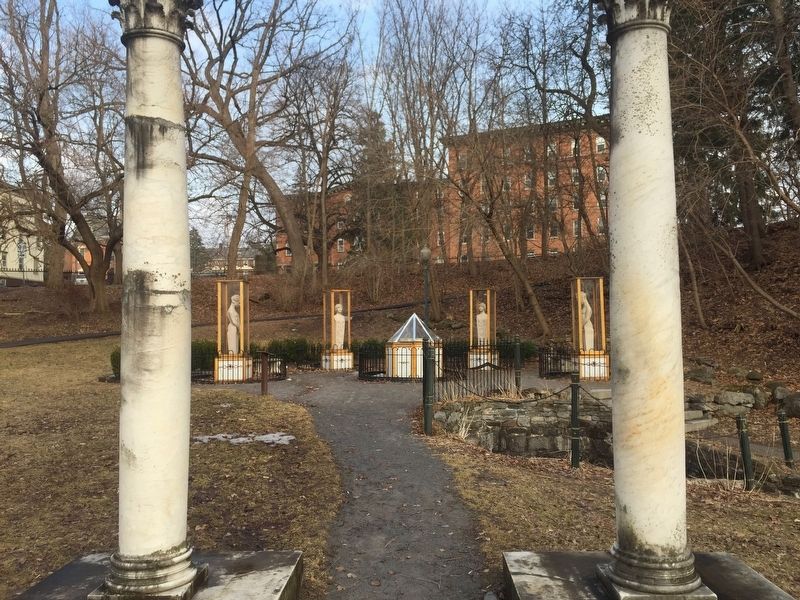
Photographed by Steve Stoessel, March 29, 2019
5. Palladian Circle
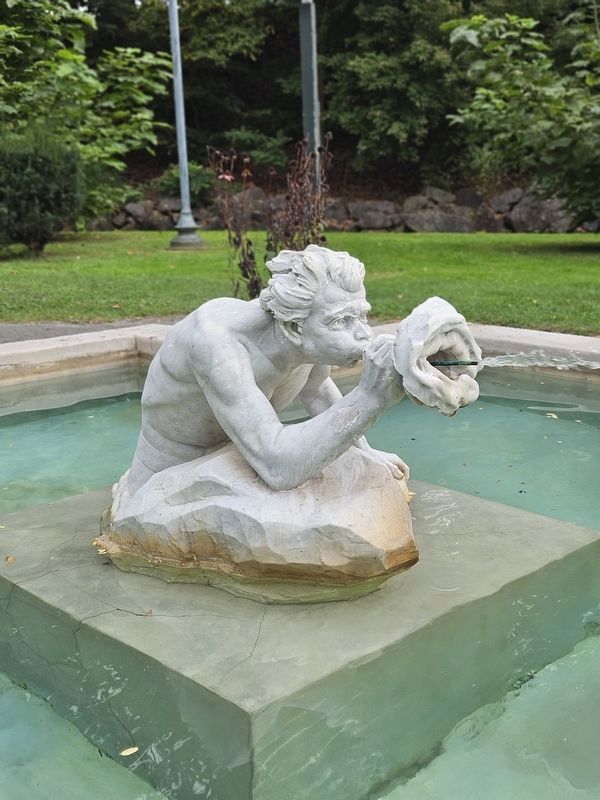
Photographed by Terry Ashmore, October 6, 2023
6. The Italian Renaissance Gardens Statue image
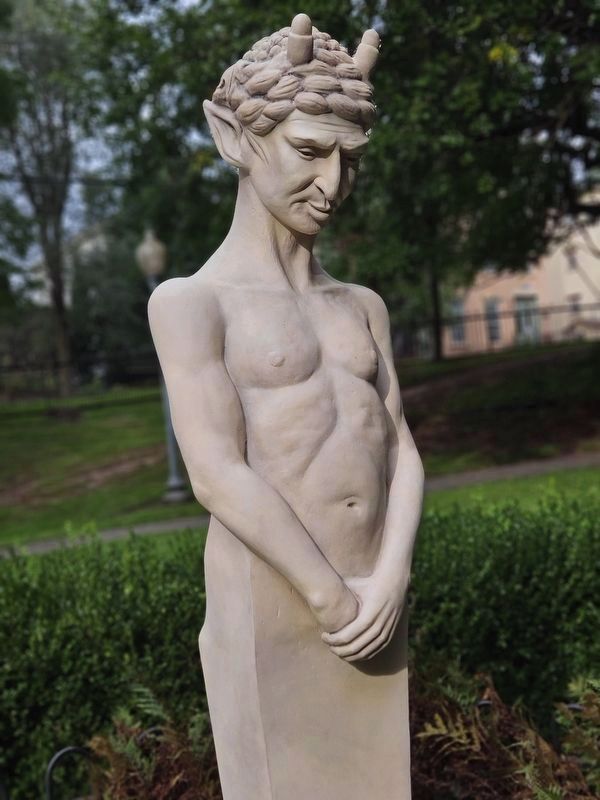
Photographed by Terry Ashmore, October 6, 2023
7. The Italian Renaissance Gardens Statue
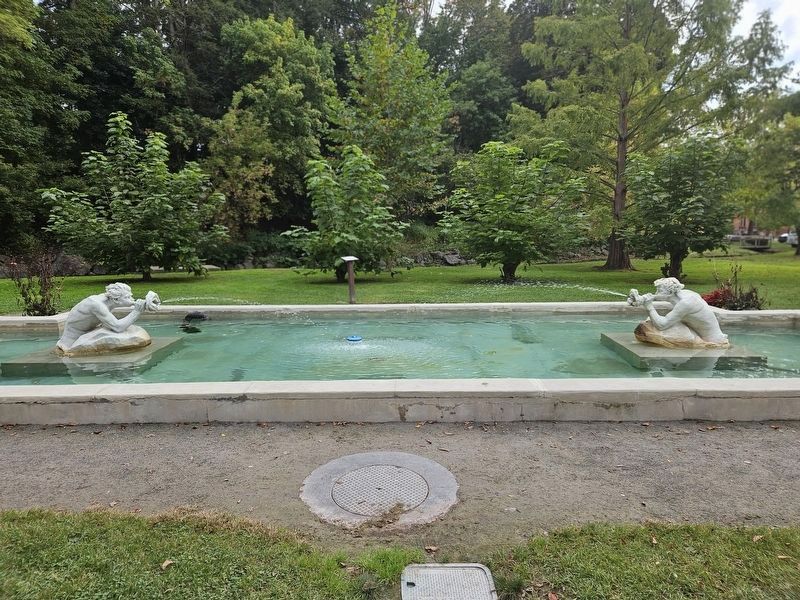
Photographed by Terry Ashmore, October 6, 2023
8. The Italian Renaissance Gardens Spit and Spat
Credits. This page was last revised on January 12, 2024. It was originally submitted on March 31, 2019, by Steve Stoessel of Niskayuna, New York. This page has been viewed 1,569 times since then and 123 times this year. Photos: 1, 2, 3, 4, 5. submitted on March 31, 2019, by Steve Stoessel of Niskayuna, New York. 6, 7, 8. submitted on January 1, 2024, by Terry Quattrociocch1 of Gardner, Massachusetts. • Bill Pfingsten was the editor who published this page.
