
Charles Town in Jefferson County, West Virginia — The American South (Appalachia)
Martin Robison Delany
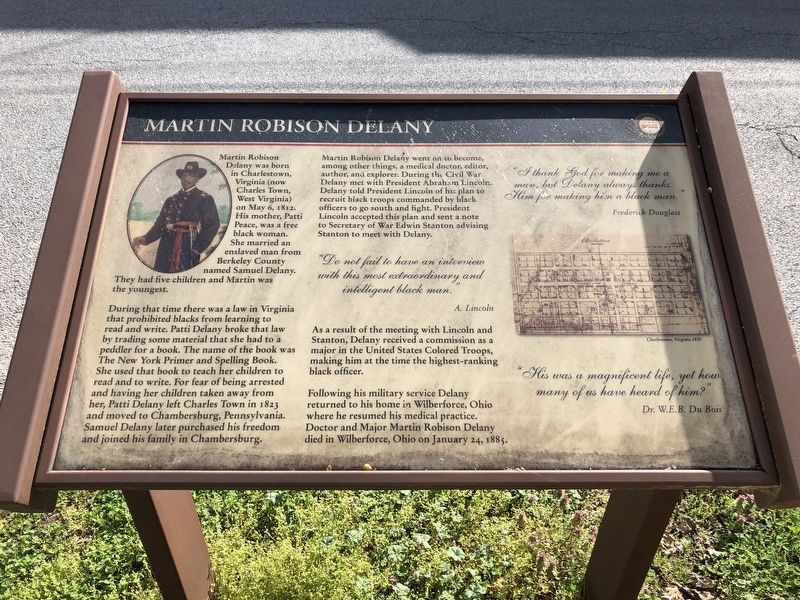
Martin Robison Delany was born in Charlestown, Virginia (now Charles Town, West Virginia) on May 6, 1812. His mother, Patti Peace was a free black woman. She married an enslaved man from Berkeley County named Samuel Delany. They had five children and Martin was the youngest.
During that time there was a law in Virginia that prohibited blacks from learning to read and write. Patti Delany broke the law by trading some material that she had to a peddler for a book. The name of the book was The New York Primer and Spelling Book. She used that book to teach her children to read and write. For fear of being arrested and having her children taken away from her, Patti Delany left Charles Town in 1823 and moved to Chambersburg, Pennsylvania. Samuel Delany later purchased his freedom and joined his family in Chambersburg.
Martin Robison Delany went on to become, among other things, a medical doctor, editor, author, and explorer. During the Civil War, Delany met with President Abraham Lincoln. Delany told President Lincoln of his plan to recruit black troops commanded by black officers to go south and fight. President Lincoln
this page online
As a result of the meeting with Lincoln and Stanton, Delany received a commission as a major in the United States Colored Troops, making him at the time the highest-ranking black officer.
Following his military service Delany returned to his home in Wilberforce, Ohio where he resumed his medical practice. Doctor and Major Martin Robison Delany died in Wilberforce, Ohio on January 24, 1885.
"I thank God for making me a man, but Delany always thanks Him for making him a black man."
Frederick Douglass
"His was a magnificent life, yet how many of us have heard of him?"
Dr. W.E.B. Du Bois
Erected by City of Charles Town, West Virginia.
Topics and series. This historical marker is listed in these topic lists: African Americans • Education • Science & Medicine • War, US Civil. In addition, it is included in the Former U.S. Presidents: #16 Abraham Lincoln series list. A significant historical date for this entry is January 24, 1885.
Location. 39° 17.339′ N,
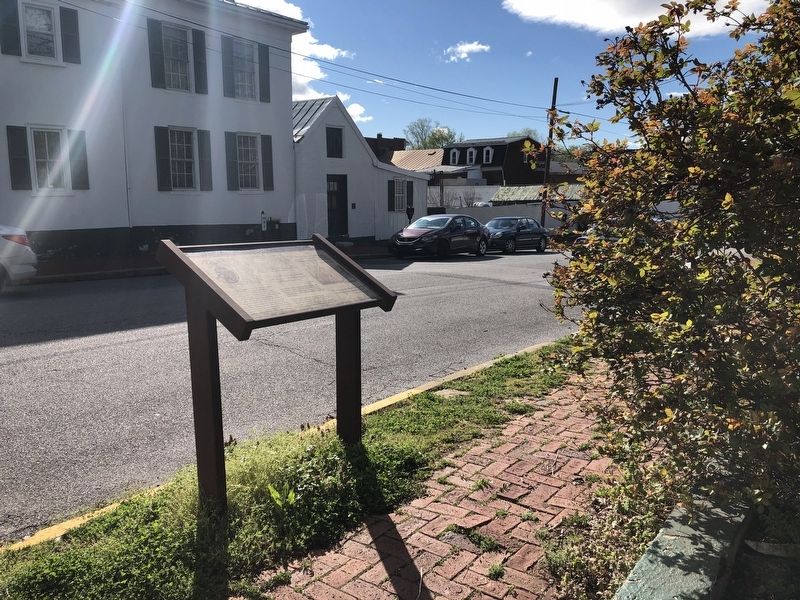

Regionally, this marker is in the Washington Metropolitan Area and in the Eastern Panhandle. It is also in the American South, specifically in the Upper South, in Appalachia, and specifically in Northern Appalachia. Globally, it is in North America, the Western Hemisphere, the Western World, and the Anglosphere. Historically, it finds itself in what was once the territory of the Mississippian Culture and also the Antebellum South.
Other nearby markers. At least 8 other markers are within walking distance of this marker: Office of Charles Washington (a few steps from this marker); John Thomas Marker (about 800 feet away, measured in a direct line); Charles Town Schools (about 800 feet away); Old Stone House / Star Lodge No. 1 (about 800 feet away); A Brief History of the Old Presbyterian Church in Charles Town (about 800 feet away); Charles Washington Hall (approx. 0.2 miles away); New Central Restaurant (approx. 0.2 miles away); Williams House (approx. 0.2 miles away). Touch for a list and map of all markers in Charles Town.
Another marker is no longer nearby. African-American Schools in Charles Town, West Virginia (was about 800 feet away but has been permanently removed).
Additional keywords. USCT
Credits. This page was last revised on January 26, 2026. It was originally submitted on April 18, 2019, by Devry Becker Jones of Washington, District of Columbia. This page has been viewed 491 times since then and 20 times this year. Photos: 1, 2. submitted on April 18, 2019, by Devry Becker Jones of Washington, District of Columbia.
