Downtown in Indianapolis in Marion County, Indiana — The American Midwest (Great Lakes)
The Plague Cemetery
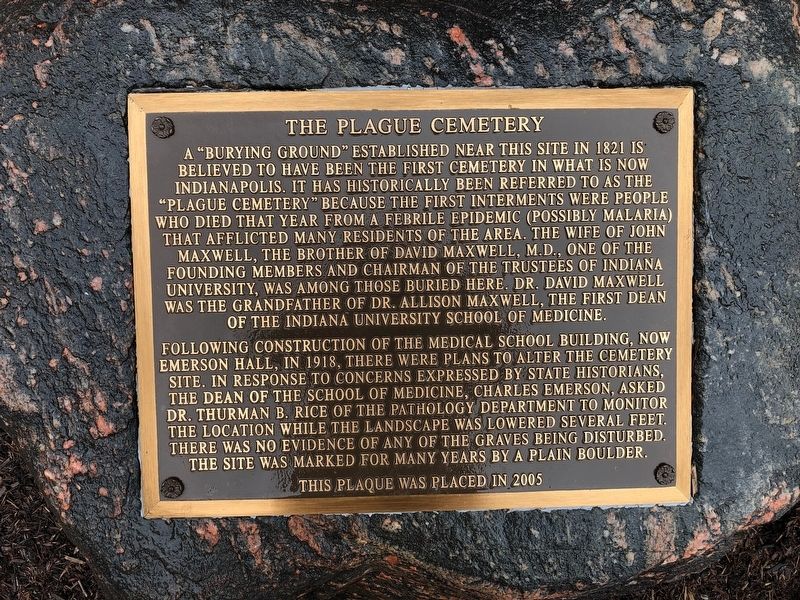
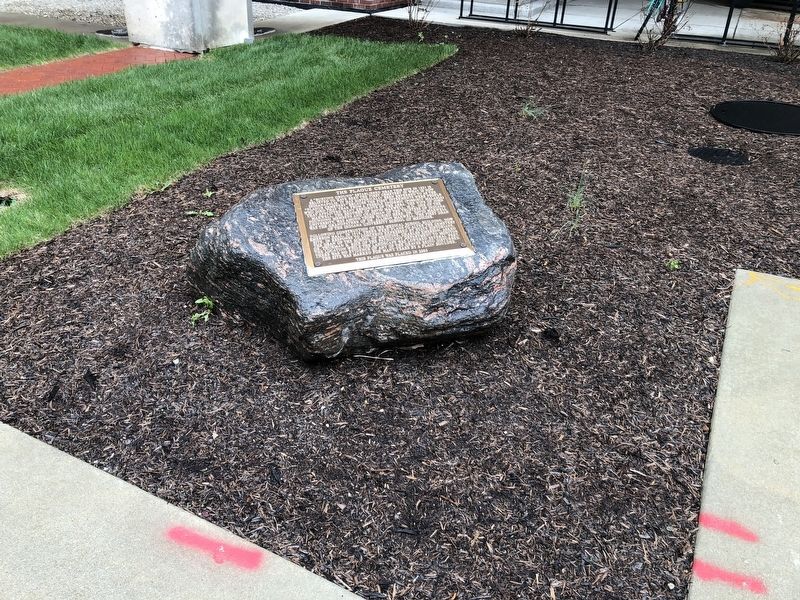
Following construction of the medical school building, now Emerson Hall, in 1918, there were plans to alter the cemetery site. In response to concerns expressed by state historians, the dean of the School of Medicine, Charles Emerson, asked Dr. Thurman B. Rice of the Pathology Department to monitor the location while the landscape was lowered several feet. There was no evidence of any graves being disturbed. The site was marked for many years by a plain boulder.
Erected 2005 by Indiana University–Purdue
this page online
Topics. This historical marker is listed in these topic lists: Cemeteries & Burial Sites • Education • Science & Medicine • Settlements & Settlers. A significant historical year for this entry is 1821.
Location. 39° 46.559′ N, 86° 10.713′ W. Marker is in Indianapolis, Indiana, in Marion County. It is in Downtown. It is on Barnhill Drive north of Medical Drive, on the right when traveling north. Touch for map. Marker is at or near this postal address: 635 Barnhill Drive, Indianapolis IN 46202, United States of America. Touch for directions.

Regionally, this marker is in Central Indiana. It is also in the American Midwest and in the Corn Belt. Globally, it is in North America, the Western Hemisphere, the Western World, and the Anglosphere. Historically, it finds itself in what was once the territory of the Mississippian Culture and also the Northwest Territory.
Other nearby markers. At least 8 other markers are within walking distance of this marker: Wilson House Site (within shouting distance of this marker); Emerson Hall (within shouting distance of this marker); This Tablet Marks the Homestead of Isaac Wilson, Pioneer and Patriot.
Credits. This page was last revised on February 4, 2023. It was originally submitted on April 25, 2019, by Devry Becker Jones of Washington, District of Columbia. This page has been viewed 1,308 times since then and 116 times this year. Photos: 1, 2. submitted on April 25, 2019, by Devry Becker Jones of Washington, District of Columbia.
