Bethune Beach in Volusia County, Florida — The American South (South Atlantic)
Bethune-Volusia Beach
Photographed by Tim Fillmon, April 16, 2019
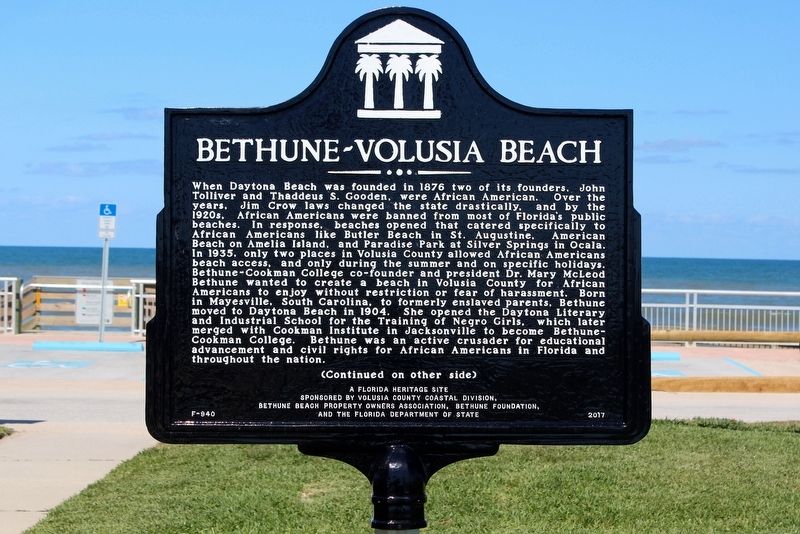
1. Bethune-Volusia Beach Marker Side 1
When Daytona Beach was founded in 1876 two of its founders, John Tolliver and Thaddeus S. Gooden, were African American. Over the years, Jim Crow laws changed the state drastically, and by the 1920s, African Americans were banned from most of Florida’s public beaches. In response, beaches opened that catered specifically to African Americans like Butler Beach in St. Augustine, American Beach on Amelia Island, and Paradise Park at Silver Springs in Ocala. In 1935, only two places in Volusia County allowed African Americans beach access, and only during the summer and on specific holidays. Bethune-Cookman College co-founder and president Dr. Mary McLeod Bethune wanted to create a beach in Volusia County for African Americans to enjoy without restriction or fear of harassment. Born in Mayesville, South Carolina, to formerly enslaved parents, Bethune moved to Daytona Beach in 1904. She opened the Daytona Literary and Industrial School for the Training of Negro Girls, which later merged with Cookman Institute in Jacksonville to become Bethune-Cookman College. Bethune was an active crusader for educational advancement and civil
this page online
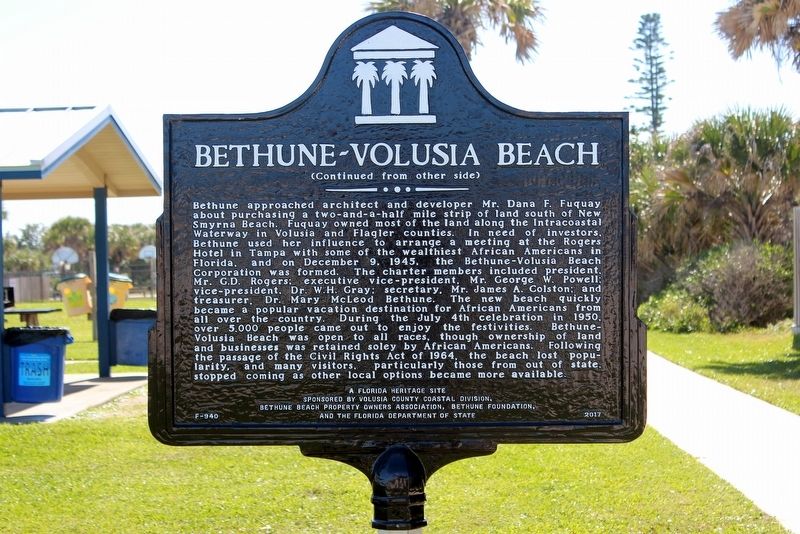
Bethune approached architect and developer Mr. Dana F. Fuquay about purchasing a two-and-a-half mile strip of land south of New Smyrna Beach. Fuquay owned most of the land along the Intracoastal Waterway in Volusia and Flagler counties. In need of investors, Bethune used her influence to arrange a meeting at the Rogers Hotel in Tampa with some of the wealthiest African Americans in Florida, and on December 9, 1945, the Bethune-Volusia Beach Corporation was formed. The charter members included president, Mr. G.D. Rogers; executive vice-president, Mr. George W. Powell; vice-president, Dr. W.H. Gray; secretary, Mr. James A. Colston; and treasurer, Dr. Mary McLeod Bethune. The new beach quickly became a popular vacation destination for African Americans from all over the country. During the July 4th celebration in 1950, over 5,000 people came out to enjoy the festivities. Bethune-Volusia Beach was open to all races, though ownership of land and businesses was retained solely by African Americans. Following the passage of the Civil Rights Act of 1964, the beach lost
Photographed by Tim Fillmon, April 16, 2019
2. Bethune-Volusia Beach Marker Side 2
Erected 2017 by Volusia County Coastal Division, Bethune Beach Property Owners Association, Bethune Foundation, and the Florida Department of State. (Marker Number F-940.)
Topics and series. This historical marker is listed in these topic lists: African Americans • Civil Rights • Parks & Recreational Areas. In addition, it is included in the Historically Black Colleges and Universities, and the Mary McLeod Bethune series lists. A significant historical date for this entry is December 9, 1945.
Location. 28° 57.058′ N, 80° 50.364′ W. Marker is in Bethune Beach, Florida, in Volusia County. It is on South Atlantic Avenue (County Road A1A) 0.1 miles south of Kingfish Avenue, on the right when traveling south. Marker is in Mary McLeod Bethune Beach Park. Touch for map. Marker is at or near this postal address: 6656 South Atlantic Avenue, New Smyrna Beach FL 32169, United States of America. Touch for directions.

Regionally, this marker is in Florida’s First Coast. It is also in the American South and
Photographed by Tim Fillmon, April 16, 2019
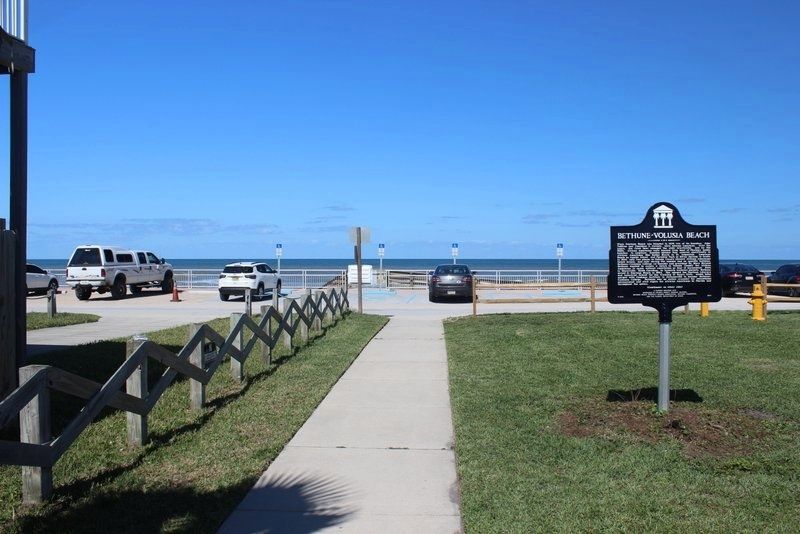
3. Bethune-Volusia Beach Marker
Atlantic Avenue is in the background
Other nearby markers. At least 8 other markers are within 4 miles of this marker, measured as the crow flies: Bethune Beach (within shouting distance of this marker); The Mound Builders (approx. 1.6 miles away); Turtle Mound (approx. 1.7 miles away); A Gateway to the Stars (approx. 1.9 miles away); Veterans Memorial (approx. 2.6 miles away); Veterans Field of Honor (approx. 2.7 miles away); Eldora House (approx. 3.1 miles away); Eldora Village (approx. 3.1 miles away).
Credits. This page was last revised on August 3, 2025. It was originally submitted on June 30, 2019, by Tim Fillmon of Webster, Florida. This page has been viewed 1,884 times since then and 178 times this year. Photos: 1, 2, 3. submitted on June 30, 2019, by Tim Fillmon of Webster, Florida. • Bernard Fisher was the editor who published this page.
