Lexington's Long History with Slavery
⎯⎯⎯
Driven by Money
1820
| — | Downtown African-American Heritage Trail | — |
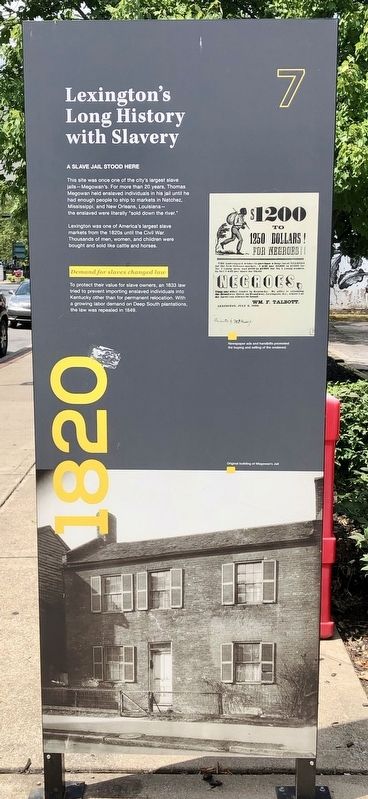
This site was once one of the city's largest slave jails—Megowan's. For more than 20 years, Thomas Megowan held enslaved individuals in his jail until he had enough people to ship to markets in Natchez, Mississippi, and New Orleans, Louisiana—the enslaved were literally "sold down the river."
Lexington was one of America's largest slave markets from the 1820s until the Civil War. Thousands of men, women, and children were bought and sold like cattle and horses.
Demand for slaves changed law
To protect their value for slave owners, an 1833 law tried to prevent importing enslaved individuals into Kentucky other than for permanent relocation. With a growing labor demand on Deep South plantations, the law was repealed in 1849.
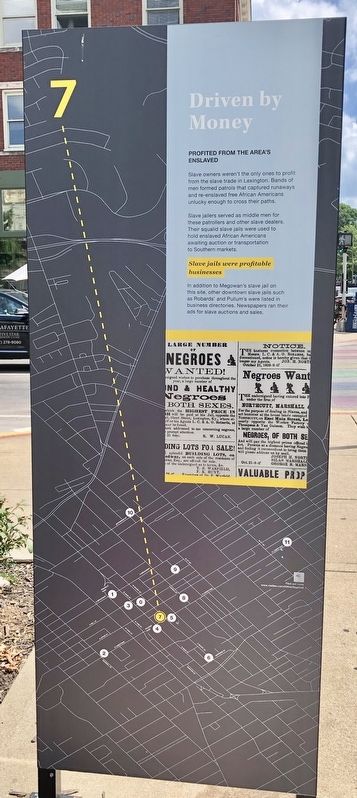
Slave owners weren't the only ones to profit from the slave trade in Lexington. Bands of men formed patrols that captured runaways and re enslaved free African Americans unlucky enough to cross their paths.
Slave jailers served as middle men for these patrollers and other slave dealers. Their squalid slave jails were used to hold enslaved African Americans awaiting auction or transportation to Southern markets.
Slave jails were profitable businesses
In addition to Megowan's slave jail on this site, other downtown slave jails such as Robards' and Pullum's were listed in business directories. Newspapers ran their ads for slave auctions and sales.
Erected 2018 by Together Lexington. (Marker Number 7.)
Topics. This historical marker is listed in these topic lists: African Americans • Civil Rights • Notable Events. A significant historical year for this entry is 1833.
Location. 38° 2.814′ N, 84° 29.785′ W. Marker is in Lexington,
this page online

Regionally, this marker is in the Bluegrass Region. It is also in the American South and specifically in the Upper South. Globally, it is in North America, the Western Hemisphere, the Western World, and the Anglosphere. Historically, it finds itself in what was once the territory of the Mississippian Culture and also the Antebellum South.
Other nearby markers. At least 8 other markers are within walking distance of this marker: From Enslaved to Community Activist / The Original Power Couple (within shouting distance of this marker); Skuller's Clock (within shouting distance of this marker); Rotary Club of Lexington / Phoenix Hotel (about 300 feet away, measured in a direct line); Strength in Numbers / Forcing a Change (about 300 feet away); Phoenix Park (about 400 feet away); Fayette National Bank Building
Regarding Lexington's Long History with Slavery / Driven by Money. Slavery (1782-1865)
Lexington’s early success was built upon the enslavement of its residents. Those who did not directly profit from the enforcement of slavery indirectly supported those who owned, jailed, captured, bred, or sold Lexington’s African-American residents. In 1860, a little under half (45%) of Lexington’s population were enslaved. Of the total African-American men and women within the city, six percent were free. These subjugated individuals did not passively accept their station; they fought to define their independence through religious institutions, business networks, and legal systems.
Also see . . . African American Heritage Self-Guided Walking Tour. Visit Lexington website entry (Submitted on June 24, 2023, by Larry Gertner of New York, New York.)
Credits. This page was last revised on June 24, 2023. It was originally submitted on July 29, 2019, by Mark Hilton of Montgomery, Alabama. This page has been viewed 1,848 times since then and 194 times this year. Photos: 1, 2, 3, 4. submitted on July 29, 2019, by Mark Hilton of Montgomery, Alabama.
