Fort Recovery in Mercer County, Ohio — The American Midwest (Great Lakes)
Weaponry at the Battle of the Wabash and the Battle of Fort Recovery
Photographed by Dale K. Benington, July 15, 2019
1. Weaponry at the Battle of the Wabash and the Battle of Fort Recovery Marker
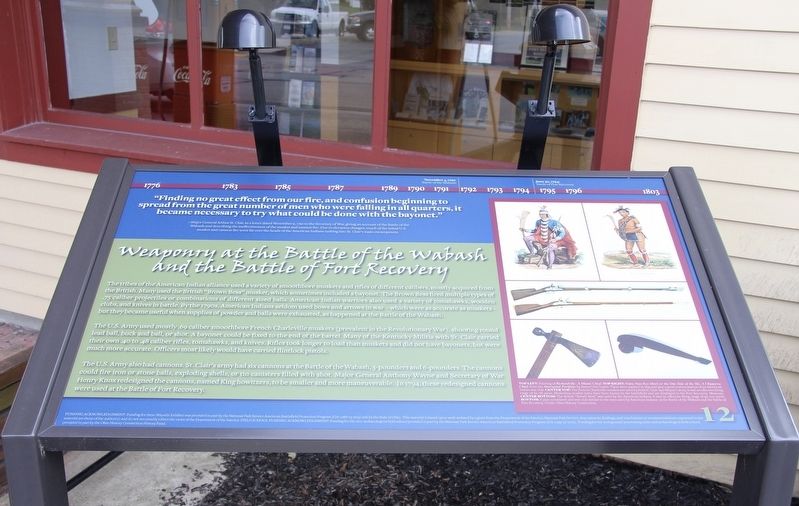
--Major General Arthur St. Clair, in a letter dated November 9, 1791 to the Secretary of War, giving an account of the Battle of the Wabash and describing the ineffectiveness of the musket and cannon fire. Due to elevation changes, much of the initial U.S musket and cannon fire went far over the heads of the American Indians rushing into St. Clair''s main encampment.
The tribes of the American Indian alliance used a variety of smoothbore muskets and rifles of different calibers, mostly acquired from the British. Many used the British "Brown Bess” musket, which sometimes included a bayonet. The Brown Bess fired multiple types of .75 caliber projectiles or combinations of different sized balls. American Indian warriors also used a variety of tomahawks, wooden clubs, and knives in battle. By the 1790s, American Indians seldom used bows and arrows in war-which were as accurate as muskets but they became useful
this page online
The U.S. Army used mostly .69 caliber smoothbore French Charleville muskets (prevalent in the Revolutionary War), shooting round lead ball, buck and ball, or shot. A bayonet could be fixed to the end of the barrel. Many of the Kentucky Militia with St. Clair carried their own .40 to .48 caliber rifles, tomahawks, and knives. Rifles took longer to load than muskets and did not have bayonets, but were much more accurate. Officers most likely would have carried flintlock pistols.
The U.S.Army also had cannons. St. Clair''s army had six cannons at the Battle of the Wabash, 3-pounders and 6-pounders. The cannons could fire iron or stone balls, exploding shells, or tin canisters filled with shot. Major General Anthony Wayne and Secretary of War Henry Knox redesigned the cannons, named King howitzers, to be smaller and more maneuverable. In 1794, these redesigned cannons were used at the Battle of Fort Recovery.
Erected by National Park Service American Battlefield Protection Program and the State of Ohio. (Marker Number 12.)
Topics.
Photographed by Dale K. Benington, July 15, 2019
2. Weaponry at the Battle of the Wabash and the Battle of Fort Recovery Marker
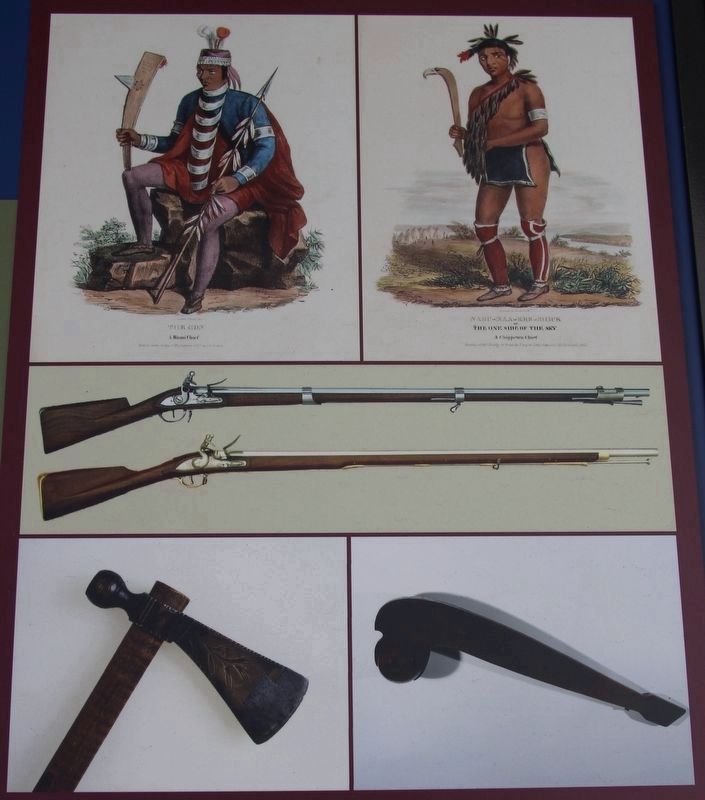
Close-up view of several features that are displayed on this marker. The captions read as follows: Top Left: Painting of Richardville; A Miami Chief; Top Right: Nabu-Naa-Kee-Shick or the One Side of the Sky, A Chippewa Chief, from the Aboriginal Portfolio by James Otto Lewis. These were painted in 1835 and give a good representation of an American Indian war club. Center Top: The French Charleville musket was used by both St.Clair and Wayne's army. It had an effective firing range of 60-76 yards. Numerous musket parts have been found on the battlefield and are displayed in the Fort Recovery Museum. Center Bottom: The British "Brown Bess” was used by the American Indians. It had an effective firing range of 50-100 yards. Bottom: A pipe tomahawk and war club similar to the ones used by American Indians at the Battle of the Wabash and the Battle of Fort Recovery. Credit: Ohio History Connection.
Location. 40° 24.841′ N, 84° 46.735′ W. Marker is in Fort Recovery, Ohio, in Mercer County. It is on East Boundary Street east of Wayne Street, on the right when traveling east. This marker is located on the eastern edge of the downtown district, on the grounds of the community Visitor Center. Touch for map. Marker is at or near this postal address: 110 East Boundary Street, Fort Recovery OH 45846, United States of America. Touch for directions.

Regionally, this marker is in the Till Plains. It is also in the American Midwest and in the Corn Belt. Globally, it is in North America, the Western Hemisphere, the Western World, and the Anglosphere. Historically, it finds itself in what was once the Haudenosaunee (Iroquois) Confederacy, the territory of the Mississippian Culture, and the Northwest Territory.
Other nearby markers. At least 8 other markers are within walking distance of this marker: The Battle of Fort Recovery (within shouting distance
Photographed by Dale K. Benington, July 15, 2019
3. Weaponry at the Battle of the Wabash and the Battle of Fort Recovery Marker
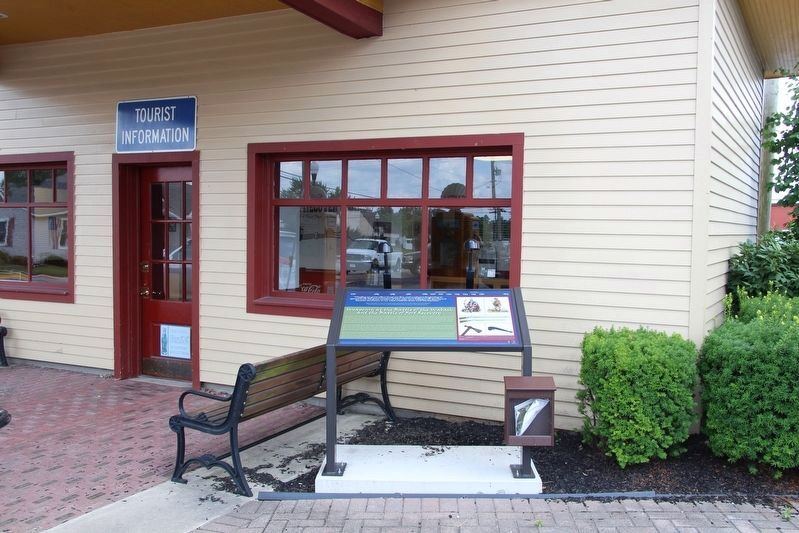
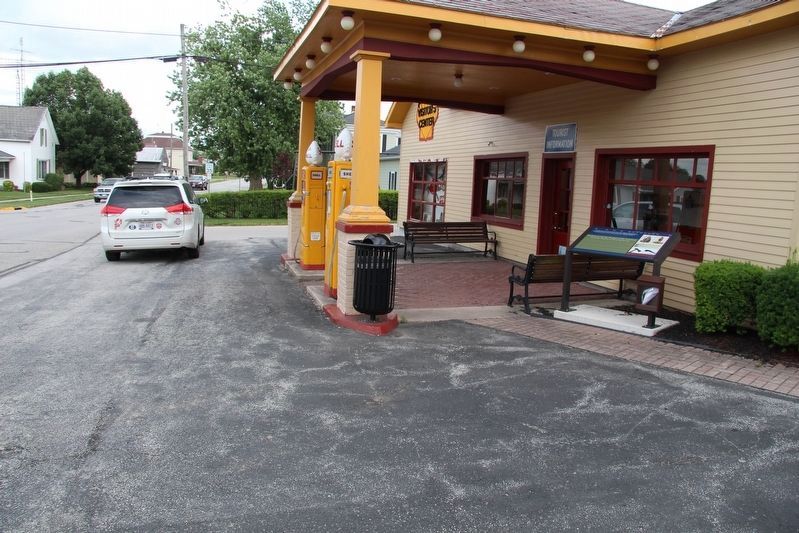
View of the marker situated in front of the community Visitor Center.
Photographed by Dale K. Benington, July 15, 2019
4. Weaponry at the Battle of the Wabash and the Battle of Fort Recovery Marker
View of the marker looking west along Boundary Street.
Photographed by Dale K. Benington, July 15, 2019
5. Weaponry at the Battle of the Wabash and the Battle of Fort Recovery Marker
View of the marker looking east along Boundary Street.
Credits. This page was last revised on January 30, 2023. It was originally submitted on August 4, 2019, by Dale K. Benington of Toledo, Ohio. This page has been viewed 1,036 times since then and 85 times this year. Photos: 1, 2, 3, 4, 5. submitted on August 4, 2019, by Dale K. Benington of Toledo, Ohio.
