Fort Recovery in Mercer County, Ohio — The American Midwest (Great Lakes)
Towards a Better Understanding
⎯⎯⎯
Remembering the Fallen

Photographed by Dale K. Benington, July 15, 2019
1. Towards a Better Understanding / Remembering the Fallen Marker
"This splendid granite shaft, handsome in its proportions; durable in its material; permanent in its foundation and pedestal, and simple in its purity and design, we now dedicate to commemorate the last resting place of those of our heroic countrymen who fell here and are here interred..."
-Address of General J. Warren Keifer during Monument dedication on July 1, 1913
Towards a Better Understanding
The speech excerpt below and monument plaques reflect attitudes in 1913. The American Indians' efforts to protect their homelands are more fully appreciated today. Also recognized now are the U.S. government's complete disregard for American Indian treaties at that time. Words used in the past to describe American Indians, and even the monument itself with references to only U.S. losses, can be offensive to many people including American Indias. The Fort Recovery Museum strives to work with our American Indian partners to educate our patrons and visitors on current American Indian thoughts and concerns about our shared history.
Remembering the Fallen
In 1851, boys playing along the banks of the Wabash River discovered
this page online
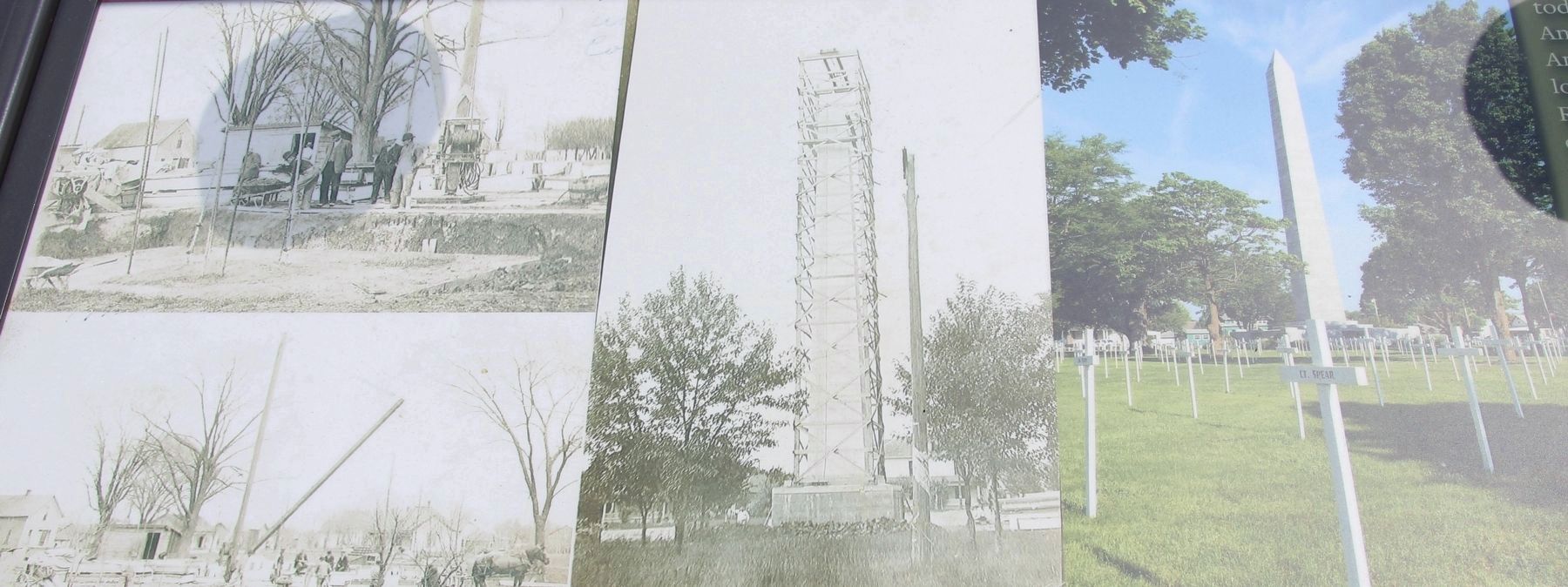
In 1908, President William Howard Taft authorized the building of a monument to honor the soldiers of Major General Arthur St. Clair and Major General Anthony Wayne. Construction began in early 1912. A crypt was prepared in the concrete foundation of the monument for the final internment of the remains of the fallen soldiers, allowing Monument Park to serve both as a memorial and a military cemetery. The Monument was dedicated on July 1, 1913 with several thousand people attending the ceremony. Speakers included dignitaries and local officials. The total height of the monument is over 101 feet. It is estimated that 800 tons of granite, concrete and other materials were used in the structure. The total cost in 1913 was $23,700, which is the equivalent of over a half million dollars in 2017.
Erected by National
Photographed by Dale K. Benington, July 15, 2019
2. Towards a Better Understanding / Remembering the Fallen Marker
Close-up view of four features that are displayed on this marker. The captions read as follows: Left and Center: Building the monument in 1912 and 1913, photos courtesy of Jim Wagner and the Fort Recovery Historical Society. Right; Over 900 crosses are set up each Memorial Day to honor those killed in the Battle of the Wabash (1791) and the Battle of Fort Recovery (1794). Credit: Christine Thompson.
Topics and series. This historical marker is listed in these topic lists: Cemeteries & Burial Sites • Indigenous Peoples and Communities • Wars, US Indian. In addition, it is included in the Former U.S. Presidents: #27 William Howard Taft series list. A significant historical date for this entry is July 1, 1913.
Location. 40° 24.814′ N, 84° 46.587′ W. Marker is in Fort Recovery, Ohio, in Mercer County. It is on Elm Road (Ohio Route 49) south of East Boundary Street, on the left when traveling south. This marker is located on the western boundary of the grounds of Monument Park, west of the granite memorial shaft. Touch for map. Marker is in this post office area: Fort Recovery OH 45846, United States of America. Touch for directions.

Regionally, this marker is in the Till Plains. It is also in the American Midwest and in the Corn Belt. Globally, it is in North America, the Western Hemisphere, the Western World, and the Anglosphere. Historically, it finds itself in what was once the Haudenosaunee (Iroquois) Confederacy, the territory
Photographed by Dale K. Benington, July 15, 2019
3. Towards a Better Understanding / Remembering the Fallen Marker
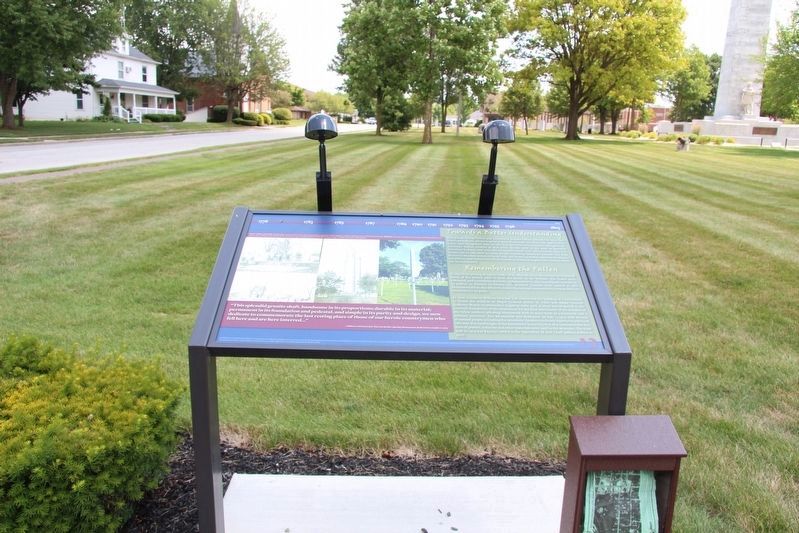
View of the marker looking east along East Boundary Street.
Other nearby markers. At least 8 other markers are within walking distance of this marker: Veterans Memorial Arch (within shouting distance of this marker); St. Clair's Defeat / Fort Recovery (within shouting distance of this marker); Dr. Victor Grasson (within shouting distance of this marker); Fort Recovery Monument (within shouting distance of this marker); Fort Recovery Civil War Veterans Memorial (within shouting distance of this marker); Memorial Arch (about 300 feet away, measured in a direct line); Fort Recovery Veterans Plaza (about 400 feet away); Weaponry at the Battle of the Wabash and the Battle of Fort Recovery (about 700 feet away). Touch for a list and map of all markers in Fort Recovery.
Photographed by Dale K. Benington, July 15, 2019
4. Towards a Better Understanding / Remembering the Fallen Marker
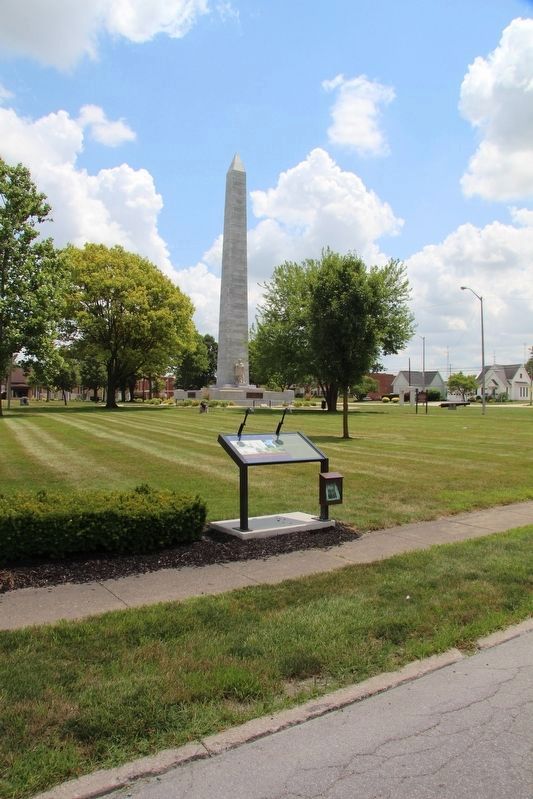
View of the marker, looking east, with Monument Park in the immediate background, and the granite shaft memorial monument in the distant background.
Credits. This page was last revised on August 1, 2020. It was originally submitted on August 4, 2019, by Dale K. Benington of Toledo, Ohio. This page has been viewed 346 times since then and 33 times this year. Photos: 1, 2, 3, 4. submitted on August 4, 2019, by Dale K. Benington of Toledo, Ohio.
