
Near North Riverfront in St. Louis, Missouri — The American Midwest (Upper Plains)
Le Grange de Terre (Big Mound)
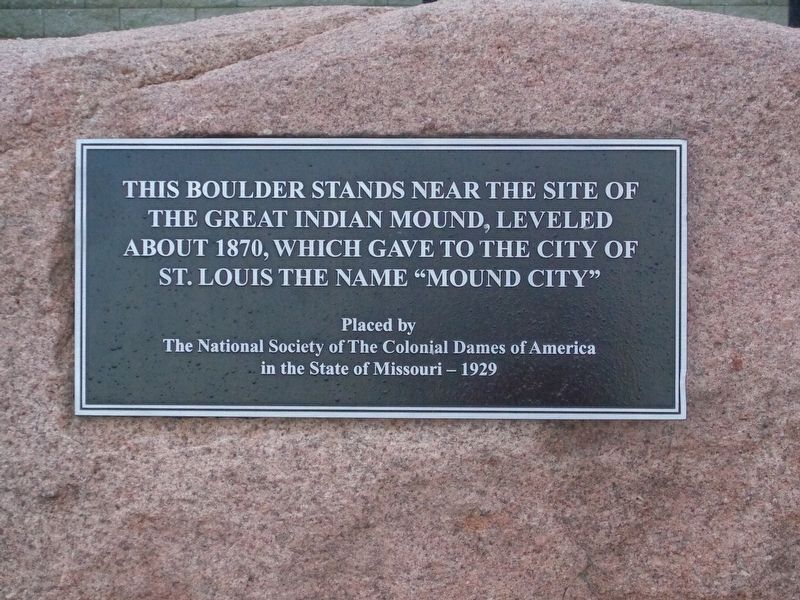
Photographed by Jason Voigt, September 10, 2019
1. Le Grange de Terre (Big Mound) Plaque
Erected 1929 by The National Society of The Colonial Dames of America in the State of Missouri.
Topics and series. This historical marker is listed in these topic lists: Anthropology & Archaeology • Indigenous Peoples and Communities. In addition, it is included in the The Colonial Dames of America, National Society of series list.
Location. 38° 38.589′ N, 90° 11.105′ W. Marker is in St. Louis, Missouri. It is in Near North Riverfront. It is on Mound Street, on the left when traveling east. Touch for map. Marker is at or near this postal address: 1700 North Broadway, Saint Louis MO 63102, United States of America. Touch for directions.

Regionally, this marker is in the American Midwest, in the Lewis & Clark Corridor, in the Corn Belt, and in the Great River Road Region. Globally, it is in North America, the Western Hemisphere, the Western World, and the Anglosphere. Historically, it finds itself in what was once the
this page online
Other nearby markers. At least 8 other markers are within walking distance of this marker: Mounds Heritage Trail (a few steps from this marker); Neighborhood Gardens Apartments (approx. half a mile away); Fr. Edward S. Filipiak Park (approx. 0.6 miles away); Biddle Street Trailhead (approx. 0.6 miles away); AMDG Shrine of St. Joseph (approx. 0.6 miles away); Star Bucket Pump Company (approx. 0.8 miles away); 1993 (approx. 0.8 miles away); 1992 (approx. 0.8 miles away). Touch for a list and map of all markers in St. Louis.
More about this marker. This marker and memorial were originally placed where the Stan Musial Veteran's Memorial bridge stands now. The bridge opened in 2014.
Regarding Le Grange de Terre (Big Mound). As the marker says, St. Louis was nicknamed "Mound City" and the biggest of the 27 mounds found on the west side of the Mississippi River once stood at that spot. The mound stood approximately 30 feet high. When the French first claimed the city, they named the mound, "Le Grange de Terre", which in English means "Earthen
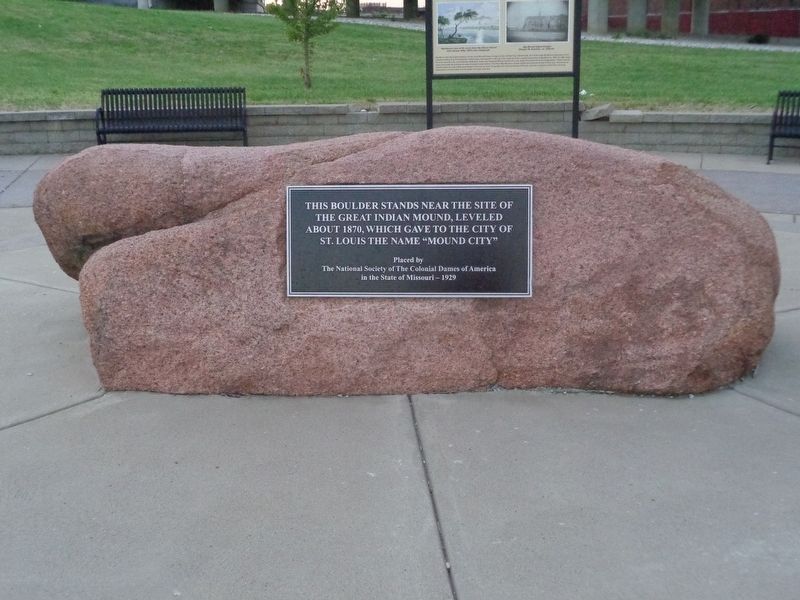
Photographed by Jason Voigt, September 10, 2019
2. Le Grange de Terre (Big Mound) Marker
Also see . . . The Big Mound of St. Louis. From the history blog, Distilled History, this tells the story about the "Big Mound" that was once in St. Louis. (Submitted on September 10, 2019, by Jason Voigt of Glen Carbon, Illinois.)
Credits. This page was last revised on January 30, 2023. It was originally submitted on September 10, 2019, by Jason Voigt of Glen Carbon, Illinois. This page has been viewed 1,463 times since then and 133 times this year. Photos: 1, 2. submitted on September 10, 2019, by Jason Voigt of Glen Carbon, Illinois. • Andrew Ruppenstein was the editor who published this page.
