Chantilly in Fairfax County, Virginia — The American South (Mid-Atlantic)
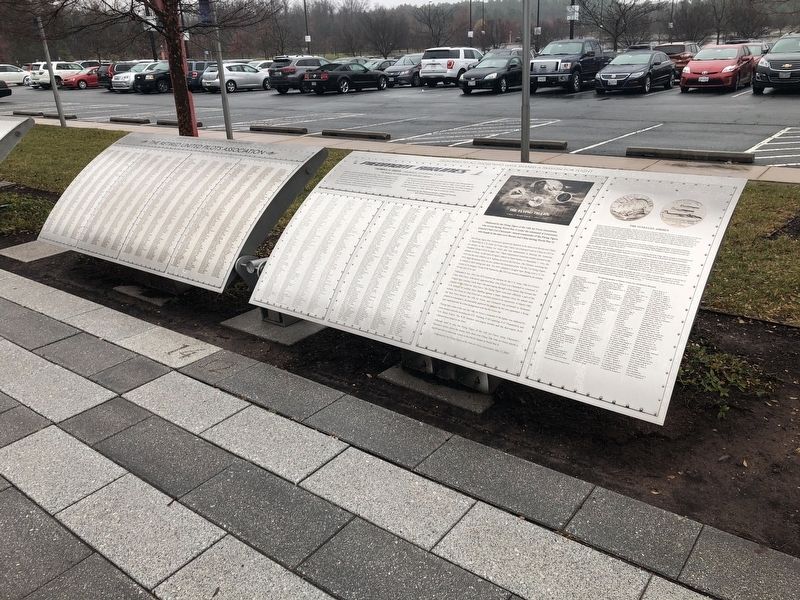
The Tuskegee Airmen
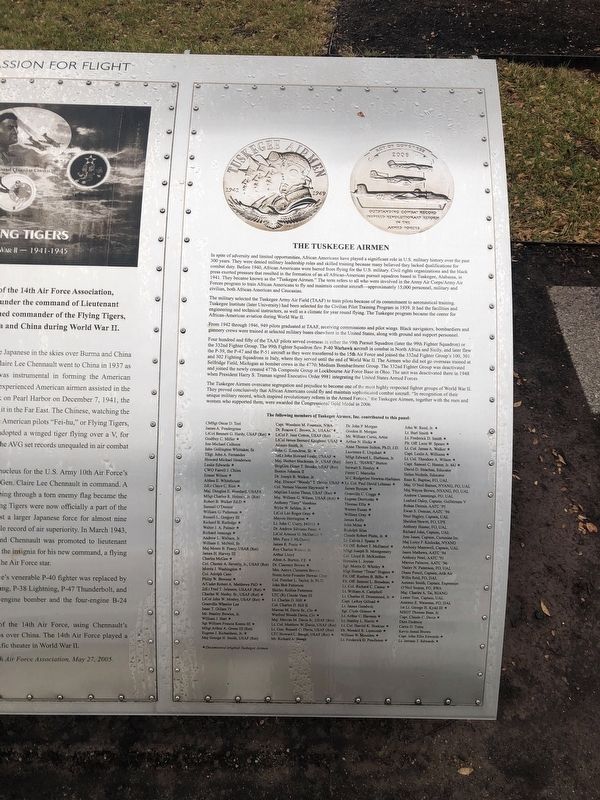
The military selected the Tuskegee Army Air Field (TAAF) to train pilots because of its commitment to aeronautical training. Tuskegee Institute (later University) had been selected for the Civilian Pilot Training Program in 1939. It had the facilities and engineering and technical instructors, as well as
this page online
From 1942 through 1946, 949 pilots graduated at TAAF, receiving commissions and pilot wings. Black navigators, bombardiers and gunnery crews were trained at selected military bases elsewhere in the United States, along with ground and support personnel.
Four hundred and fifty of the TAAF pilots served overseas in either the 99th Pursuit Squadron (later the 99th Fighter Squadron) or the 332nd Fighter Group. The 99th Fighter Squadron flew P-40 Warhawk aircraft in combat in North Africa and Sicily, and later flew the P-39, the P-47 and the P-51 aircraft as they were transferred to the 15th Air Force and joined the 332nd Fighter Group's 100, 301 and 302 Fighting Squadrons in Italy, where they served until the end of World War II. The Airmen who did not go overseas trained at Selfridge Field, Michigan as bomber crews in the 477th Medium Bombardment Group. The 332nd Fighter Group was deactivated and joined the newly crated 477th Composite Group at Lockburne Air Force Base in Ohio. The unit was deactivated there in
The Tuskegee Airmen overcame segregation and prejudice to become one of the most highly respected fighter groups of World War II. They proved conclusively that African Americans could fly and maintain sophisticated combat aircraft. "In recognition of their unique military record, which inspired revolutionary reform in the Armed Forces," the Tuskegee Airmen, together with the men and women who supported them, were awarded the Congressional Gold Medal in 2006.
[Names listed]
Erected by Tuskegee Airmen, Inc.
Topics and series. This historical marker is listed in these topic lists: African Americans • Air & Space • Civil Rights • Education • War, World II. In addition, it is included in the Former U.S. Presidents: #33 Harry S. Truman, the Historically Black Colleges and Universities, and the Tuskegee Airmen series lists. A significant historical year for this entry is 1940.
Location. 38° 54.683′ N, 77° 26.532′ W. Marker is in Chantilly, Virginia, in Fairfax County. It can be reached from Air and Space Museum Parkway west of Localizer Road, in the median. Touch for map. Marker is at or near this postal address: 14390 Air and Space Museum Parkway, Chantilly VA 20151, United States of America. Touch for directions.

Regionally, this marker is in the Washington Metropolitan Area and in Northern Virginia. It is also in the American South, specifically in the Upper South, in the Mid-Atlantic, and on the Eastern Seaboard. Globally, it is in the North Atlantic Region, North America, the Western Hemisphere, the Western World, and the Anglosphere. Historically, it finds itself in what was once the territory of the Mississippian Culture, one of the original Thirteen Colonies, one of the Confederate States of America, and the Antebellum South.
Other nearby markers. At least 8 other markers are within walking distance of this marker: Piedmont Airlines (here, next to this marker); The Flying Tigers (here, next to this marker); F-100 Super Sabre Society (here, next to this marker); F-86 Sabre Pilots Association (here, next to this marker); The Distinguished Flying Cross Society (here, next to this marker); Sully Plantation (approx. 0.6 miles away); Robert Edward Wagstaff (approx. 0.6 miles away); Heirloom Garden (approx. 0.6 miles away). Touch for a list and map of all markers in Chantilly.
Credits. This page was last revised on December 1, 2019. It was originally submitted on December 1, 2019, by Devry Becker Jones of Washington, District of Columbia. This page has been viewed 333 times since then and 16 times this year. Photos: 1, 2. submitted on December 1, 2019, by Devry Becker Jones of Washington, District of Columbia.
