Town of Scott near Green Bay in Brown County, Wisconsin — The American Midwest (Great Lakes)
Heyrman I: A Multi-component Workshop and Campsite
From First Americans to Euroamericans
| — | Archaeology and History of the WIS 57 Transportation Corridor | — |

Photographed by Devon Polzar, 2019
1. Heyrman I: A Multi-component Workshop and Campsite Marker
The Heyrman I site represents a campsite and stone tool workshop occupied almost continuously from Paleoindian to Historic Euroamerican times.
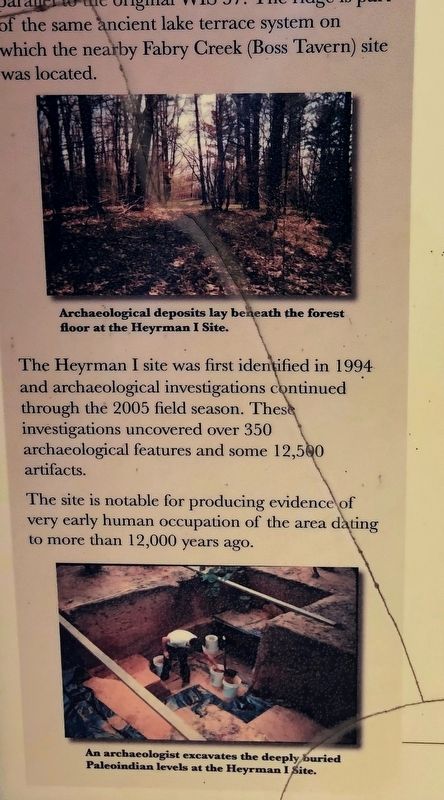
The Heyrman I site was situated on a long, narrow, saddle-shaped sand ridge, running parallel to the original WIS 57. The ridge is part of the same ancient lake terrace system on which the nearby Fabry Creek (Boss Tavern) site was located.
The Heyrman I site was first identified in 1994 and archaeological investigations continued through the 2005 field season. These investigations uncovered over 350 archaeological features and some 12,500 artifacts.
The site is notable for producing evidence of very early human occupation of the area dating to more than 12,000 years ago.
Cultural Components
Paleoindian
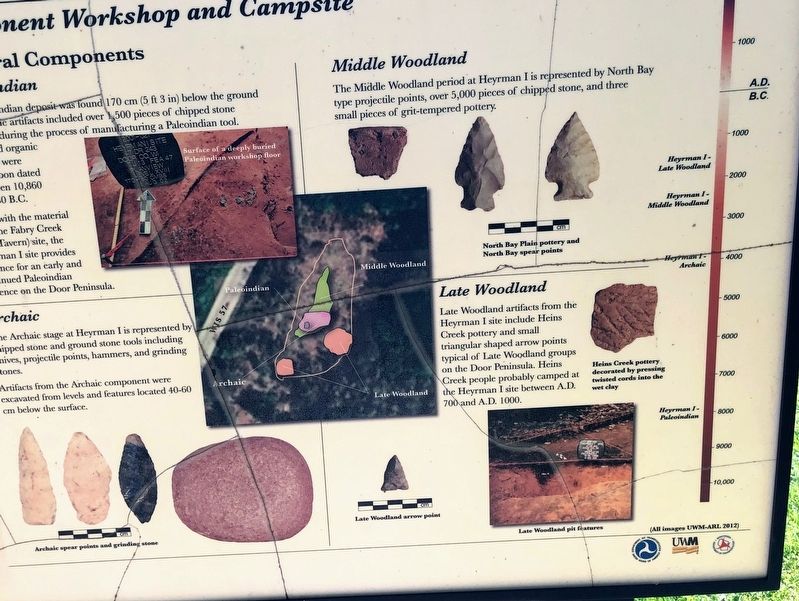
The Paleoindian deposit was found 170 cm (5 ft 3 in) below the ground surface. The artifacts included over 1,500 pieces of chipped stone produced during the process of manufacturing a Paleoindian tool. Associated organic materials were radiocarbon dated to between 10,860 and 9980 B.C.
Along with the material from Fabry Creek (Boss Tavern) site, the Hayrman
this page online
Archaic
The Archaic stage at Heyrman I is represented by chipped stone and ground stone tools including knives, projectile points, hammers, and grinding stones.
Artifacts from the Archaic component were excavated from levels and features located 40-60 cm below the surface.
Middle Woodland
The Middle Woodland period at Heyrman I is represented by North Bay type projectile points, over 5,000 pieces of chipped stone, and three small pieces of grit-tempered pottery.
Late Woodland
Late Woodland artifacts from the Heyrman I site include Heins Creek pottery and small triangular shaped arrow points typical of Late Woodland groups on the Door Peninsula. Heins Creek people probably camped at the Heyrman I site between A.D. 700 and A.D. 1000.
Erected by University of Wisconsin-Milwaukee, U.S. Department of Transportation, Wisconsin Department of Transportation.
Topics. This historical marker is listed in these topic lists: Anthropology & Archaeology • Indigenous Peoples and Communities.
Location. 44° 34.083′ N,
Photographed by Devon Polzar, 2019
2. Close Up of Photos

Regionally, this marker is in the Fox River Valley. It is also in the American Midwest and in the Corn Belt. Globally, it is in North America, on the Great Lakes, in the Western Hemisphere, in the Western World, and in the Anglosphere. Historically, it finds itself in what was once the Viceroyalty of New France, the territory of the Mississippian Culture, and the Northwest Territory.
Other nearby markers. At least 8 other markers are within walking distance of this marker: The WIS 57 Reconstruction Project in Brown, Kewaunee, and Door Counties (here, next to this marker); The Holdorf Site: A Chipped Stone Workshop/The Christoff Site: A Prehistoric Campsite (here, next to this marker); Delfosse-Allard: A Multi-component Site (here, next to this marker); Fabry Creek (Boss Tavern): A Multi-component Site (here, next to this marker); From First Americans to Euroamericans (here, next to this marker); The Beaudhuin Village Site: A North Bay Middle Woodland Camp (here, next to this marker); Transportation Archaeology on the WIS 57 Project (here, next to this marker); Red Banks (about 500 feet away, measured in a direct line). Touch for a list and map of all markers in Green Bay.
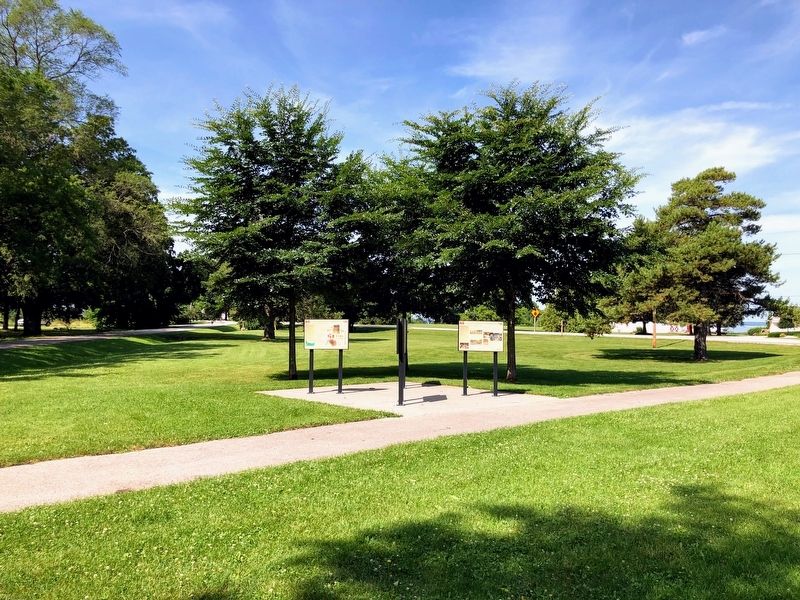
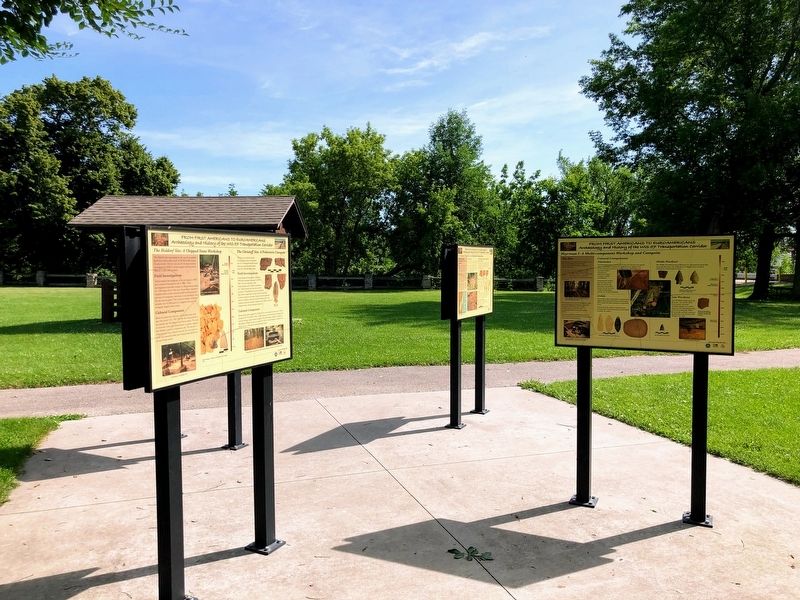
More about this marker. This marker is part of the group of markers at this location titled From First Americans to Euroamericans: Archaeology and History of the WIS 57 Transportation Corridor. The markers are a few steps from the southern parking lot in the Wequiock Falls County Park.
Photographed by Devon Polzar, 2019
3. Close Up of Photos
Photographed by Devon Polzar, 2019
4. From First Americans to Euroamericans Markers
Photographed by Devon Polzar, 2019
5. From First Americans to Euroamericans Markers
Credits. This page was last revised on November 15, 2025. It was originally submitted on December 14, 2019, by Devon Polzar of Port Washington, Wisconsin. This page has been viewed 425 times since then and 43 times this year. Photos: 1, 2, 3, 4, 5. submitted on December 14, 2019, by Devon Polzar of Port Washington, Wisconsin. • Mark Hilton was the editor who published this page.
